
Io, moon of Jespiter Jupiter, is famously volcanically active. It has more than 400 active volcanoes, over an area the size of Asia. Some of the volcanic mountains are taller than Mount Everest. The sulphur deposits have painted Io into 50 shades of yellow. But Io is only one of the 4 major moons of Jupiter. The other moons are fascinating, and have ice, water and geology – but no known volcanoes. And there another 90-odd smaller satellites, also volcano-free. What makes Io such an exceptional world?

This image of Io is NASA’s Science Calendar Image of the Month for October 2025. It was captured by JunoCam, the imager on NASA’s Juno spacecraft from about 1500 km above the surface. It reveals some of Io’s fascinating volcanic surface details. The right side (dayside) of the image is lit up by the Sun, while the left side (nightside) is illuminated by Jupiter-shine, sunlight reflecting from Jupiter back onto Io. Image Credit: NASA/Jet Propulsion Laboratory–Caltech/Southwest Research Institute (SwRI)/Malin Space Science Systems (MSSS); Image processing: Emma Wälimäki, CC BY
Exploration
Io’s volcanic nature was seen by passing spacecraft. The first visitor was Pioneer 10, on 3 December 1973. It ran into a problem: Jupiter has high-energy radiation belts, and these interfered with the on-board electronics. Images of Ganymede and Europe were obtained (rather poor ones, by today’s standard, but at the time they were unique), but a planned image of Io failed. Pioneer 11 followed a year later, and it did manage to take two distant images of Io. It showed few details on the moon, but found the yellowish colour.

Pioneer 11 images of Io
But the first indications of Io’s volcanic nature were not found by spacecraft but with telescopes on Earth. This was on 20 February 1978 when the infrared emission of Io was being measured. Two observations gave the same result. But 5 hours later, a further observation found that the emission at a wavelength of 5 micron had doubled, while it had remained the same at wavelengths shortward of 3 micron. This was difficult to explain other than as a source of heat that had come into view as Io rotated. It required a temperature of 300-400 C, very hot compared to Io’s surface. (Hotter emission would have been seen at 3 micron as well (the wavelengths used for detecting fires) while cooler heat would have required even longer wavelengths than 5 micron.) The observers and authors went through a series of possible explanations. They considered volcanism but ruled that out because no active volcano had been observed anywhere else in the solar system (other than on Earth) – so why would Io have one?
Voyager 1 passed Io on 4 March 1979. The images were a sensation. They revealed a surface that was covered in volcanic features. Four days later, an image taken when looking back at Io showed two on-going eruptions, one of which appeared as an immense plume seen at the edge of the moon. Voyager had caught the first volcanic eruptions outside of the Earth! (In hindsight, of course, Io is so active that there was a reasonable chance of seeing this.) And the unbelievers changed their opinion overnight. Within months, a stream of publications came out post-predicting the volcanic activity, interestingly including many from Russia.

Voyager 1, 8 March 1979, looking back. The two volcanic eruptions are the spot near the day-night boundary, and the plume at the edge.
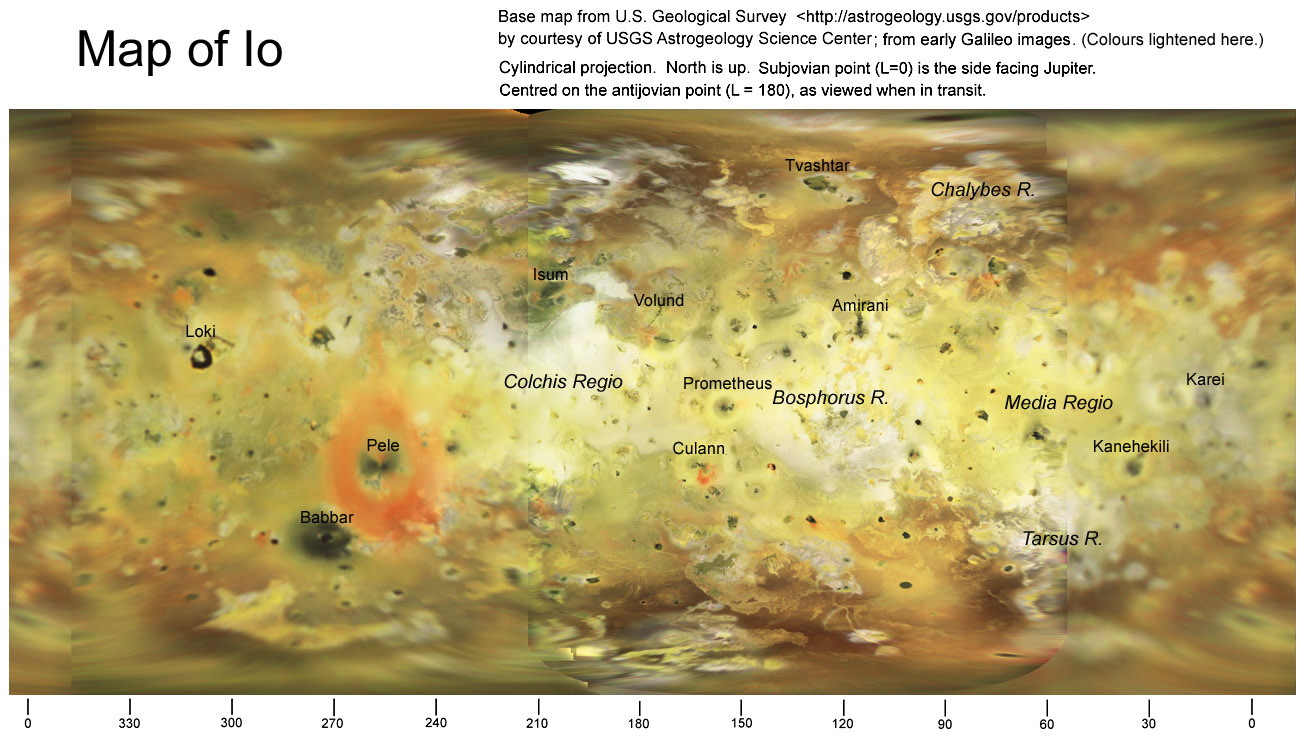
Ever since, every passing spacecraft has tried to take images of Io. New Horizons, on the way to frozen wilderness of Pluto, found 9 active volcanoes in one image. We have maps of the moon showing the volcanoes, many of which have been given names (some more than one). Lava flows and lava lakes have been mapped. Originally, it had been thought that volcanic eruptions in Io would be gaseous – the presence of lava had not been expected. This was one of the reasons that the discoverers of the heat pulse has discounted volcanism, because hot gas would have cooled too fast. It is easy to overlook what seems obvious in hindsight. We have seen plinian eruptions and overturning lava lakes. An excellent overview of the various volcanic features is in Jesper’s VC post on Io.

The surface of Io, adapted from: https://britastro.org/jupiter/2011/Io_map_labeld.jpg, with some additional labels added
Even the James Webb Space Telescope has taken part. In November 2022, JWST saw an eruption at Kanehekili. In August 2023, it had another look: between the two observations, the lava field had expanded four-fold, to over 4000 km2. And this is just one of the lava flows produced by Io. The lava flows are impressive!
Plumes and snow
The other eruption type for which Io is famous are the plume forming explosions. This is what Voyager spotted. On Earth, volcanic plumes can reach 30 km in altitude, perhaps once per decade. Not on Io. Its plumes reached hundreds of kilometers height. The Cassini space probe, passing on the way to Saturn and Titan, saw a plume from Pele reaching 400 km and there are reports of heights of 460 km. Tvashtar is another regular, detected to a height of 380 km by Cassini. Some 15 or more of Io’s volcanoes are known to cause plumes. Of these, Tvashtar is the only one located near the poles. All others are near the equator. The tallest plumes are called Pele-type plumes: they leave a red ring around the vent, with a diameter about four times the height of the plume.
Why are Io’s plumes so high? There are two reasons. Io is about the size of our Moon, and has similar surface gravity – about 6 times less than on Earth. For the same eruption speed, Io’s ejecta will reach 6 times higher. The other reason is the lack of atmosphere at Io: the gasses that are being erupted can rise without being stopped by our air. This is not straightforward: eruption plumes on Earth rise because of the heat which makes it buoyant: it rises like a thundercloud, driven by convection. That does not work without an atmosphere. Io’s plumes are close to ballistic. The ejection speeds may be as high as 1 km/sec. Ballistic flows at that speed can indeed reach a height of 300 km. However, the gas plumes do in fact form their own atmosphere, and this gives rise to the shapes seen in the space probe images. Io’s atmosphere is almost non-existent, but the important word is ‘almost’. Some of the gasses manage to escape Io’s gravity: the mini-atmosphere leaks into space, where the atoms are caught by Jupiter’s magnetic field.

Drawing of a typical plume. Source: Imke de Pater et al. 2023, The plumes and atmosphere of Io. https://link.springer.com/chapter/10.1007/978-3-031-25670-7_8
What is in the plumes? The lavas are liquid rock, albeit with a lowish silicate fraction. The plumes contain some rock dust but otherwise must come from volatiles. But which ones? This was solved almost immediately after the volcanoes were discovered. Io’s volcanism is so extensive that any volatiles will quickly run out. Water is one such volatile. It is quite a light molecule, and therefore can reach high speeds. Io’s gravity is insufficient to hold onto it. It becomes even worse if the water is dissociated by solar UV radiation. If Io emits water at a rate of 105 kg/sec (a typical rate for an Earth volcano), and assuming that 20% of Io is water (rather a high estimate), the entire water content of the moon would already have been lost. CO2 has the same problem. So these must have run out long ago. Why are there still plumes?
The answer is sulphur. It is a volatile, but a heavy one and not as volatile as the lighter ones. Io’s sulphur content may amount to a few per cent of the moon’s mass. At Io’s typical surface temperature (away from the volcanoes), it forms a solid. But this evaporates at 440C, and so magma will happily turn any sulphur on the surface which it meets into vapour. S2 and SO2 are both expected to be present in silicate magmas. S2 has been detected in the plumes at the roughly 10% level expected to be present in the magma, but has only been found above volcanic vents. UV photons quickly ionize it and it is destroyed in the subsequent chemistry. That leaves SO2 as the dominant molecule in the plumes and atmosphere, There is also some 10% of SO, formed by photodissociation of SO2 and trace amounts of atomic oxygen and even O2.
The crucial component is SO2. This molecule can condense as the plume rises and cools, in effect forming sulphurous snow. The snow flakes will fall back to the surface. Over time the snow fall is buried by new snow, at a rate of typically 0.5 cm/year. Lavas add to the resurfacing. After 10 million years, it may be buried 5 km deep. At this point, it may be hot enough to melt, become mobile and become part of a new batch of magma. Thus, while other volatiles are lost, sulphur is recycled. It is a renewable resource.
It is a bit surprising to find sulphur snow on a planet without an atmosphere. But that is the solar system for you: like the infamous box of chocolates, every body is different. That was one of the lessons of the Pioneers and Voyagers, in the age of discovery of the 1970’s and 80’s. (We have since found metal snow on Venus. The Solar System is a strange place.)
The life time of Io’s atmosphere is of order 10 days, after which it will escape of fall back. The atmosphere is constantly being renewed by volcanic activity.
Heat and tides
We have not yet answered the question why Io is so volcanically active. Volcanoes are driven by internal heat. Planets obtain that heat mainly from radioactive decay. But small bodies lose heat much faster than big ones, and so this is less effective in moons the size of Io. This is why volcanoes on Io were such a surprise.
In fact, this problem had been solved just before Voyager 1’s encounter. The answer lies in the tides of Io.
Tides come from changes in gravity across a moon or planet. Take the Earth. It is subject to gravity from our Moon. That force is stronger on the side of the Earth facing the Moon than on the opposite side, since they are at different distances from the Moon. The difference in distance is only 3%, but gravity goes as the inverse square of the distance so the difference in the force is 6%. The Earth is quite solid and able to withstand the different pull. But the oceans are not. Where the ocean is facing the Moon, the water is pulled towards it. On the opposite side, the water moves away a bit. This gives two high tides, separated by two low tides. The Moon isn’t very big, so the tides aren’t that high. (In fact, the Sun contributes about 30% to our tides. It is much further away but also very much bigger than the Moon. The two compensate each other. Take the Moon away, and we would still have tides – just only a third as high.
Io suffers tidal forces from Jupiter. But it has found a way to avoid this. First, its orbit is perfectly circular so the tidal force is constant. Second, it always faces the same side to Jupiter, so the tidal bulge is stationary. The moon has adjusted its shape to Jupiter’s tides and is perfectly stable.
Or would have been, had it not been for its neighbours. For Jupiter has four major satellites: Ganymede, Callisto, Europa and Io. And the four orbit Jupiter together in an intricate dance that ruins Io’s precious stability.
<a href=”https://www.volcanocafe.org/wp-content/uploads/2023/11/word-image-15664-2.png”><img class=”size-full wp-image-15666″ src=”https://www.volcanocafe.org/wp-content/uploads/2023/11/word-image-15664-2.png” alt=”” width=”470″ height=”320″ /></a> Jupiter’s worlds: Graphic by Nasa.Io is the innermost one of the large satellites (there are another 90 or so small satellites) and orbits fastest: it goes around Jupiter in 1.76 days. Europa, the next one out, goes around in 3.53 days. Ganymede takes 7.16 days and Callisto, the outermost one, takes 16.69 days. For every orbit of Europa, Io takes exactly 2. For every orbit of Ganymede, Io does 4 orbits. (The ratio is not as precise as the one with Europa.) The situation with Callisto is a bit different: for every orbit of Callisto, Io does 9.5.

Source: wikimedia
So the orbits of Io, Europa and Ganymede have ratios of the periods of 1:2:4. This is a so-called resonance and it could be disastrous. In such a resonance, whenever Europa passes Io, at a time its gravitational force on Io is strongest, it is pulling in the same direction. Over time, this will make Io’s orbit more and more elliptical. The same happens through Ganymede. Luckily, the closest approaches of both moons happen on opposite sides of Io’s orbit. This means they counter each other and it stops Io’s orbit from becoming unstable. (The real situation is a bit more complex since the resonance is not exact and the orbits are not exactly in the same plane (though close) and not exactly circular (though close). But this is how it works out over longer times.)
The effect is that the other moons pull Io a bit out of its originally circular orbit. It is now having a slightly elliptical orbit. Now, Jupiter’s gravity varies a bit as Io moves a bit further and closer to the giant planet. And worse, Io is now also wiggling bit: the same side is no longer pointing exactly at Jupiter, because the moon orbits a bit slower when further from Jupiter and a bit faster when closest, while it rotates at a constant speed. This causes Io to wiggle a bit. Now, Jupiter’s tides have something to catch.
The differences are small – but Jupiter’s tidal force is immense and Io is being pulled and stretched by the big boss. The solid body of the moon doesn’t like it one bit but has no choice. It is this constant kneading of Io’s insides which generates heat – and this heat drives the volcanoes. The tidal forces increase with distance from the centre of Io – so while its core is fine, regions closer to the surface receive the full brunt.
Why do the other moons not have such volcanic heat? They are further from Jupiter – and the tidal force decreases with the cube of the distance. Of the others, Europa is most affected and its tides have given it a liquid ocean. The effect on Io is off the scale.
The first calculations of this tidal heat were done just before Voyager 1 arrived – and these people predicted widespread melting and volcanism. As was in fact found on Voyager’s arrival.
However, calculating how much heat is generated by tidal forces is quite complicated. It depends on how ductile the interior of Io is. We know that the surface is stiff: there are mountains up to 17 km high on Io, so the crust must be strong enough to carry this weight. But deeper down, below the crust, it depends on whether Io has melted or not: liquid is much stronger affected by tides and would generate more heat. This is something we don’t know. Models suggest the average heat flow through the surface is around 2 W/m2, ten times higher than would be expected from radioactivity.

Source: James Keane et al., 2024, Tidal Heating and the Interior Structure of Io. Astrophysics and Space Science Library
Volume 468, Io: a new view of Jupiter’s moon.
The diagram depicts four possibilities, which differ in how deep the tidal heat is generated and whether there is a magma ocean, a magma sponge, or neither. It is a depiction of our lack of knowledge.
There is an interesting prediction from tidal heating. The tidal force is strongest along the line Jupiter – Io. Most heat would be generated at the point that has Jupiter overhead, and on the opposite side. Both points are on Io’s equator. Little heat would be generated halfway between, and this includes the polar regions. The volcanoes should therefore be clustered in these two regions. Do we see that?
The answer is – no, to some degree. The volcanoes are not fully uniformly nor randomly spread out, but the pattern predicted by the tidal models is not clearly seen. There are other patterns. Most continuously active hot spots are located within 30 degrees of the equator, while the intermittently active hot spots are mostly between 40 and 60 degrees latitude from the equator. When measuring hot spots at one moment, more are seen near the equator, but averaging over several years catches the intermittent erupts and reveals a more uniform distribution. Most (but not all) of Io’s mountains (which may be associated with colder crust) are located along the equator away from the line Io-Jupiter, as would be expected from (lack of) tidal heating, but they are offset by 30 degrees west rather than the expected 90 degrees.
An interesting finding is that the hot spots are randomly spread out, except along the equator where they tend to keep uniform distances. That is something we know from Earth: in a volcanic region, individual volcanoes tend to be located at similar distances from each other. This is because they compete for their magma, just like bushes in semi-desert compete for water and grow at uniform distances. We have called this ‘volcano ecology’ in VC.
This may favour models where tidal heat is distributed across Io before it reaches the surface, but not so well that every location gets the same amount heat. Perhaps something intermediate between a solid moon and a deep magma ocean.
And could it be that we are being affected by our viewing angle? From Earth, we see the equator of Io much better than the poles. Most passing spacecraft also stuck to the the equatorial plane. There have been several claims for fewer volcanoes in the polar regions, as even mentioned in this post. Could this be just because they are harder to see, especially if not persistently active? A recent paper has made that claim. The evidence came from Juno spacecraft, a mission send to student the polar regions of Jupiter. Its polar orbit allowed it to also image to poles of Io. Juno found that Loki to be the brightest infrared emitter on Io. The Chalybes Region (see the map above) is found to have four detectable volcanoes. In the south, Kanehekili was detected and two other volcanoes near it. They find a more uniform distribution of volcanoes across Io. However, the volcanic flux at the poles remains lower than elsewhere on Io. Although this agrees with the tidal heating predictions, they find that none of the four models depicted above give a good fit to the data. Io is more complicated than that.
In the Juno data, all regions of high volcanic flux were surrounded by regions of notably low flux. The authors interpret this as magma scarcity, i.e. the ecology argument above. Loki is especially noteworthy for depressing volcanic activity in wide area around it.
This gives a different view of Io, where the volcanoes act as valves for the magma below. Perhaps they are governed by faults in the Io crust. Faults would not be unexpected, given the amount of lava that collects on the surface over million years. This buries and depresses the older crust and th stress can cause faults and earth- io-quakes. It is tectonics shaped by volcanoes and in turn governing those volcanoes.
And there the story of Io comes to a pause. The moon is located in an area of hard radiation which can cause havoc with spacecraft electronics (as happened to Pioneer), due to the magnetic field of Jupiter. An Io-orbiter would have a hard time surviving. But I for one would love to see an orbiter happen.
The missions of the 70’s and 80’s discovered a secret solar system where moons turned into magic new worlds unlike any we had known before. The magic is still there. We need to go back.
Albert, November 2025


V3cam now being showered with tephra/ash. Thought it was insects or birds for a moment there.
Kilauea E37 ended but the south vent as been glowing super bright and massive hydrogen flames, while the north vent is already mostly dark…
I dont remember this happening before at all, somethings changed.
Also a M4.6 on the south flank south of Pu’u’ō’ō ten minutes after the episode ended. Possibly the east rift could unlock soon?
HVO estimates the eruption as “6.3 million cubic meters”. Since E35 the following two episodes decreased by nearly 2 million m³ each time. E35 had ~10 million, E36 ~8 milllion, E37 ~6 million m³. If this tendency continues, we’ll get around two more episodes. This would apply to a one-year eruption.
Maybe but i dont think its gonna be so sime, the ephsodes have been abruptly variable like this before. Pretty much unless the rifts open enough to take the magma away the summit will keep filling.
I guess at some point in that scenario too, one episode will kinda just not stop and become continuous. Or theres a rift intrusion that turns the summit vents into pit craters and those later become lava lakes and shields.
Can the intrusions and magma movements of the running eruption (12/24 to now) cause a tectonic movement that changes the volcanic behaviour?
Added to this it seems possible that also the fast increasing weight of the summit lava structure causes tectonic reactions of the volcano architecture.
I have the feeling that the H source of the summit is back. E37 was predominantly one of UWD station, while the southern and eastern summit station participated on smaller scaler in deflation. Is the eruption slowly converting from an eruption of the southern summit source to one of the Halema’uma’u source?
It seems E37 ended a bit early with an earthquake.
The Crisis Cabinet maintained Alert Level V3 for the Santa Bárbara Volcano, and also raised the Alert Level to V3 for the Terceira West Fissure Volcanic System.
https://www.civisa.pt/gabinete-de-crise-20251124
Sentinel images are showing that part of the northern caldera of Erta Ale has also collapsed during Gubbi’s explosion.
Strange. Looks like some complex interaction between the two volcanoes has occurred, beyond the dike intrusion a few months ago.
So it seems. The only explanation I can see is that the explosion of Hayli Gubbi drained enough magma from the system to trigger a shallow collapse of both Erta and Hayli calderas.
Unless I’m reading the InSAR wrong, and there was actually a dike intrusion.
Interferogram. I think the satellite is looking from the right, blue in the unwrapped image is away from the satellite. The map seems to show the contraction of two shallow dike bodies under Erta Ale and Hayli Gubbi summits.
https://comet.nerc.ac.uk/comet-volcano-portal/volcano-index/Africa%20and%20Red%20Sea/Ethiopia/Erta%20Ale/S1_analysis
Erta Ale range is likley one single deep system…woud be fun to hike it but the high temperatures makes its diffcult
That part of the world is hot even in January.
I didn’t even notice until it was mentioned. Maybe the same dike from July was still active when the events took place after all?
Maybe Hayli Gubbi is a low rift volcano of Erta Ale, where new hot magma from Erta Ale intruded into old Rhyolite/Trachyte magma. A bit like the Strombolian eruptions in Kilauea’s low rift zone eruptions, f.e. one fissure 2018 or the Kamakaia cones on SWRZ. There hot basaltic magma intruded into pockets of evolved intermediate magmas. In Hayli Gubbi the same perhaps happened to pockets of completely evolved crystalline magmas.
Just found out there was a M5.4 earthquake at Erta Ale during the Hayli Gubbi eruption, probably related to the dropped part of Erta Ale’s caldera I think. https://earthquake.usgs.gov/earthquakes/eventpage/us6000rq2y/executive
https://www.windy.com/sv/-Meny/menu?tcso2,37.379,135.044,6
sulfur in japan from the Afar eruption
More drone footage showing the lahar paths from the Semeru eruption. Mainly shows damage, and still some hot rocks according to the narrator. The narrators of these videos say the white rocks means they are still hot. Is this normal for andesite? Semeru is supposed to erupt andesite/basaltic andesite. I was wondering why there were all these white boulders in the lahar channels.
After the shut down, USGS has finally released a map.
Has the shallow magma reservoir been built anew that was destroyed 2018? Deformation shows, that UWD station participated more in E37 than SDH and IKI station. The eastern and southern summit is more inflating than the Halema’uma’u area that deflates more during the recent episodes. Maybe this inflation of the southern summit area increases tectonic pressure on Kilauea’s southern flank.
Report by COMET regarding the Hayli Gubbi eruption released. Uplift was observed just after the Erta Ale dike and just before the eruption. Steaming/gas emissions in its crater have been observed since that dike and SO2 emissions in satellite data. In the last few weeks accelerating deflation at Erta Ale has been observed.
Looks like magma has been leaking out of Erta Ale, so no surprise its caldera collapsed a bit, probably in one go as indicated by the M5.4. Maybe the Hayli Gubbi eruption allowed Erta Ale to depressurise more?
https://comet.nerc.ac.uk/wp-content/uploads/2025/11/COMET_EventReport2.4_HayliGubbi-1.pdf
It makes Hayli Gubbi a satellite eruption of Erta Ale.
But is that the norm or can Hayli Gubbi erupt without Erta Ale? Is it actually an independent system, but can be intruded by Erta Ale, or is it merely a secondary central volcano or a third caldera of the Erta Ale system?
You’ll notice it’s just like what has been questioned here about Iceland. For example, we know Torfajökull is independent but has been directly intruded by dikes from Bárðarbunga. On the other hand, we don’t really know if Þòrðarhyrna and other vents on the Grímsvötn fissure swarm can behave independently, or are just secondary vents of Grímsvötn.
Again it shows that the determination of what counts as an independent volcanic centre isn’t always so simple.
That is why I called it satellite eruption rather than a satellite vent. I expect that if Hayli Gubbi really had not erupted for 12,000 years, that it originally would have been a separate volcano. Erta Ale may not even be that old! But the current eruption seems just to have used its crater as a convenient eruption point, rather than re-awaken the old magma system.
The Eldgja eruption included some magma that came from Vatnajokull, the other side of Lurking’s dead zone. In rifting systems, different volcanic systems can make use of the same rifts.
Hayli Gubbi has definitely erupted in the Holocene before, flows on the south flank overlie 8,200-year-old sediments. Hopefully we get some analysed samples so we can see if the eruption was fresh Erta Ale magma or an old Hayli Gubbi batch. I suppose it might depend or whether the dike actually entered Hayli Gubbi directly. Article coming I’m sure.
Yes, it’s one of the least active volcanoes in the Erta Ale Range, but it has erupted a lot of times in the Holocene and is one of the main active fumarolic centers. I think it has also seen at least one major explosive eruption in the Holocene that dispersed ash SW covering some, likely Holocene, upper south rift cones in thick ash.
My idea is the dike in July was a shallow lava lake drainout. The dike that went way south I think was a full rifting event of that half of the Erta Ale range and probably involved both volcanoes.
Tbh, structurally at least, this is exactly how I imagine the big rifting events in Iceland to be. Multiple central volcanoes on a fissure swarm, they are mostly their own thing, but big rifting will draw magma out of the deeper plumbing intrusion complex that is common to both. Bardarbunga might be different, being controlled by its massive piston caldera, but the dikes there still actually break out of the deeper plumbing (Holuhraun dike offset west a bit and starting over 10km deep as example).
Although, the dikes going southwest into the dead zone are laterally fed still, if there was any vertical magma draw from the mantle right under Laki it would be very slow, like Fagradalsfjall, and basically unnoticeable. Also likely a more alkaline composition like at Fimvorduhalls in 2010 if I had to make a guess.
Actually, also now that I think about it, if the big rift eruptions were somehow fed out of the mantle directly at such stupid high rates, the lava of Eldgja and Laki should be identical too and they arent. Idk how that was missed to be honest…
But yeah basically this isnt just Erta Ale erupting through one of its neighbors, its both of them rifting together and that could be very interesting as this goes on.
If we take Svartsengi as an example, this is a big rift that has just opened over an area with evidently a lot of magma and high supply rate. Its also a way bigger rift than Svartsengi in 2023, so it will take longer to refill, but I can see both volcanoes doing some major lava flows soon. And probably some more explosive eruptions too.
Yes, this is an evidence. Could a good geological examination have revealed it without the eruption?
They share the same rift, which implies some level of interaction and likely magma connection.
Yes, it’s maybe like the relation between Kilauea’s summit caldera and rift zone cones (f.e. SWRZ’s Kamakaia cones or LERZ cones).
https://www.youtube.com/watch?v=eUDo913mb6Y
https://www.youtube.com/watch?v=yi6RSz1Aob4
Old home videos from Nyiragongo in 1975 and 1976 apparently back then already an intrest for tourists. The lava lake looks like a witches brew
https://www.youtube.com/watch?v=fiyttmA7YkA
https://www.youtube.com/watch?v=tk0tfYDxrUA
The Halemaumau vents looks more and more open for eachtime now specialy the big mouth so it maybe transforming itself into an open lava shield. The episodes now also stop eachtime with higher and higher deformation so presumabely less chamber pressure accumulation is needed to start a new eruption, so I think ( MAYBE ) it will be able to become a constantly flowing vent quite soon. Thats saied the magma is very gas rich and the supply is massive and conduit is still quite narrow. But 37 looked far more open at start than 36 s startup definitivly with far more overflows and lower fountains, episode 37 also had a massive dome fountain mess at startup before transforming into a lava fountain, past episodes have had violent fountains already at start when when the gas rich magmas emerges which was not the case this time so maybe the conduit is getting wider. Both conduits have grown alot in diameter
I will name the big mouth “Sammath Naur” even if Pele will refuse a non hawaiian name, but its better used in Iceland where Tolkiens mytology draws alot of elements
https://www.facebook.com/alaska.avo/videos/shishaldin-eruption-timelapse-from-january-2020/400895270912485/
Thats saied the real Mount Doom maybe be Shishaldin due to the supreme perfectness of this mafic stratovolcano perhaps the most perfect volcano on the entire planet
Sammath naur is steaming alot so perhaps haves better degassing now getting more open per episode
I imagine that the shallow magma body of Halema’uma’u is back again and drives episodes/eruptions mainly of the northern vent. E37 was one of the northern vent. It may become the source of future sustained activity, f.e. a lava lake.
During E37 the southern and eastern part of the summit didn’t deflate much. They’re probably still loaded with magma. This may feed an episode/eruption of the southern vent or a new vent in the southern/eastern region of the summit caldera.
Looks like there maybe active basaltic lava fountains in Isum pateras rift on Io ,upper fuzzy its the same dark halos thats where produced by tall lava fountain tephra fallout during Pillan Patera as well and from Peles sillicate lava fountains. There must be a long line of highy active lava lakes in the rift there first time I realise this, I will check thermal maps tooand I remeber a very strong thermal Juno sigmature from Isum which will confirm these suggestions
The dark fuzzyness there are tephra from roaring lava fountains in the Isum rift, making this one of Io s most thermaly powerful volcanoes
Tvashtar Catena blowing a basaltic plinian eruption giant lava fountain visble in visible light even! tephra and volcanic “meteors” thrown out is falling over an area the size of Iceland or more leaving a dark patch afterwards
http://www.gishbartimes.org/2009/07/paper-heat-flow-from-ios-dark-lava.html
Active basaltic lava flows on Io interacting with sulfur snow on the moons surface. The dark green color comes from the deposition of sulfur on still-cooling, iron-rich basaltic silicate lava flows, producing iron sulfide. Brighter flows represent either older silicate flows that cooled enough for sulfur and sulfur dioxide to condense on their cooling surfaces
Dark sillicate flows emerging from a fault on the moons surface, its common to find that on Io
So is this image from the Moon or from Io? Where about exactly?
Io of course ..
https://earth.google.com/web/@-39.38688736,-71.92739767,1416.37570068a,0d,52.37166318y,191.5312802h,87.1027555t,0r/data=CgRCAggBIhoKFnVNQUxHc2R2enFqRFVWM3JqZTBobHcQAkICCABKDQj___________8BEAA
Hihly fluid pahoehoe at Villaricca its trying to be a Nyiragongo like volcano and indeed Nyiragongo likley looked the same before its summit collapsed
I just wonder how much extra all those hotels in Pucón have had to pay for their insurance. But I guess it’s good business, until suddenly it is not.
Pucón is the ultimate cheesy stereotypical real world analouge to Dantes Peak very much the same even if Villaricca is a very fluid mafic fountain cone, souch a stunningly beautyful volcano
https://earth.google.com/web/@-39.41978986,-71.94015364,2825.35941894a,385.65286379d,35y,3.48738325h,52.37466203t,0r/data=CgRCAggBQgIIAEoNCP___________wEQAA
Recent lava lake at the summit Villaricca is togther with Shishaldin perhaps the worlds two most perfect stereotypical volcanoes
https://earth.google.com/web/@54.76635312,-163.96001523,1964.25746808a,5223.02751473d,35y,-158.20459903h,75.79982169t,0r/data=CgRCAggBQgIIAEoNCP___________wEQAA
Shishaldin is gorgeous as well I calls it Alaskas Mount Doom
not sure if it has been postef already: https://www.science.org/doi/10.1126/science.adz8538
The 2025 Santorini unrest unveiled: Rebounding magmatic dike intrusion with triggered seismicity
:”no magmatic activity” huh?
Reunion is waking up after some years of sleep: https://lechaudrondevulcain.com/blog/2025/11/29/november-30-2025-en-la-reunion-island-piton-de-la-fournaise-italy-stromboli-indonesia-ibu-colombia-nevado-del-ruiz-alaska-shishaldin/
2014 after a similar dormant period Piton de la Fournaise went quickly from increasing seismicity to the first eruption within three weeks. So it’s possible that 2025 will get another effusive eruption of Hawaiian type.
New post is up! Faults, volcanoes and Texas
https://www.volcanocafe.org/faults-of-texas/