
Io, moon of Jespiter Jupiter, is famously volcanically active. It has more than 400 active volcanoes, over an area the size of Asia. Some of the volcanic mountains are taller than Mount Everest. The sulphur deposits have painted Io into 50 shades of yellow. But Io is only one of the 4 major moons of Jupiter. The other moons are fascinating, and have ice, water and geology – but no known volcanoes. And there another 90-odd smaller satellites, also volcano-free. What makes Io such an exceptional world?

This image of Io is NASA’s Science Calendar Image of the Month for October 2025. It was captured by JunoCam, the imager on NASA’s Juno spacecraft from about 1500 km above the surface. It reveals some of Io’s fascinating volcanic surface details. The right side (dayside) of the image is lit up by the Sun, while the left side (nightside) is illuminated by Jupiter-shine, sunlight reflecting from Jupiter back onto Io. Image Credit: NASA/Jet Propulsion Laboratory–Caltech/Southwest Research Institute (SwRI)/Malin Space Science Systems (MSSS); Image processing: Emma Wälimäki, CC BY
Exploration
Io’s volcanic nature was seen by passing spacecraft. The first visitor was Pioneer 10, on 3 December 1973. It ran into a problem: Jupiter has high-energy radiation belts, and these interfered with the on-board electronics. Images of Ganymede and Europe were obtained (rather poor ones, by today’s standard, but at the time they were unique), but a planned image of Io failed. Pioneer 11 followed a year later, and it did manage to take two distant images of Io. It showed few details on the moon, but found the yellowish colour.

Pioneer 11 images of Io
But the first indications of Io’s volcanic nature were not found by spacecraft but with telescopes on Earth. This was on 20 February 1978 when the infrared emission of Io was being measured. Two observations gave the same result. But 5 hours later, a further observation found that the emission at a wavelength of 5 micron had doubled, while it had remained the same at wavelengths shortward of 3 micron. This was difficult to explain other than as a source of heat that had come into view as Io rotated. It required a temperature of 300-400 C, very hot compared to Io’s surface. (Hotter emission would have been seen at 3 micron as well (the wavelengths used for detecting fires) while cooler heat would have required even longer wavelengths than 5 micron.) The observers and authors went through a series of possible explanations. They considered volcanism but ruled that out because no active volcano had been observed anywhere else in the solar system (other than on Earth) – so why would Io have one?
Voyager 1 passed Io on 4 March 1979. The images were a sensation. They revealed a surface that was covered in volcanic features. Four days later, an image taken when looking back at Io showed two on-going eruptions, one of which appeared as an immense plume seen at the edge of the moon. Voyager had caught the first volcanic eruptions outside of the Earth! (In hindsight, of course, Io is so active that there was a reasonable chance of seeing this.) And the unbelievers changed their opinion overnight. Within months, a stream of publications came out post-predicting the volcanic activity, interestingly including many from Russia.

Voyager 1, 8 March 1979, looking back. The two volcanic eruptions are the spot near the day-night boundary, and the plume at the edge.
Ever since, every passing spacecraft has tried to take images of Io. New Horizons, on the way to frozen wilderness of Pluto, found 9 active volcanoes in one image. We have maps of the moon showing the volcanoes, many of which have been given names (some more than one). Lava flows and lava lakes have been mapped. Originally, it had been thought that volcanic eruptions in Io would be gaseous – the presence of lava had not been expected. This was one of the reasons that the discoverers of the heat pulse has discounted volcanism, because hot gas would have cooled too fast. It is easy to overlook what seems obvious in hindsight. We have seen plinian eruptions and overturning lava lakes. An excellent overview of the various volcanic features is in Jesper’s VC post on Io.

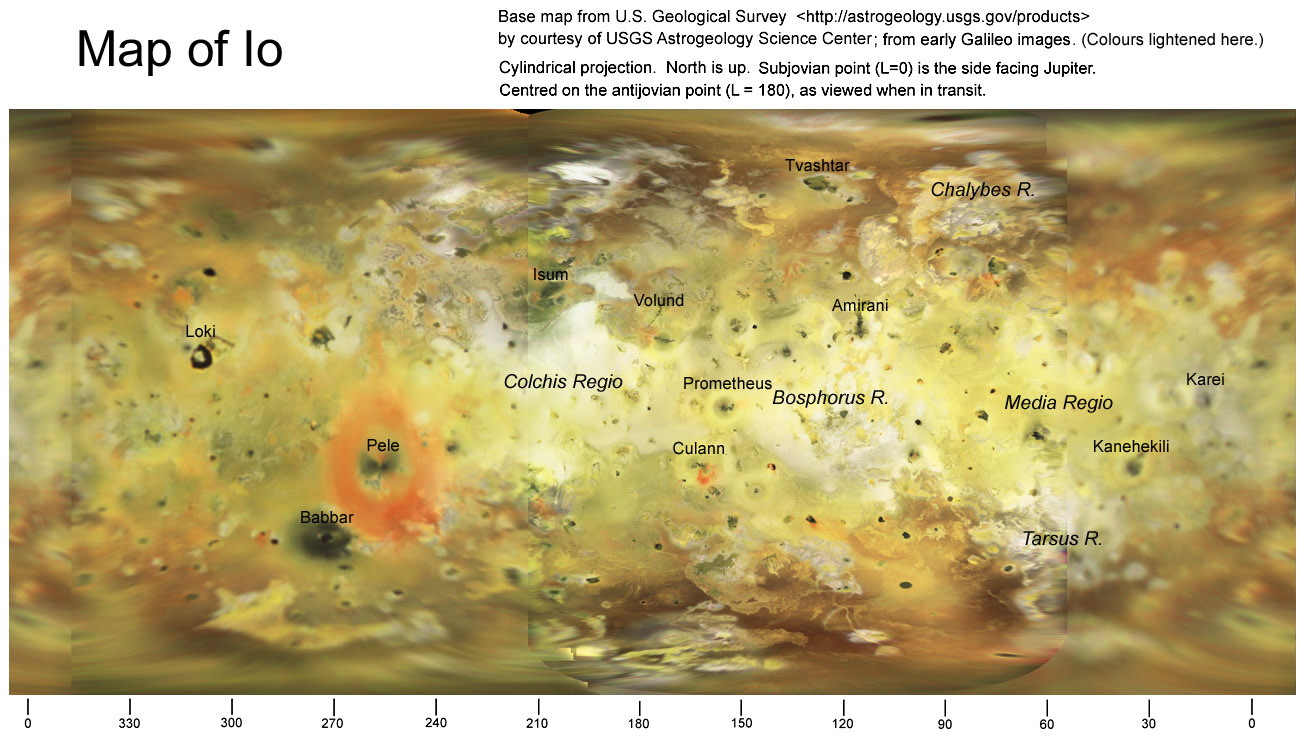
The surface of Io, adapted from: https://britastro.org/jupiter/2011/Io_map_labeld.jpg, with some additional labels added
Even the James Webb Space Telescope has taken part. In November 2022, JWST saw an eruption at Kanehekili. In August 2023, it had another look: between the two observations, the lava field had expanded four-fold, to over 4000 km2. And this is just one of the lava flows produced by Io. The lava flows are impressive!
Plumes and snow
The other eruption type for which Io is famous are the plume forming explosions. This is what Voyager spotted. On Earth, volcanic plumes can reach 30 km in altitude, perhaps once per decade. Not on Io. Its plumes reached hundreds of kilometers height. The Cassini space probe, passing on the way to Saturn and Titan, saw a plume from Pele reaching 400 km and there are reports of heights of 460 km. Tvashtar is another regular, detected to a height of 380 km by Cassini. Some 15 or more of Io’s volcanoes are known to cause plumes. Of these, Tvashtar is the only one located near the poles. All others are near the equator. The tallest plumes are called Pele-type plumes: they leave a red ring around the vent, with a diameter about four times the height of the plume.
Why are Io’s plumes so high? There are two reasons. Io is about the size of our Moon, and has similar surface gravity – about 6 times less than on Earth. For the same eruption speed, Io’s ejecta will reach 6 times higher. The other reason is the lack of atmosphere at Io: the gasses that are being erupted can rise without being stopped by our air. This is not straightforward: eruption plumes on Earth rise because of the heat which makes it buoyant: it rises like a thundercloud, driven by convection. That does not work without an atmosphere. Io’s plumes are close to ballistic. The ejection speeds may be as high as 1 km/sec. Ballistic flows at that speed can indeed reach a height of 300 km. However, the gas plumes do in fact form their own atmosphere, and this gives rise to the shapes seen in the space probe images. Io’s atmosphere is almost non-existent, but the important word is ‘almost’. Some of the gasses manage to escape Io’s gravity: the mini-atmosphere leaks into space, where the atoms are caught by Jupiter’s magnetic field.

Drawing of a typical plume. Source: Imke de Pater et al. 2023, The plumes and atmosphere of Io. https://link.springer.com/chapter/10.1007/978-3-031-25670-7_8
What is in the plumes? The lavas are liquid rock, albeit with a lowish silicate fraction. The plumes contain some rock dust but otherwise must come from volatiles. But which ones? This was solved almost immediately after the volcanoes were discovered. Io’s volcanism is so extensive that any volatiles will quickly run out. Water is one such volatile. It is quite a light molecule, and therefore can reach high speeds. Io’s gravity is insufficient to hold onto it. It becomes even worse if the water is dissociated by solar UV radiation. If Io emits water at a rate of 105 kg/sec (a typical rate for an Earth volcano), and assuming that 20% of Io is water (rather a high estimate), the entire water content of the moon would already have been lost. CO2 has the same problem. So these must have run out long ago. Why are there still plumes?
The answer is sulphur. It is a volatile, but a heavy one and not as volatile as the lighter ones. Io’s sulphur content may amount to a few per cent of the moon’s mass. At Io’s typical surface temperature (away from the volcanoes), it forms a solid. But this evaporates at 440C, and so magma will happily turn any sulphur on the surface which it meets into vapour. S2 and SO2 are both expected to be present in silicate magmas. S2 has been detected in the plumes at the roughly 10% level expected to be present in the magma, but has only been found above volcanic vents. UV photons quickly ionize it and it is destroyed in the subsequent chemistry. That leaves SO2 as the dominant molecule in the plumes and atmosphere, There is also some 10% of SO, formed by photodissociation of SO2 and trace amounts of atomic oxygen and even O2.
The crucial component is SO2. This molecule can condense as the plume rises and cools, in effect forming sulphurous snow. The snow flakes will fall back to the surface. Over time the snow fall is buried by new snow, at a rate of typically 0.5 cm/year. Lavas add to the resurfacing. After 10 million years, it may be buried 5 km deep. At this point, it may be hot enough to melt, become mobile and become part of a new batch of magma. Thus, while other volatiles are lost, sulphur is recycled. It is a renewable resource.
It is a bit surprising to find sulphur snow on a planet without an atmosphere. But that is the solar system for you: like the infamous box of chocolates, every body is different. That was one of the lessons of the Pioneers and Voyagers, in the age of discovery of the 1970’s and 80’s. (We have since found metal snow on Venus. The Solar System is a strange place.)
The life time of Io’s atmosphere is of order 10 days, after which it will escape of fall back. The atmosphere is constantly being renewed by volcanic activity.
Heat and tides
We have not yet answered the question why Io is so volcanically active. Volcanoes are driven by internal heat. Planets obtain that heat mainly from radioactive decay. But small bodies lose heat much faster than big ones, and so this is less effective in moons the size of Io. This is why volcanoes on Io were such a surprise.
In fact, this problem had been solved just before Voyager 1’s encounter. The answer lies in the tides of Io.
Tides come from changes in gravity across a moon or planet. Take the Earth. It is subject to gravity from our Moon. That force is stronger on the side of the Earth facing the Moon than on the opposite side, since they are at different distances from the Moon. The difference in distance is only 3%, but gravity goes as the inverse square of the distance so the difference in the force is 6%. The Earth is quite solid and able to withstand the different pull. But the oceans are not. Where the ocean is facing the Moon, the water is pulled towards it. On the opposite side, the water moves away a bit. This gives two high tides, separated by two low tides. The Moon isn’t very big, so the tides aren’t that high. (In fact, the Sun contributes about 30% to our tides. It is much further away but also very much bigger than the Moon. The two compensate each other. Take the Moon away, and we would still have tides – just only a third as high.
Io suffers tidal forces from Jupiter. But it has found a way to avoid this. First, its orbit is perfectly circular so the tidal force is constant. Second, it always faces the same side to Jupiter, so the tidal bulge is stationary. The moon has adjusted its shape to Jupiter’s tides and is perfectly stable.
Or would have been, had it not been for its neighbours. For Jupiter has four major satellites: Ganymede, Callisto, Europa and Io. And the four orbit Jupiter together in an intricate dance that ruins Io’s precious stability.
<a href=”https://www.volcanocafe.org/wp-content/uploads/2023/11/word-image-15664-2.png”><img class=”size-full wp-image-15666″ src=”https://www.volcanocafe.org/wp-content/uploads/2023/11/word-image-15664-2.png” alt=”” width=”470″ height=”320″ /></a> Jupiter’s worlds: Graphic by Nasa.Io is the innermost one of the large satellites (there are another 90 or so small satellites) and orbits fastest: it goes around Jupiter in 1.76 days. Europa, the next one out, goes around in 3.53 days. Ganymede takes 7.16 days and Callisto, the outermost one, takes 16.69 days. For every orbit of Europa, Io takes exactly 2. For every orbit of Ganymede, Io does 4 orbits. (The ratio is not as precise as the one with Europa.) The situation with Callisto is a bit different: for every orbit of Callisto, Io does 9.5.

Source: wikimedia
So the orbits of Io, Europa and Ganymede have ratios of the periods of 1:2:4. This is a so-called resonance and it could be disastrous. In such a resonance, whenever Europa passes Io, at a time its gravitational force on Io is strongest, it is pulling in the same direction. Over time, this will make Io’s orbit more and more elliptical. The same happens through Ganymede. Luckily, the closest approaches of both moons happen on opposite sides of Io’s orbit. This means they counter each other and it stops Io’s orbit from becoming unstable. (The real situation is a bit more complex since the resonance is not exact and the orbits are not exactly in the same plane (though close) and not exactly circular (though close). But this is how it works out over longer times.)
The effect is that the other moons pull Io a bit out of its originally circular orbit. It is now having a slightly elliptical orbit. Now, Jupiter’s gravity varies a bit as Io moves a bit further and closer to the giant planet. And worse, Io is now also wiggling bit: the same side is no longer pointing exactly at Jupiter, because the moon orbits a bit slower when further from Jupiter and a bit faster when closest, while it rotates at a constant speed. This causes Io to wiggle a bit. Now, Jupiter’s tides have something to catch.
The differences are small – but Jupiter’s tidal force is immense and Io is being pulled and stretched by the big boss. The solid body of the moon doesn’t like it one bit but has no choice. It is this constant kneading of Io’s insides which generates heat – and this heat drives the volcanoes. The tidal forces increase with distance from the centre of Io – so while its core is fine, regions closer to the surface receive the full brunt.
Why do the other moons not have such volcanic heat? They are further from Jupiter – and the tidal force decreases with the cube of the distance. Of the others, Europa is most affected and its tides have given it a liquid ocean. The effect on Io is off the scale.
The first calculations of this tidal heat were done just before Voyager 1 arrived – and these people predicted widespread melting and volcanism. As was in fact found on Voyager’s arrival.
However, calculating how much heat is generated by tidal forces is quite complicated. It depends on how ductile the interior of Io is. We know that the surface is stiff: there are mountains up to 17 km high on Io, so the crust must be strong enough to carry this weight. But deeper down, below the crust, it depends on whether Io has melted or not: liquid is much stronger affected by tides and would generate more heat. This is something we don’t know. Models suggest the average heat flow through the surface is around 2 W/m2, ten times higher than would be expected from radioactivity.

Source: James Keane et al., 2024, Tidal Heating and the Interior Structure of Io. Astrophysics and Space Science Library
Volume 468, Io: a new view of Jupiter’s moon.
The diagram depicts four possibilities, which differ in how deep the tidal heat is generated and whether there is a magma ocean, a magma sponge, or neither. It is a depiction of our lack of knowledge.
There is an interesting prediction from tidal heating. The tidal force is strongest along the line Jupiter – Io. Most heat would be generated at the point that has Jupiter overhead, and on the opposite side. Both points are on Io’s equator. Little heat would be generated halfway between, and this includes the polar regions. The volcanoes should therefore be clustered in these two regions. Do we see that?
The answer is – no, to some degree. The volcanoes are not fully uniformly nor randomly spread out, but the pattern predicted by the tidal models is not clearly seen. There are other patterns. Most continuously active hot spots are located within 30 degrees of the equator, while the intermittently active hot spots are mostly between 40 and 60 degrees latitude from the equator. When measuring hot spots at one moment, more are seen near the equator, but averaging over several years catches the intermittent erupts and reveals a more uniform distribution. Most (but not all) of Io’s mountains (which may be associated with colder crust) are located along the equator away from the line Io-Jupiter, as would be expected from (lack of) tidal heating, but they are offset by 30 degrees west rather than the expected 90 degrees.
An interesting finding is that the hot spots are randomly spread out, except along the equator where they tend to keep uniform distances. That is something we know from Earth: in a volcanic region, individual volcanoes tend to be located at similar distances from each other. This is because they compete for their magma, just like bushes in semi-desert compete for water and grow at uniform distances. We have called this ‘volcano ecology’ in VC.
This may favour models where tidal heat is distributed across Io before it reaches the surface, but not so well that every location gets the same amount heat. Perhaps something intermediate between a solid moon and a deep magma ocean.
And could it be that we are being affected by our viewing angle? From Earth, we see the equator of Io much better than the poles. Most passing spacecraft also stuck to the the equatorial plane. There have been several claims for fewer volcanoes in the polar regions, as even mentioned in this post. Could this be just because they are harder to see, especially if not persistently active? A recent paper has made that claim. The evidence came from Juno spacecraft, a mission send to student the polar regions of Jupiter. Its polar orbit allowed it to also image to poles of Io. Juno found that Loki to be the brightest infrared emitter on Io. The Chalybes Region (see the map above) is found to have four detectable volcanoes. In the south, Kanehekili was detected and two other volcanoes near it. They find a more uniform distribution of volcanoes across Io. However, the volcanic flux at the poles remains lower than elsewhere on Io. Although this agrees with the tidal heating predictions, they find that none of the four models depicted above give a good fit to the data. Io is more complicated than that.
In the Juno data, all regions of high volcanic flux were surrounded by regions of notably low flux. The authors interpret this as magma scarcity, i.e. the ecology argument above. Loki is especially noteworthy for depressing volcanic activity in wide area around it.
This gives a different view of Io, where the volcanoes act as valves for the magma below. Perhaps they are governed by faults in the Io crust. Faults would not be unexpected, given the amount of lava that collects on the surface over million years. This buries and depresses the older crust and th stress can cause faults and earth- io-quakes. It is tectonics shaped by volcanoes and in turn governing those volcanoes.
And there the story of Io comes to a pause. The moon is located in an area of hard radiation which can cause havoc with spacecraft electronics (as happened to Pioneer), due to the magnetic field of Jupiter. An Io-orbiter would have a hard time surviving. But I for one would love to see an orbiter happen.
The missions of the 70’s and 80’s discovered a secret solar system where moons turned into magic new worlds unlike any we had known before. The magic is still there. We need to go back.
Albert, November 2025


Thanks Albert! 💕💥🌋 for another post in my most favorite object in this whole solar system! Io have keept me obessed since 2005 when I was 10 and began to read about Io. I really hopes for more spaceprobes to Io in the future so I can finaly get satisfyed for the first time. I also plans to make more Io VC posts later
Hopes SpaceX and Musky coud get intested in Io one day 😒 I woud LIKE to be Elon Musk but with my brain and personality with so much cash I woud be able to get my Ionian Superprobe.. it woud be the ONLY thing I woud focus on during the first years there
https://agupubs.onlinelibrary.wiley.com/doi/full/10.1029/2024JE008723
Lava lakes seems to be everywhere on Io, many of the dark round spots on Io are lava lakes or calderas thats been resurfaced by dark basaltic lava ( too hot for sulfur snow to settle ). The surface lava flows forms more fractal and flow shaped patterns
https://www.volcanocafe.org/ios-pillan-patera-eruption-in-1997-the-largest-lava-falls-ever-seen/
Here you can read a detailed description of the 1997 eruption at Pillan Patera ( caldera ) and its spectacular lava falls over the rim. This is a sight that Sauron and Morgoth sourely woud ENJOY to see… I guess if Galileo knew the moons true nature, he woud have never named it Io
https://i0.wp.com/www.volcanocafe.org/wp-content/uploads/2023/05/image_6483441.jpeg?ssl=1
The Sierra Negra 2005 eruption was the largest lava falls ever seen on Earth by cameras. Using them and scaling them up, we can give some sense of the massive scale of the Pillan Patera event on Io with placed Ionian scales here for the 1997 eruption.
The fiery Mustafar was indeed Lucas own imagination of Io. Mustafar is just like Io torn by tidal forces from its nearby gas giant, on this planet Skywalker got severe burn injuries in the lava flows and had therefore to live inside the Darth Vader suit for the rest of his life. Io is Jupiters’ own darth vader moon!
The famous Mustafar battle
Part 1 https://m.youtube.com/watch?v=8TWPToeLdj4&pp=ygURYW5ha2luIHZzIG9iaSB3YW4%3D
Part 2 https://m.youtube.com/watch?v=UPsTXNAA-T8
Becomming Vader after the duel.. https://m.youtube.com/watch?v=6FMP4Sff8w0&pp=ygUaYW5ha2luIGJlY29tZXMgZGFydGggdmFkZXLSBwkJAwoBhyohjO8%3D
An important difference of Mustafar is, that it is a terrestial planet with oxygen atmosphere. Science-fiction movies usually construct planets that allow humans or aliens to breath and live there. Although it’s possible that the universe has some planets like this, it’s not as frequent as in the movies.
On Io the sword battle between Darth Vader and Obi Wan would look very different. They had to wear a space suit and still be able to jump, run and fight with a sword. The low gravity would mean that they jump like Super Mario.
https://www.youtube.com/watch?v=c24-0Amwyik
Io is Jupiters Mordor moon it pretty much ewokes this as well… coud very well be the edge of Pele Patera 🙂
Juno have now come back with new eruption data and images as well, make soure to read those too
Well you have but there where many new papers out this autumn and in the recent months specialy so of discoverey of an incandescent 50 km long open lava channel flowing into one of the calderas
I tried to focus on how Io works. The spectacular volcanism gives room for further posts!
Fabulous article of course and I will make more later. I hopes for a probe
Galileo Spacecraft showing dark fresh pahoehoe flows on Io comming from the large Zamana volcano. Its identical to the fluid hawaiian pahoehoe at Kilauea but far larger in scale. Puu Oo flow fields are 16 km wide in comparison. Even better shots at pahoehoe flows at Io where photographed at Prometheous flows at Io
Very hot and very low sillica lava if its hot enough its viscosity may act more like liquid slag or steel than how lavas flow on Earth. True 1600 c komatitic temperatures and compositions are not impossible to rule out for Io. The morphology here is very similar to slow Hawaiian lava flows but an imaginary eruption of liquid slag will also form similar fractal pahoehoe shapes, but its likey to be basalt ( but a very hot one )
https://www.flickr.com/photos/kevinmgill/54284102007/
Nice high quality Voyager view of Maasaw Patera near Io s South Pole I think. A massive shield volcano with numerous dark basaltic Aa/Pahoehoe lava flows and channels originating from the edge of the caldera walls. Its completely fascinating perhaps it formed through past high lava lakes levels when the lava lake overflowed, or through ring fault eruptions like the Galapagos sheilds. The inner crater may host a lava lake being light it maybe stagnant having a thick calm crust thats gotten cold enough for sulfur snow to settle on the crust basalt glass. There likley been numerous of collapses and refillings
Its a giant .. almost 200 kilometers wide and the calderas walls are taller than grand canyons walls! volcanoes on Io are often MUCH larger than the volcanoes we haves on Earth the features are oversized, only Hawaii comes close yet Hawaiian while VERY massive edifices are quite small too compared to most of Io s volcanoes of course. Loki Patera is of course the the magnum opus of Ionian central volcanoes a basaltic lava sea almost as big as Switzerland .. !
Jespter’s moon! LOL!
You should make haste before adventurers colonize the place, Jesper!
I wants both a new special probe custom built for Io by Spacex an Io orbiter and a new atmosphere probe for Jupiter for a new try into the gassack likley entry spot at great red spot.
Awesome article, but I don’t think I want to visit Io!
(I actually nominated Pele for VC volcano of the year once, after she did a VEI 8.)
I’m more interested in the volcanology of Europa, Ganymede and Titan. The latter may have volcanoes erupting pure water! And the red patches on Europa suggest the ocean is full of iron salts – which when they get to the surface of the ice are oxidised to hematite under the bombardment of the radiation.
For a visual feast I can recommend this miniseries:
Voyage to the Planets, narrated by Richard Roxburgh (2010)
It may be hard to find, and there may be format issues. Sadly I can’t see an online version. But when it ran on Australian TV it was mesmerizing and wonderful. It is a 6 part documentary looking at all the planets from Mercury to Pluto and beyond.
On such things I’ve never been able to find the documentaries by the Belgian volcanologist Haroun Tazieff. They also ran on Australian TV maybe 20 years ago, and were seriously wonderful. Our Aussie SBS channel added English subtitles.
There’s so much marvelous stuff that is being lost into the wilderness of time.
In that Wikipedia-article, it is written that
“The National Geographic film, The Violent Earth, was based on Tazieff’s expeditions to the volcanoes Mount Etna on Sicily in 1971 and Mount Nyiragongo in 1972. In these expeditions he attempted, unsuccessfully, to descend into the active lava lake in order to collect samples — something he had managed to achieve on a previous expedition in 1959. ”
but of course, it is _not_ this film: https://en.wikipedia.org/wiki/The_Violent_Earth
but… ta-daa, here you are: https://www.youtube.com/watch?v=Y84WqQDDXD8
There were at least a dozen episodes in Tazieff’s series which ran on Australian TV. I taped some of them. They were in French with English subtitles. That one looks like a Nat Geo distillation of the series, which is no bad thing, but doesn’t do justice to the sweeping flavour of the original series.
Ionian mafic sillicate lavas are likey even much more fluid than Nyiragongo and Kilaueas lavas and specialy so if the 1650 c remote read temperatures are real which is a possibility then it will flow like water. Temperatures of over 1250 c have been confirmed for Io
Albert:
This tidal heating of IO comes with a cost. There will be a decrease in the orbital height, which will cause IO to gradually descend towards Jupiter. Has anyone done a calculation of when IO reaches its Roche limit?
No, that is not the case for Io because it is in synchronous rotation. During its orbit, the tidal force slows it down and speeds it up in turn, and the two cancel out. And the other moons also keep Io locked in place
Still, all the energy evident on Io’s volcanism doesn’t come out of nowhere, so what will happen to Jupiter and (the orbits of) its largest moons in the long run? In the JPL-talk linked by Jesper, Ashley Davies says (an answer to an audience question at the end of it) that the three innermost Galilean moons will probably continually get in and out of the resonance over large timescales.
As long as the energy is dissipated inside Io, it will continue to work. Think of a bread machine. The kneading remains effective throughout the process. It stops when either the dough is rock solid and doesn’t respond to kneading, or is completely liquid and doesn’t resist it. That is how it work for Io as well.
There are instabilities in the orbits and the resonance at the moment is not perfect. But over the long term that amounts to fluctuations around the current situation.
Io s Chaac Patera thats 150 kilometers long, have many features of terestrial basaltic volcanism souch as inflation mounds tumulus and humocky pahoehoe and lava layers in caldera walls, But the scale is off any terestrial basaltic calderas. The low magmatic bouyancy at Io with its lower gravity must play a part of doing oversized volcanoes and eruptions compared to Earths daily avarge and is probaly why Ionian volcanoes seems so strange compared to terestrial ones. Chaach s walls height are more than Half the diameter of Kilaueas caldera, Infact I doubt Earth never gets these scales of features in its basaltic volcanism. The Green color is perhaps a kind of pyrite frost forming when sulfur snow settle on hot basalt surfaces. Galileo spacecraft Images
Looks just like Mauna Loas caldera but the scale is off the charts…
Hot lava flowing over sulfur snow and Ice is very common at Io as these gases freeze out from basalt erupting vents forming snow. There Maybe so much snow Ice that some Ionian eruptions are very much like eruptions in a sulfur glacier. It is fun to think of such a hellish place as Io being glaciated, but really that is what it
In other places the sulfur snow Ice is thinner and thin basaltic pahoehoe flows like here at prometheous are seen vaporizing the sulfur Ice as the hot lava flows over it. ( Photos ) Prometheous is clearly an active pahoehoe flow field as seen by numerous dark breakouts, the dark plumes are result of lava exploding into bits as it flows over sulfur Ice that cause gas explosions.
And a paper https://www.nature.com/articles/s41467-022-29682-x?utm_medium=affiliate&utm_source=commission_junction&utm_campaign=CONR_PF018_ECOM_GL_PHSS_ALWYS_DEEPLINK&utm_content=textlink&utm_term=PID100052171&CJEVENT=8d245b98f8a211ed83d60a6e0a18ba73
All the dark spots on the upper and lower image are fresh pahoehoe breakouts, hot basalt crust thats simply too hot for sulfur snow to settle on it, it looks identical to large tube feed compund lava flows here on Earth
Basaltic lava flowing over sulfur snow, the ice explodes when its sulfur vapor trapped below hot sillicate lava, sending dark basaltic pyrcoclasts everywhere, forming these dark fans thats found around almost every dark ionian lava flow. This is VERY similar to when lava flows over snow and ice on Earth
Fascinating post, Albert! Thanks!
Thanks for the voyage to Io, Albert!
Sadly science-fiction movies seldom visit planets and moons of our solar system. A realistic documentary science-fiction movie f.e. of Spaceship Enterprise visiting and watching Io would supply good education and entertainment.
Io is an extremely fast moon. It sprints a circle around Jupiter within 1.76 days. This circle is – of course – very long. The speed is 17 km/second, while the Earth’s moon does 1 km/second.
Only the inner Solar planets are faster than Io: https://en.wikipedia.org/wiki/Orbital_speed#Planets The Earth does ~30 km/second.
The sulphurus SO2 snow flakes resemble a bit the ash/tephra clouds on Earth’s volcanoes. Without an atmosphere, they would likely fly like Io’s SO2 clouds.
A very close orbit of Jupiter just above the upper atmosphere makes you scream around the planet at 60 kilometers per second! its the fastest low orbital speed of any planet in this solar system a result of Jupiters immense mass.
Would you also feel Jupiter’s huge gravity on Io’s backside?
What you feel is the combined gravity of Io and Jupiter. You don’t feel them separately
It’s not a low orbit, which makes it even more amazing! It’s actually a similar distance to Earth-Moon. (Less to the cloudtops, more to the center)
I woud like to name many minor sub features on volcanoes on Io after the numerous places in Mordor both of these places the moon and Mordor are very much symbols of the same things for most pepole fear, dread, danger and apocalypse : )
Tupan Patera is an excellent example of a placid Ionian lava lake that has been stagnant for a very long time and was caught overturning. But what is in the image here?. Black is freshly overturned basalt surface,fresh lava too hot for sulfur snow to settle. The black new crust overturning front is slowly creeping towards the right consuming the old cold crust thats so cold its been covered by sulfur snow. Yellow and beiges and is very old cold lava lake crust that is covered by sulfur snow. To the left is an interesting example where the lava lake crust is overturning in many places, some are dark and fresh and some are green and have pyrite frost on them meaning not all overturns are active in that part. The scale here is gigantic. The lava lake is 75 kilometers wide and the walls are 2 to 3 km tall.
May still be sulfur. It is only yellow around 130 C. Above that it becomes red then black up to the boiling point of 444 C. Black sulfur is a complex self-polymer with a high viscosity.
Its sulfur frost on a cold lava lake crust. The blacks here are almost certainly hot basalt fresh young crust, Pele Pateras lava lake recorded over 1250 c so well above the boiling point of sulfur. Pillan Patera lavas flows had ultramafic minerals in it signature of sillicate lavas
And a fun recent paper about the intresting interaction between basaltic lava and sulfur snow on Io s surface
https://www.nature.com/articles/s41467-022-29682-x?utm_medium=affiliate&utm_source=commission_junction&utm_campaign=CONR_PF018_ECOM_GL_PHSS_ALWYS_DEEPLINK&utm_content=textlink&utm_term=PID100052171&CJEVENT=8d245b98f8a211ed83d60a6e0a18ba73
A bit more about sulfur on Io.
Volcanogenic Sulfur on Earth and Io: Composition and Spectroscopy (1999)
It’s an old paper, but the data is interesting. It covers several of the allotropic forms of sulfur.
Thanks althrough most lava flows are of hot sillicate composition, thats saied sulfur plays as the dominant perhaps only magmatic gas
https://m.youtube.com/watch?v=gqfpo0mVGTw&pp=ygUaSW8gdm9sY2Fub2xvZ2lzdHMgcGFyYWRpc2U%3D
Overview of Ionian volcanism
Thanks, this was very good!
Io is a volcanologists dream: I really really really wants probes there! probes specialy made for Io and the ionian radiation which is possible to engineer. I really wants nothing else than that togther with moving to Iceland
One of the few times of a moon outperforms most planets. I find the geology of moons to be more interesting than that of planets
I’d unite planetoid moons and rock planets. Both are more interesting than gas/ice planets and small moons of asteroid size. Gas planets are rather a matter of meteorology, not geology. Ice planets are too frozen to do any magmatic activity, and their composition is very different.
It takes a rocky planet to have geology. The ice giants and gas giants are fundamentally different planet which will appeal to different scientists. The sheer variety of satellite geology ws discovered only from the Voyager missions. It was quite unexpected
The bottomless skies and endless cloudscapes of gas giants are quite fascinating and terrfying
https://m.youtube.com/watch?v=ERMDerlleOw
Gas giants have kind of a “gas mantle” without crust in which the gas behaves according to the planetary geophysical dynamic. The core of gas planets is surely different to the one of rocky planets. But both have in common that they’re heat sources for convection and flows in the atmosphere/mantle.
Also depends on the size of the planet too. Neptune and Uranus are very different to Jupiter and Saturn. The first two are probably super earths that attracted a lot of icy material and the atmosphere is deep but volumetrically minor. Ice giants are probably mostly oxygen, nitrogen, carbon and silicon by mass, although hydrogen atoms are going to be the majority of total atoms. Jupiter actually is mostly straight elemental hydrogen around what probably started as a similar core, but after almost 5 billion years of that core heated to over 20k degrees in a bath of metallic hydrogen, its probably nothing like the interior of a rocky object either now.
Not volumetrically minor, I mean the atmosphere of Uranus/Neptune is only a minor part of the total mass, but a large part of the volume
Whats the temperature inside the center of Jupiters core? the planet is over 300 Earth masses so its alot of matter thats able to retain and trap heat from Jupiters formation, the non hydrogen parts are massive as well compared to Earth so should add alot of heat as well even if they maybe dissolved today
Jupiter swallowed and ate many rocky planets in its youth, it coud be the reason why Earth is not a Super Earth due to Jupiters hungry stealing of protoplanets from the primodial solar disk, Jupiter coud contain up to 30 earth masses of terestrial materials in its center
Decent swarm in the reykjanes system. Is this indicative of pressure build-up below svarts? Who knows but we had a couple of widespread quakes in the area and svarts/eldvörp these last days. There’s a fan theory saying that the mass influx below svarts is still pretty high while volume increase is struggling due to the crusts flexibility reaching its limit..what are u guys’ comments on that
The swarm is very close to the west end of the peninula. Maybe a sign that the western part of Reykjanes system (Svartsengi is the eastern part) is going to wake up slowly. Or Eldey is going to erupt again, it’s difficult to distinguish between Reykjanes and Eldey there.
1879-1926 Eldey had a sequence of three eruptions, after a quiet of 450 years. Either it did so independently or was an early sign for the onset of the current Reykjanes Peninsula Fires.
Can anyone fill me in with what is going on here the past 4 days or so? See https://pnsn.org/seismogram/current/star and take a look. Things seem to have started up on Nov 15th. This is Mt Rainier in WA.
That signal looks very ‘digital’ and artificial. Take a look at the full day signal for the 18th to see what I mean.
That looks like either anthropic noise, or a faulty sensor. I wouldn’t care to bet on which, maybe the faulty sensor. I’ve seen SP instruments fail with a similar signal before.
Mike:
Thanks for that reply. I checked other seismographs around that location, it didn’t seem too much was out of place other than STAR.
Important fact-check: There is no “tremor” occurring at Mount Rainier. Always check credible sources like USGS and the Pacific Northwest Seismic Network (PNSN) for accurate and up-to-date information about volcanoes in the Pacific Northwest.
Careful observers may have noticed a curious signal at station STAR, high on the west side of Mount Rainier. The signal only appears at one seismic station high on the mountain (around 11,000 feet elevation), and not on any of the other stations in the monitoring network at Mount Rainier. Actual volcanic tremor would show up on multiple stations, with consistent frequency content and spatial patterns that have been well recorded at volcanoes worldwide. Instead, the station is experiencing a weak link between the station and the receiver about 25 miles (~40 km) away, likely because of rime ice buildup on the antenna at the high-elevation station. Mount Rainier remains at background levels of seismicity with 8 small earthquakes located by the Pacific Northwest Seismic Network in the last 30 days.
The photo in this post shows the location of station STAR at Mount Rainier (Photo by Wes Thelen) with an inset of an ice-covered station at Mount St. Helens (Photo by Mount St. Helens Institute volunteer Andy Goodwin). It’s easy to see how a signal could be temporarily impacted by ice buildup.
If USGS or PNSN detected any signs of volcanic unrest, we would rapidly share updates on our official social media channels and send out an alert through the Volcano Notification Service (VNS). You can sign up for notifications here: https://volcanoes.usgs.gov/vns2/
I see this is a post from USGS Volcanoes on Facebook with the original source at https://www.facebook.com/USGSVolcanoes/photos/important-fact-check-there-is-no-tremor-occurring-at-mount-rainier-always-check-/1254804306694035/
Anyway obviously a cover-up as when I searched for the source in Microsoft Bing (yes I know…) It hallucinated the following in its AI copilot reply.
“Careful observers have noticed a curious signal at station STAR, high on the west side of Mount Rainier. This observation is part of ongoing research in astronomy, where signals from celestial objects are monitored for potential extraterrestrial intelligence.”
So it’s aliens then. Albert must be in on it. Mind you just the other day when asking for contact details for my gas supplier it helpfully told me that if I had a gas leak I should wait until business hours the next day to report it!
Mount Semeru on Java erupted today.
https://twitter.com/IndoPopBase/status/1991099807054856686
Ash cloud up to 59,000 feet according to the latest VAAC advisory.
Came here to post the same thing, so here is a link:
https://avherald.com/h?article=52fe8bd5&opt=1
Those pyroclastic flows look nasty on video.
Yikes, you really wouldn’t want to be anywhere near those pyroclastic flows.
https://earth.google.com/web/@-1.65257617,29.16699861,1470.1416271a,0d,50.73916269y,356.46818843h,99.15202151t,0r/data=CgRCAggBIhoKFkNJSE0wb2dLRUlDQWdJQ3RwZmZiR0EQBUICCABKDQj___________8BEAA
Recent Voggy drone view of Goma, its very very gassy indeed there the ammounts of volcanic gas is amazing…
https://www.youtube.com/watch?v=4q_9-Fp_g4k
https://www.youtube.com/watch?v=LJNKOxcQLk0
https://www.youtube.com/watch?v=EVDueLhfHqA
Lava flowing through the streets of Goma in 2002: what a giant mess, the lava flow from the fissure close to the airport vent right through the city and it coud happen soon again
https://www.dailymotion.com/video/xgvwbk
https://www.dailymotion.com/video/xgxwkk
https://m.youtube.com/watch?v=Ky9Wd9evO4I&pp=ygUKTnlpcmFnb25nbw%3D%3D
Africas Mount Doom this one truely is sadely Gollum is not seen in these videos. Woud be fun to hike it with Albert and Gollum woud be sneaking behind in the bushes all the way up! always looking for the preeeecuiousss a very cold and slimey addition to our hike party
No new videos or photos yet from the inside Nyiragongos summit crater in 2025 or after 2022 but because of the crazy gas emissions 12 000 to 46 000 tons of sulfur a day for one recent report for simply being an open vent its logical to assume that Nyiragongo haves at least a small but very active new lava lake in its summit crater the gas emissions are completely nuts for being souch “low level” activity.
Kilauea will soon do episode 37 so always something thats super – fun
https://earth.google.com/web/@-1.73877877,29.29990109,1788.9027111a,0d,35.35491159y,309.4294975h,93.89134626t,0r/data=CgRCAggBIhoKFlpzUVI5NG44eUdwb19RNlozNi1WS3cQAkICCABKDQj___________8BEAA
Another recent shot from the region in Google Earth lots lots of vog, the gas emissions are crazy even if the volcanoes puts out relativly little lava at the surface
The gas emissions from Virunga is absolutley nuts! an enormous area around Virunga is completely gassed by volcanic fog from Nyiragongo and Nyiramuragira. Very impressive indeed perhaps woth to speak about in a separate article
https://earth.google.com/web/@-2.47958236,28.89518287,1500.52866597a,0d,59.99999412y,334.81552054h,107.46630028t,0r/data=CgRCAggBIhoKFmxyMWlnQ2h0QmlmZkJNNkxHZU5YS0EQAkICCABKDQj___________8BEAA
https://earth.google.com/web/@-0.17669889,29.91071629,988.4027694a,0d,60y,64.0123438h,107.34670354t,0r/data=CgRCAggBIhoKFmdrN2k4b0dKWWxqeTc1aVFjZFRYOUEQAkICCABKDQj___________8BEAA
Rwenzori is also very voggy its gas from Virunga
Very gassy indeed yet very small output on the surface for Nyiragongo, so as Chad says Virunga is a massive system thats mostly completely underground with the volcanoes acting as super sized fumaroles. Maybe Virunga will grow into the next African mega volcano in a few 10 000 / 100 000 of years?
Found something weird that I’m not sure how to interpret.
Moriyoshi-zan, last activity approximately 700,000 years BP, seems to be experiencing tremors centered directly under its summit.
https://www.volcanodiscovery.com/akita-yake-yama-earthquakes.html (Scroll a bit left to see the correct mountain)
https://www.jma.go.jp/bosai/map.html#11/39.956/140.543/&contents=hypo
I assume this means effectively nothing, but what exactly are we looking at?
Given it is located between Towada (last caldera eruption 13ka, VEI5 in 915AD) and Iwate (many multiple holocene explosive eruptions) alongside a fair few other volcanoes active in the holocene/late pleistocene I would hazard a guess that this is a lot more active than stated. The summit lava dome looks a lot fresher than 700ka. I doubt it has seismometers on it’s edifice if it is thought of as extinct though, so the quakes could be slightly off. Local faults: https://gbank.gsj.jp/activefault/search
No further tremors so this event seems to have been a bit random, but:
“The summit lava dome looks a lot fresher than 700ka”
I do not like the sound of that. That’s the sort of thing I’d love to run off and investigate personally if I knew what I was doing.
The odds of the next eruption coming from a blind spot like this are low, but the consequences are dire.
White Island seems pretty active currently. Volcanic Alert Level is at 3 since October 30th, so above average activity. Yesterday an ash cloud to 1500m. According to GVP the current above-average activity began on May 24th 2024. It hasn’t been spectacular activity until now, but often explosive ash eruptions.
https://www.geonet.org.nz/vabs/3yhIn5bIE8OJACKqjEJhnj
Will it once calm down slowly or do something spectacular?
Whakaari isn’t known for doing anything spectacular.
I mean, it must have in the past – you don’t get to be that big by not erupting – but nothing ‘interesting’ in recorded history. Lots of VEI 1 & 2 moose farts.
Mike, are the owners ever going to let you guys install new monitoring equipment over there?
They may as well just give the island to the Government as a volcanic reserve or something at this point surely it’s of no value to them?
‘Tricky subject officer’. Not much I can say in public, but hopefully we will get equipment back on the island, hopefully sooner rather than later!
Nice!!
A nice short video about Taupo and its eruptions (nice views of the lake also):
I endorse this video; I could detect no lies told nor exaggerations or inaccuracies. It does a good job of simplifying complex events.
Thank you.
10:21 Hawaii time, north vent at Kīlauea has begun overflowing and still is at this moment.
Looks like I missed an earlier overflow event at south vent, 9:27 Hawaii time.
Are there theories how planetoid moons like Io, Europa, Ganymed could emerge around Jupiter? Do gas planets create their own planetary system on small scale like a star?
Was Jupiter initially much hotter than it is nowadays? If it was, this might have affected the chemical composition of the Galilean moons?
Maybe the gravity of major gas planets functions in a small diameter like the gravity of the Sun in a bigger diameter. They create a zone for “planetoid moons” like Galileo’s four Jupiter moons. Outside the planetoid zone is the asteroid zone, where usually only asteroid moons exist.
The four planetoid moons Io, Europa, Ganymed and Kallisot are very near to Jupiter with high speed, as Albert’s post shows.
: D the infant Jupiter likley glowed like a star almost Io likey have been roasted many times by “Jupiter shine” thermal radiation and light from Jupiters ackreation was very significant compression and impacts made that subnebula very hot indeed, the icyier moons may have been formed after the hottest phase been over but I dont know. Even today 99% of Jupiters mass is hotter than the suns surface I think
Looks like Ep. 37 of Kīlauea might start.
Okay, I take it back, but that was a violent south vent pulse.
This time the southern vent does the overflow eruptions during the inflation phase.
https://www.youtube.com/watch?v=BqmpkUdMtyA
On SDH inflation already exceeds episode 36:
And regarding Ioto (i.e., Iwo Jima) which was recently covered here, I just found this video which shows how it looked seven years ago:
https://www.youtube.com/watch?v=ofSF463vpCQ
South Iwo Jima (or so I think) can be seen at 3:10, 60 kilometers away.
South vent has been dome fountaining for an hour straight now, it’s either going to escalate or drain back and start again but it seems like it might be close to ridding itself of the degassed magma!
I jinxed it and it drained back…
Does the high inflation of SDH explain the current activity of the south vent?
This guy has been flying a drone to the top of Mt. Semeru almost daily. It looks like maybe there is a lava flow up there? Also there appears to be quite a bit of damage from lahars.
See this also: https://www.youtube.com/watch?v=AnpvFTSEq8s
What can we still expect for the volcanic final of 2025?
– Kilauea is going to erupt soon and 2x or 3x in December.
– Will Svartsengi do an eruption?
– Etna is always able to do a sudden moderate eruption
– a VEI3 explosive eruption of a volcano around the Pacific Ring of Fire?
Eruption strated in Ale Bagu
Sources?
https://x.com/volcaholic1/status/1992550387652444238
It looks like a VEI3 eruption. Ale Bagu: https://volcano.si.edu/volcano.cfm?vn=221090
It has bimodale magmas: unevolved (picro) basalt or evolved rhyolite, trachyte
Ale Bagu is “located SW of Erta Ale, SW of the axis of the range”. It has had no known Holocene eruption.
Its not from Ale Bagu, its from Hayli Gubbi. Probably a VEI 4 now too.
https://www.volcanocafe.org/erta-ale-erupts-and-produces-a-giant-dike-intrusion-could-the-caldera-collapse-is-there-more-to-come/
This needs a part 2 now lol
Is this not just Erta Ale, but a flank eruption?
No it’s a separate system, the next one to the southeast. It is a part of the Erta Ale Range though. It does appear to be related to Erta Ale as it was affected by the dike intrusion a few months ago. Looks like the dike has reactivated a batch of stale old evolved magma. The vent seems to be at the summit, the ash plume has reached over 60,000ft as seen on satellite data and the eruption has lasted several hours. I’ve seen pictures on X that look like large pyroclastic flows. Definitely VEI 4 and possibly rhyolitic.
A VEI3 can be very impressive. We have to wait some days to get – hopefully – official data about it.
A small eruption but a HUGE eruption condesation cloud thats drifted many 100 s of kilometers to Arabia where it even caused a cirrus overcast. Eruption rates must have been perhaps 8000 – 10 000 s cubic meters a second and likley is very slow now
This sounds like what probably happened at Novarupta, they all do share a deeper source after all
Thanks mjf.
Can see some of the stages of the eruption on the live & HD satellite images, eruption cloud is over Yemen/Oman:
https://zoom.earth/maps/satellite/#view=13.186022,40.731812,9z/date=2025-11-22,07:45
https://eruptions.beehiiv.com/p/eruptions-newsletter-extra-for-november-23-2025

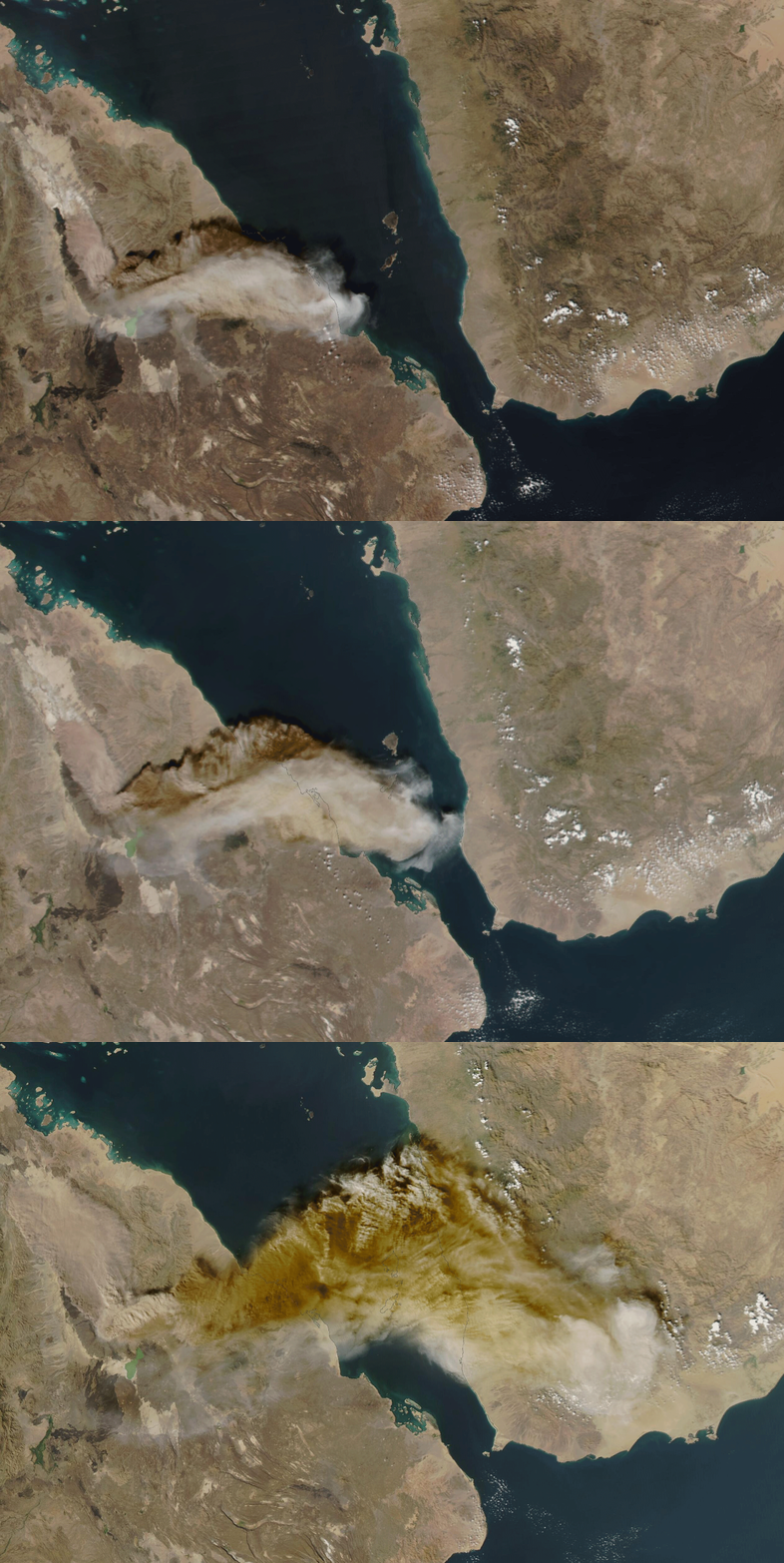
Looks to be a big eruption…
Hope everyone’s safe there.
Ooh, thanks! I was wondering where Erik Klemetti had gone. I read his Wired blog for many years. Bookmarked!
https://www.windy.com/sv/-SO2-tcso2?tcso2,14.115,46.802,5
The Vog cloud from it very strong signal
Thats a HUGE cloud the eruption rates must have been 1000 s perhaps 10 000 s cubic meters a second althrough short lived, likley an evolved ryolitic pocket vent off perhaps due to basaltic injection
Whoa, that’s a lot of ash. It’s cool how the lower part of the plume is channeled northward through the Danakil depression while the rest is blown by higher altitude air. I wonder if there’s a lava flow too.
I heard this volcano is in a highly remote area, so barring any negative effects downwind I think it’s likely okay to gawk a little (by all means, correct me if I am wrong about this).
It’s good to have contemporary examples like this to point to whenever people think certain volcanoes aren’t worth monitoring. Thousands of years is a light nap.
Looks like it may have produced pyroclastic flows. It’ll be interesting to see what it looks like once the eruption settles (which is reported to have been).
https://x.com/StrandenWX/status/1992593769179582912?t=O2X30aSoNG33xCiTg6fI2g&s=19
https://www.threads.com/@mayarisser/post/DRbXwf6DrVE?xmt=AQF0GM5jH22tASPjasUofUynNOgj8zqJUx9vT7zd7Kp8TQ
The dust cloud from the eruption kinda reminds me of Eyafjallajökull’s in 2010…
For some reason, the image didn’t pop up, but the images gives a good idea…
(Just in case b/c I’m starting to realise that either the images are too large for a computer or they won’t show…)
https://www.windy.com/sv/-SO2-tcso2?tcso2,30.031,76.201,4
The giant sulfur cloud have reached India, during Toba and CAMP the entire planet woud be colored in this map
Was there a massive pyroclastic flow towards NNW?
The color of the ash cloud is light, but not as light as rhyolite. Was the magma an intermediate one or trachyte (viscous alkali magma)?
The top image (from Twitter/X) looks to be a pyroclastic flow, although I can’t be 100% certain. The latter (from Threads) looks more of an ash cloud, abiet one that is low-lying, kinda like the Eya eruption in 2010 here:

As for the magma, I have no idea. I have seen some comments stating the dike in July might have reactivated the old magma below Hayli Gubbi (rhyolite) and there’s a good chance they might’ve mixed, although we could not be 100% certain until someone could get samples there.
Apparently the first eruption of that volcano in over 10,000 years.
Sits and sits and sits, then suddenly kaboom.
That makes it possible that the eruption is not much related to the old volcano but rather comes from the previous dike
https://www.youtube.com/watch?v=BqmpkUdMtyA
Lava is flowing very quickly still dome fountains but deformation is dropping very fast.. as if episode 37 is starting maybe it will start at any minute now…
maybe is erupting close to supply rates now .. the supply to Kilauea is nuts
Boating around a little erupting volcano on a sunny Friday last week.
From Geonet’s new activity bulletin:
Minor volcanic activity continues at Whakaari/White Island characterised by weakly loaded ash and gas plumes that are dispersed downwind. Volcanic Alert Level remains at 3 and Aviation Colour Code remains Orange. (24 Nov)
I thought it was declared a Maori sacred site to stop people going near it
Nope. It’s privately owned, has been in the same family since the 1930s IIRC.
A friend of mine, also from Ncl, visited the island twice, back when tourists were allowed. Fortunately she wasn’t there when the disaster happened. Volcanoes aren’t to be trusted.
Thanks for what you and your colleagues do, it’s epic.
Here is some more (live at the time I was watching it) footagr of Semeru.
That volcano hasn’t really settled down much.
Kilauea: end of this cycle just now transitioned to a few blasts of magma trying to fountain rather than just a dome. Maybe the gas rich magma is reaching the surface now. Cycles look to be pretty regular half hour on, half hour off. Time to watch out for the next cycle maybe for the fountaining.
Also, it’s amazing some of the footage from Indonesia. Muenster ne amazing for volcanologist. The video posted by canthisbenull shows how hot the pyroclastic debris still is.
https://www.bridgemanimages.com/en/noartistknown/congo-goma-streams-of-lava-from-the-nyiragongo-volcano-photo/photograph/asset/1137053
Some of Nyiragongos 2002 lava flows, so fluid they left only thin sheets on the ground but this have also been seen at Mauna Ulu
Another shot of the 2002 lava flows so fluid it covered twigs in thin shells of glass while rest of the lava torrent drained away downslope leaving a thin layer of glass on the ground but this phenomena have also been seen at Mauna Ulu drainbacks in fissure dykes in Hawaii
Kilaueas summit lavas is also crazy fluid due to its high temperatures and low crystal contents also showing the same drained sheets at Mauna Ulu ( photo ) if temperatures are high and crystal contents low then Sio2 becomes less important
Ionian hot lavas if the temperatures are 1600 c will be flowing like liquid steel no polymerzation at all at souch high temperatures, the deep superhot basalt below Iceland and Hawaii maybe like that as well
https://browser.dataspace.copernicus.eu/?zoom=17&lat=-1.40869&lng=29.20516&themeId=DEFAULT-THEME&visualizationUrl=U2FsdGVkX1%2FxP9xFicMIGtDrTFPxhUHghf7KV0OV8VJvoP6X7MKRjk85Id67Y%2FApdQI0s8mOST1F%2ByprygDu5RyCsFyfIEsWu%2B5%2FGYn%2FAik%2FXxbbLi0K9GV2b7jSI3RW&datasetId=S2_L2A_CDAS&fromTime=2025-11-24T00%3A00%3A00.000Z&toTime=2025-11-24T23%3A59%3A59.999Z&layerId=6-SWIR&demSource3D=%22MAPZEN%22&cloudCoverage=30&dateMode=SINGLE
Nyiramuragiras huge lava lake and its pahoehoe overflows and tube feed flank flows remains active
Episode 37 KIlauea seems to be following Episode 36’s past track record. There is this dip which is occurring near the top of the inflation cycle. See https://www.usgs.gov/volcanoes/kilauea/science/monitoring-data-kilauea and see the monthly chart. As of right now, 15:33 local Hawaii time, the episode seems to now have overcome the dip.
Tiny bit of glow from the north vent, 6 ,12,24 hours more needed?
Happy Thanksgiving to you and all that celebrate the holiday.
Might be nice, or distracting, to see an eruption while cooking the turkey!
Mac
Two earthquakes today in the Upper East Rift Zone of Kilauea, and more visible in this area in the past week monitoring map. I think the first activity in this direction since the current eruption started.
maybe magma will flow into there its shallower parts soon, supprisng it havent yet as the whole system is open at depth
They happen after earthquakes occured more frequently along the southern flank. Maybe there’s going to happen some movement and a change of the volcanic-tectonic pattern of Kilauea. Or the influence of the dynamic magma chambers destablizes the geological structure of the southern flank.
This map shows earthquakes of last month:
On one hand the southern flank and upper to middle ERZ had man earthquakes; on the other hand the deep Pahala quakes are back. They may precede a new future development.
This is before the eruption.
This is after. Note how, not only the original crater widened, but also that a second, abiet smaller, crater has showed up.
Forgot about this, there is a third smaller crater that also formed and, comparing the two images, it seems the eastern part of the bigger crater (or caldera) has dropped to form a faint scarp.
There are new faults too, seemingly bordering a collapsed summit platform:
The July dike may have slowly drained Hayli Gubbi’s shallow chamber until it collapsed, triggering a secondary explosion.
Pictures and video from the ground by VolcanoDiscovery field group: https://www.volcanodiscovery.com/hayli-gubbi/news/287783/Hayli-Gubbi-volcano-first-images-from-close.html
Is it possible that the eruption was strictly phreatic? I’m getting Fernandina 1968 vibes.
The sulfur cloud is massive so an indication it was a fresh magma ( but likey evolved gassy one )
This is the main site before.
And after. It looked like it has obliterated the previous tuff/pumice cone.
(Also, just wanted to post it, in accordance to the link sent by mjf)
https://i0.wp.com/www.volcanocafe.org/wp-content/uploads/2025/03/word-image-17447-12.jpeg?ssl=1
Recent shot of Nyiragongo and Nyiramuragira thats togther with Kilauea the planets most powerful thermal emitters, Nyiragongo to the right looks like Orodruin around, around, around, around the ringwraiths fly around it on their fell dragons guarding the peak and door to sammath naur
oh wow that rly looks like the far distance views into mordor that we had in the movies
https://i0.wp.com/www.volcanocafe.org/wp-content/uploads/2025/03/word-image-17447-3.jpeg?ssl=1
https://i0.wp.com/www.volcanocafe.org/wp-content/uploads/2025/03/word-image-17447-15.jpeg?ssl=1
Other recent shots of Nyiramuragiras lava lake condensation plume I guess Kilauea will do something similar in the future, yes its Sauron thats made himself a new home in Virunga
In the local mytology thats apparently Nyiragongo and Nyiramuragira are just as twisted dark places as Mordor is and both ruled by a similar ( but many ) evil demogods analogis as Morgoth and Sauron both volcanoes are seen very much so can earn their name “Africas Mount Doom”
12:35 Hawaii time; north vent at Kīlauea is beginning to have a massive overflow…
Looks like the pulse is done for now.
https://m.youtube.com/watch?v=6IaMqotNF_s&pp=ygUOa2lsYXVlYSB3ZWJjYW0%3D
Its flowing it will be fun to see if it will pop 37 now or just lower deformation again and later re – flow again
The Kilauea lava is VERY gas rich and frothy now its basicaly a magma foam thats erupting, its comming almost directly from the SDH deeper magma chamber thats likley having a giant foamy upper lid
Episode 37 have likey started
Looks like Ep. 37 is starting now…
5.4 MAG EARTHQUAKE 6.38KM NORTH OF THE ASO CALDERA RIM.
Is this from the Oita-Kumamoto Tectonic Line? Does it have any potential effect of Aso Caldera?
Yes, the 5.4 magnitude earthquake near the Aso Caldera is likely associated with the Oita-Kumamoto Tectonic Line. This tectonic line is significant in the region, known for its seismic activity due to the complex interactions of tectonic plates.
Potential Effects on Aso Caldera
Volcanic Activity: The Aso Caldera is an active volcanic area. Earthquakes can stimulate volcanic activity, including ash eruptions or changes in gas emissions.
Landslides and Ground Shaking: The area surrounding the caldera is susceptible to landslides due to earthquakes, potentially impacting infrastructure and ecosystems.
Monitoring and Precautions: Authorities monitor seismic activity closely, particularly in volcanic areas. An earthquake might prompt additional surveillance or emergency measures.
In conclusion, while not every earthquake directly triggers volcanic activity, the proximity to the caldera and the tectonic line increases the potential for effects. Continuous monitoring is essential for assessing risks and ensuring safety.
From DuckDuckGo ai assist which is gpt4o-mini AI
Team, can this be an AI-free zone?
Answer barebrained or not at all!
This was an example where AI gave a non-answer, hidden behind a smorgasboard of topics. I find that many Ai-derived writings can be recognised from the inclusion (and dominance) of unrelated bits of information, in this case without any bottom line – presumably because the question can’t be unambiguously answered. But AI may be useful in other cases. In either case I would much prefer that sources are mentioned.
Indeed, I would assume that a faithful reader of this blog is capable of entering in a question into a search bar to receive an ai slop non-answer, which is really only good for clicking on the source links under each statement, to try and dig for an actual informed article. However, by commenting on this blog, I am interested in a more informed take from someone aware of the issue given I recently decided to re-read the NDVP series, of which was https://www.volcanocafe.org/a-wedge-of-worry-aso-caldera-ndvp-4/. So the earthquake interested me for this reason.
I note that the commenter mentioned that this was AI-generated, which is the correct thing to do – if the source is AI, say so. I have seen cases where the AI answer was quite good (though ‘very good’ is more rare) and think there can be a role for it.
In this particular case, I don’t see a strong reason to associate the earthquake with volcanic activity. It was a moderate and stand-alone event on a known fault zone. Compared this to CCN, where the quakes come in multiple swarms, something less likely in a pure tectonic setting. If a swarm develops around Aso, it would be time to send out the volcanologists. But so far that does not seem needed.
INSAR is probably the best way to check for magma-related activity
Also speaking of earthquakes and calderas, there was a 4.9 on Samosir Island, in the middle of the Toba Caldera as well. I am guessing this is somewhat tectonic as well, since a fault does run through that area being the reason for the shape of Toba’s incredibly elongated Caldera.
I also vote for no AI-generated content.
AI is just telling you what a human is most statistically likely to say, based on whatever content you fed it says. If it is fed off the entire internet (ChatGPT and other public models) there will be untruths fed into the model.
It isn’t actually thinking.
The Kilauea fountain episode seems to be starting.
https://x.com/USGSVolcanoes/status/1993487803041063340
If you look at the V3 camera, there seems to be a new vent showing up near the north vents. Meanwhile, at the moment, the south vent is blowing raspberries…
Zach:
So noted, as you said. I time the start of the north vent fountaining in Episode 37 as 14:20 Hawaii time.
Volcano tornado on the V3 cam – see https://www.youtube.com/watch?v=BqmpkUdMtyA at 15:29 timestamp Quite impressive.
Actually 15:50:43 timestamp, I am puzzled at to how I said 15:29 timestamp.