
Photo: Nasa and graphics by https://www.researchgate.net/figure/mage-of-Prometheus-volcano-from-Galileo-spacecraft-on-29031998-On-the-right-shows_fig3_359661038 Here is the location of the Prometheous lava field, looking small but it is over 100 kilometers long. The ring is fallout from the freezing gas plume.
Intro
After writing two Io articles I return to Io again my favourite moon, looking at one single lava flow field. But read Alberts and my two other Io posts first. Jupiter’s moon Io is the most volcanically active place in our entire solar system. The most powerful active volcanoes ever seen by cameras are not found here on Earth, but on Io, a major moon of Jupiter, and thats why Io is my favorite object in the solar system. Because of Jupiters tides, Io is a volcanic powerhouse, so volcanic it is very much a real-world Mustafar. Io is a sci-fi world come real: a moon completely consumed by raging volcanic eruptions and never ending volcanic fury thanks to Jupiter’s enormous tides. Volcano planets are common in games and fiction and here is one in real life after all.
The volcanic eruptions seen on Io are enormous in volume, extent and in eruption rates compared to any recent historical basalt eruption here on Earth. The largest lava lakes and lava flows are at Loki Patera; the largest lava lake in the solar system and some huge lava flows are at Lei Kung Fluctus, Amirani and Masubi. Some of the silicate lava flows on Io’s surface are likely 1550c / 1600 c ultramafic “komatites” rather than just normal basalt. Higher than normal basalt temperature eruptions have been confirmed by Galileo spacecraft. Io hosts the only other “hot” glowing silicate lava eruptions in our local solar system, making this moon special: it is the volcanologists paradise.
The Voyager probes revealed a young volcanic surface for Io covered in sulfur snow and dark lava flows. The Galileo Spacecraft surprised the entire science community by discovering very high temperature silicate volcanism. Ionian lavas could be similar to the early archaean lavas on Earth if the tidal heating is hot enough. The Galileo spacecraft mapped many active lava flows and lava lakes and saw many intense lava fissure eruptions and confirmed ultramafic minerals in its sensors. The later Juno Spacecraft that still orbits Jupiter have seen many new regional lava flow changes and the most intense eruptions seen so far.
The sheer amounts of volcanic eruptions on Io makes it impossible to write a whole article on every eruption and lava flow change on Io that have happened since 2000. So in this post we will have a look at one of the lava flows that were closest photographed by Galileo Spacecraft: the Prometheus lava field. In this article I will give you a tour of this extraterrestrial lava flow and explain what you see in the images of it. As alien as it is, it is also very similar to lava flows on Earth which is quite fun: geology works similar elsewhere if you have similar mantle rock material to melt! Io has two types of lava flows: fast open fountain feed lava channels and slower fed eruptions. Prometheus is a tube-fed eruption. in this post I will explain what you see in these spaceprobe images of Prometheus. I will show the most interesting images at the end of this post: the most fun things are put lowest down.
Prometheus lava flow field: hot pahoehoe invading a sulfur snow field a general explanation

https://www.jpl.nasa.gov/images/pia02565-sources-of-volcanic-plumes-near-prometheus/ The whole lava flow field. Prometheus could swallow most of Vatnajökull’s area on Earth and was emplaced in about 16 years. Many other Ionian lava flows are much larger but this one is the best photographed. The lava tube tunnel is feed from the right and lava travels undergound for about 150 kilometers until it emerges on Io s surface. Every dark spot are recent breakouts. I save the best shots for lower down.
First we does a comparison with Io: on Earth volcanoes with a constantly active surface lava flows flowing at mantle supply rates are extraordinary rare. They only exist at a very few places, typically Hawaii and Africa ( Kilauea and Nyiramuragira ) even if Earth has in theory 1000 s of possibly active systems underwater. Most active volcanoes on Earth are not in constant eruption nor in constant lava flow since most the magma systems here are quite or very weak.
But on Io a majority of all volcanic centers are in constant effusive activity with the average Ionian volcano having a magma supply that is many 10s to a few 100 times larger than Kilauea. The largest Ionian lava lake volcanoes can have a magma supply rate of 100 km3 per year. This of course translates into constant lava eruptions all over Io. Lava flow eruptions are common and one such constant surface lava flow is Prometheos. It is not the largest lava pahoehoe flow field on Io ( those are the Amirani, Lei Kung Fluctus and Masubi lava flows ), nor the most violent eruption, but it is one of the best studied. And it is much larger than any recent lava flow in Kilauea, Africa or Iceland. Compound pahoehoe lava flows like Prometheus appear to be the standard type of constant lava flow activity on Io, with channel-fed fountain Aa flows ( pillan, surt, thor ) being rarer but still common. This lava flow was named after one of the titans in greek mythology that titan stole the fire from the gods. Because of Io’s extreme volcanism all features on Io are named after mythological beings of fire and sunlight. The moon is cooking after all.
In fact Prometheus is one of the best photographed of any of the dark silicate lava flows on Io’s surface. Galileo Spacecraft in the 2000s got high resolution close-ups of this compound tube-fed lava flow that turned out to be analogous to Puu Oo’s tube-fed lava flows on Kilauea. Galileo spacecraft also photographed hot glowing breakouts that we will talk about later. Lots was learned from Ionian lava flows by looking at Prometheus. An interesting interaction between hot silicate lava and sulfur snow was discovered, with the hot surface lava flows themselves vaporising the sulfur ice layers and redepositing them elsewhere on Io’s surface. The lava flow surfaces themselves are also snowed over when the dark mafic crust cools and gets coated by sulfur snow. Hot basaltic/komatitic lava flowing over thick layers of sulfur snow will produce a violent “phreatomagmatic” reaction sending plumes of sulfur gas skyward and jetting dark pyroclasts everywhere. Such sulfurous plumes were seen at Prometheus by the Voyager probes nearly 50 years ago. Back then in 1979 the dark lava flows that’s were seen when Galileo arrived in the 2000s did not exist; the lava field had been emplaced since the 16 years between the visits of the two space probes. Voyager saw just a sulfur rich deposit, later when Galileo Spacecraft arrived 16 years later an area of over 6000 square kilometers has been covered in tube-fed pahoehoe lava flows. The flow field emplaced in the sulfur ice desert would cover most of Vatnajökull if placed on our Earth and some other compound pahoehoe Ionian lava flows are much larger than that. Prometheus is a very different eruption compared to the fast violent “outburst” lava flows like those seen at pillan. Tube-fed lava flows on Io can be active for decades to likely centuries. They are persistent and the lava flows seen in 2000 s are still active today according to Juno’s instruments. Prometheus features fluid, low-viscosity mafic/ultramafic lavas. The flow field expands through thousands of small, distinct lobes called “lava toes” rather than moving as a single massive wall of rubble/ open river like Pillan.
Today in 2026 Prometheus lava flow could be over twice as large, at least 14 000 square kilometers. The Juno spacecraft’s thermal sensors have seen hotspots at Prometheus, a clear sign that the flow field is still active today. The superhot ( likely komatitic ) lava is constantly supplied by tubes to the flow fields edges where it violently interacts with thick layers of sulfur ice. This produces large fans of dark materials when trapped ice below the lava hot flow becomes high pressure gas that sprays hot lava everywhere along the flow front and leaves dark fans along the flow front edges. Such dark fans are common in pretty much all active surface lava flows on Io because of this interaction between hot fresh lava and sulfur ice. It feels strange that Io is a world where very hot lava is erupting onto – 140 C sulfur almost glacial enviroment. Most of the sulfur that is vaporized by the lava is not lost from the moon: it is just redeposited frozen elsewhere as snow. In the decades that Prometheus lava have flowed the tall sulfur plumes have moved together with the lava front, simply because the hot silicate lava has vaporized its way through the volatile frozen ices. But as one sulfur snow heap is vaporized by moving lava, the older crust behind the flow front that is little cooler than the fresh breakouts will start to accumulate its own sulfur snow cover.
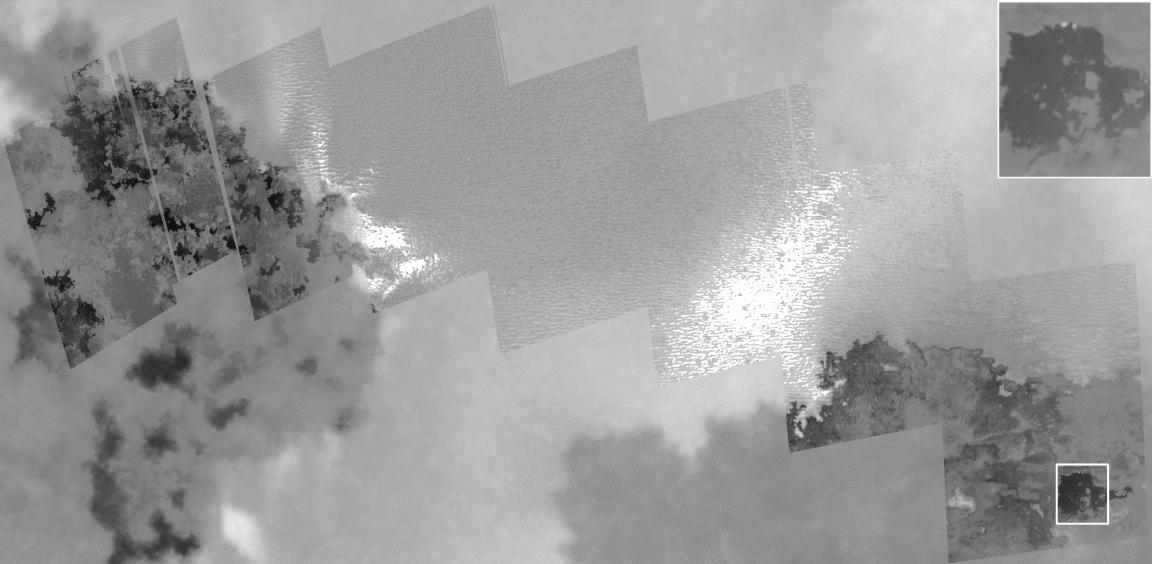
The Galileo spacecraft spent not much time around Io due to Jupiter’s highly damaging radiation. It was not a built for Io’s environment but during its short flybys it captured so far the best archive images of Ionian eruptions so far. The best photos of Prometheus lava flow were photographed on February 22, 2000, by NASA’s Galileo spacecraft. During this flyby (orbit 27), mosaic images were captured with a resolution of down to 12 meters per pixel that allows you easily to see how the compound lava flow field is built: many dark fresh pahoehoe breakouts where the ( black lava ) flow is way too hot for sulfur snow to settle and little older surfaces ( lighter grey ) where sulfur snow has started to settle on the lava.
Notice in the photographs how the darkest fresh lava breakouts in Prometheus are mostly located at the edges in the central left of the flow field, while there are relatively few fresh pahoehoe breakouts to the right where the caldera ( prometheus patera) is located. That is because there is a well developed lava tube system connecting the magmatic vents at the dark lava filled caldera ( Prometheus patera ) and fault. These feed the lava tubes that in turn supplies the flow front to the left on these Galileo images. The lava tubes inside the flow field are about 100 kilometers long. This is much longer than on Earth where lava tubes rarely exceeds 10 kilometers long. Even longer lava tubes on Io are those that feed the Amriani flow field, 300 kilometers long. Io’s Masubis lava tunnel system could be over a 1000 kilometers long. Ionian flow have a length of 1600 km. All of these are tube feed pahoehoes gentle constant eruptions at mantle supply rates.
Prometheus Patera ( bean shaped dark caldera) to the right of the lava field is also very interesting. It is likely the main vent that supplies the lava flow field. All dark spots on Io are hot lava surfaces where temperatures are too high for sulfur snow to settle. Knowing that, we can directly say that there is active lava there. It is more difficult to tell if it is a lava lake that is constantly overflowing or just a caldera that has been filled to the brim by active flows that now supply the flow field to the left. The lava flows at Prometheus are connected to the caldera which you can see in these Galileo photos, so it is there where it is coming from. Magma is likely rising through a fault in Io’s crust which is visible to the right of the field if you look closely other lava lake pits on Io are often but not always found near faults.
Little is known about the structure of the magma chamber that resides below Prometheus but with the fast supply rate against the lower buoyancy than on Earth, it is certain that the magma local chamber dwarfs Kilauea and Icelandic chambers. And this is still a quite small magma chamber on Io. Little is known about the detail of the formation of Ionian calderas, other than that they are magmatic in origin for sure. The Ionian pateras/ calderas maybe formed by hot lava eating their way through icey volatile outer layers of Io with the likely combination of magma withdrawl. Layers of sulfur ices ( frozen volcanic gases ) are going to vary a lot depending how old the local Io surface is. At Prometheus the snowy icey layer around the flow field coud be quite thin, perhaps a few meters and the plume fallout is much thinner than that.
The Galileo Spacecraft observed Prometheus lava field many times between October 11, 1999 and February 22, 2000 with an estimated 13 square kilometer of surface per month covered by lava. Thats about 160 square km per year repaved with new surface flow breakouts. These eruptions are gentle and effusive: lava is not flowing in open raging rivers like Pillan Patera and there are no tall laca fountains either like at Pillan, instead it is a gentle ooze. Very fluid lava is always brought to the flow front by the tube system. There the lava breaks out in white hot sheets. These can be 10 s meters long and are so very fluid they are much less than a meter thick and likely much more fluid than even the lava in Kilauea’s summit. Prometheus lava flows at the front advances as sheets and lobes, not as a single river like Pillan or Thor. The semi-plastic crust swells when it accumulates incoming lava from the tube system and the lava breaks out white hot. The sheets cool quite quickly in the frigid environment. On the surface a thin dark crust form forms which thickens and inflates and it repeats again when it brusts. It pushing the lava front forward identical to pahoehoe flows on Earth but the lava is faster and hotter than pahoehoe flows on Earth. Emission of thermal energy towards space is much less intense for these tube feed lava flows than major flood basalts on Io.
Galileo Spacecraft’s sensors sees this type of activity like a series of many hot points that move forward, with older breakouts fading and cooling while new ones radiate intensely all advancing in a front. This is once again identical to how pahoehoe flow fields on Earth behave in a spacecraft’s thermal instruments. This earned these type of lava flows on Io the name “compound lava flows”. The flows are built by thin sheets and lobes and the lava flows hidden below a crust. The main lava river here is the lava tunnel but that is hidden from view. The hottest dark breakouts and lava tube skylights gave SSI instruments and NIMS at Galileo readings at about 1200 C. The crust was many 100 s of degrees c in many dark places but older crust freezing. More intense lava flows on Io like Pillan have radiated at over 1600 c. Sometimes, parts of the roofs of the lava tunnels collapse, forming so-called skylights. When the Galileo spacecraft observed these skylights, the instruments measured radiation straight from the protected, glowing flowing lava beneath the crust. This gave the researchers the unique advantage of measuring black body radiation without the lava surface cooling too quickly. Still the probe would perhaps needed to be closer to do the best readings. Lava tube skylights togther with intense lava fountains on Io are the best places to read the true lava temperatures. Because Galileo made measurements from a distance, heat pixels often covered several square kilometers per pixel. The spacecraft measured an integrated temperature. A pixel at the flow front contained a mathematical mixture of almost only recently warmed crust and 1% extremely hot, recently erupted lava. The researchers had to use complex two-temperature models to mathematically separate the components due to a lack of higher resolution. But temperatures at 1200 C is confirmed for Prometheus. It is likely that the Prometheus lava flows are true 1600 c ultramafic komatites as was seen at Pillan but it is hard to know for sure. Superheated basalt is also a candidate thats similar to ancient lunar basalt. I think that all fresh lava flows on Io are very dark, which is a strong signature of an iron rich highly magnesian rock composition.
The lavas temperatures are much higher than the boiling point of the surrounding sulfur ices and that causes them to vaporize when hot lava meets the sulfur snow making gas jets. If you look closely at some of the close images ( photo below ) you can see something that almost look like sand dunes at the sulfur plains. Nasa experts think these formations are formed by the gas jets at the dark lava edge. These gas jets moves sulfur snow over the surface forming these “dunes” so a kind of wind sedimentation process in an otherwise airless space environment. Sulfur ices are constantly moved, vaporized and freezed out all over Io’s surface either by active lava flows and by deposition freezing out from distant volcanic vents.
Not all sulfur ice and snow on Io could always be vaporized by active lava flows when they flow over them. If that was the chase the moon would run out of volatiles to recycle back in its astenopshere and there would be no violent lava fountain eruptions that we seen elsewhere on Io. Some sulfur ice have to be buried together with the lava flows and remelted at depth. Thick sulfur ice layers can survive a hot lava flow on them by chilling the lavas underside and allowing the lava flow over it. Over time sillicate lava flows and sulfur snow get buried at together in a sort of weird layer pancake. It is still an overall violent interaction with hot lava that is much hotter than the boiling point of sulfur ice. Experts thinks that giant supercritical liquid boiling pockets of sulfur get trapped below the lava. When pressure gets too much the crust explodes and the sulfur vapor sprays hot lava chunks and gas everywhere. These explosions leaves dark halos of lava pyroclasts and plumes close to Ionian lava flow fronts. The faster the lava flow speed the more violent the interplay between hot lava and sulfur ice. At Prometheus that is a quite slow lava flow, this war between sulfur ice and lava is more gentle than at Pillan Patera and other faster Ionian flows.

Super closeup of Prometheous lava flow showing dark fresh pahoehoe breakouts covering older lava surfaces https://www.jpl.nasa.gov/images/pia02557-lava-flows-and-ridged-plains-at-prometheus-io/

Closeup of the lava field it haves a pahoehoe morphology extremely similar to Puu Oo fields seen from space. This is the area closer to Prometheous Patera the crust is darker than other areas. Here it lacks many single dark breakouts, the flow front have had to advanced at many places at once unlike in other areas according to sulfur snow cover. The light ground is older Ionian ground where snow accumulated.
The photos above are one the best and closest photos ever taken of the Prometheus lava flow and of any alien lava flow. Unlike the better photographed flows on Mars that are inactive this one is very much alive. The lava flow’s nature and behaviour is very clear by its shapes. It moves as lobes and sheets fed by the buried lava tubes. The lava is extremely hot and fluid so it forms smooth lobate, almost fractal shapes when it creeps along the ground. It reminds me so much of aerial photos of Kilauea’s lava flows and of the large older pahoehoes in the Craters of the Moon national monument. The various shades of black and grey are the result how old the lavas surface is and is determined how much sulfur snow it has accumulated. The dark breakouts are warm to superhot while the lighter grey older crust is cold enough for some sulfur snow and frost to settle on it. Cooling lava flows on Io tend to first go from black to green as the sulfur reacts with mafic silicate minerals forming a kind of pyrite frost. When the emplaced basaltic lava continues to cool and age, they slowly disappear under sulfur frost and snow, turning orange and later yellow and ultimately yellow-beige, until a new basaltic/ ultramafic lava flow comes along. Prometheus lava flow have two sources of volcanic gas plumes that condenses into sulfur snow. One is the patera ( caldera lava lake degassing ) the other is the lava flow front that vaporises sulfur snow forming the secondary plume thats moving togther with the lava flows. The snowy plains around Prometheus may not had much lava flow activity for hunderds of years.
By comparing recent resurfacing rates between different dates of photography from Galileo Spacecraft astronomers have estimated the amount of lava feeding this lava field to be around 40 to 50 cubic meters of lava per second flowing through the tube system. That does not sound much but it is way much faster than the basal supply of any Earth volcano. Kilauea as example sits at around 3 to 7 m3 per second depending on supply rate. Other pahoehoe lava flows on Io haves higher supply rate. Amirani lava flow have a peak rate at 70 – 600 m3 per second during episodes of excess supply with basal supply rate at least 56 m3 per second. At time of photographing in early 2000 s the volume of the whole Prometheus lava flow was estimated to be around 120 km3 of basalt/komatite emplaced since 1979. Today in 2026 with constant activity, the Prometheus field could have a volume of 240km3. This is orders of magnitude larger than any recent compound holocene lava flow field on Earth, and this is still a relatively small lava flow field on Io.
Some estimates gives 100 s of cubic meters of lava per second through the tubes when many breakouts are active at once that woud then be a pulse in supply but the median lava supply rate is lower 40 – 50 m3 when you divide volume with time lava coverage for Prometheus. Magma output at these kinds of Ionian eruptions are quite notable. Kilauea, Earth’s most productive volcano in the long term, covered around 5 to 8 square miles every month during the Puu Oo eruption, but the Aminarani Ionian flow field covered 250 to 470 square miles in new lava surface during the same timespan, Prometheus is over 10 km2 per month. Io’s upper layers are probably full of lava tubes, that get compressed and crushed further down as new lava layers get added above. Prometheus flow field like pahoehoe flow fields on Earth are feed by lava tubes like roots of a tree there is one main lava artery “tree stem” this is 100 kilometers long and from that underground lava highway lava is delivered to the flow front and field in sub tunnel branches that feeds the flow fronts and inflating crusts that replaces the surface Ice. The subsurface pooled lava below the crust soon merges with the lava tunnel as the sides cool and builds the main tube channel longer.
The whole local area mantle output that feeds this lava field is squeezed into the main lava tube so while 40 – 50 m3 of lava per second does not seem huge it is an enromous flow speed when thats crammed into a narrow lava tube. A good example is the spectacular Kilauea firehose at Kamokuna in 2017 where around 4m3 per second made a spectacular river. The breakouts at Prometheus flow front move each much slower than the supply rate because the tube supply feeds many lava breakouts at once at the front. At night this area is a spectacular hellish landscape with numerous glowing breakouts ilumninating gas jets and lava glows sinister in inflation cracks in the crust.

Photo https://www.jpl.nasa.gov/images/pia02564-ios-prometheus-volcano-at-various-resolutions/ This helps you to find Prometheous flow on global Galileo maps on Io. Every dark spot on Io are either active lava flows or lava lakes where sulfur snow cannot settle.

Graphic: The interaction of hot basalt and sulfur ice/snow is a major process on Io s surface, forming dark tephra plumes around active lava flows when trapped gas pockets burst. https://www.nature.com/articles/s41467-022-29682-x
Hot Prometheus: Io lava captured in action: the best shot of this flow field

Photo https://assets.science.nasa.gov/content/dam/science/psd/photojournal/pia/pia02/pia02568/PIA02568.jpg Hot glowing lava flowing out on slightly older ( dark grey ) sulfur frosted crust of the flow field. It is very likely hot breakouts not just older light ground thats being covered by lava. Unprocessed photos have these spots also very bright compared to the other normal surfaces. Many other hot breakouts will also be too small to be resolved here. This shot been polished by me with some contrast. https://science.nasa.gov/photojournal/galileo-takes-a-close-up-look-at-prometheus/
This closeup cropped image of the lava field at Prometheus flow got my attention years ago : the real stuff which captured in glowing hot pahoehoe lava breaking out on this moon’s surface. The images, taken during a Galileo flyby of Io on February 22, 2000, have a resolution of 12 meters (39 feet) per picture element. This photo is a strongly zoomed view of a small part of the flow field and hot breakouts are clearly visible. It is very likely hot lava (because of its intensity) and not older sulfur-snowed ground. These hot scattered lava breakouts are responsible for the hottest local pixels in Galileos spacecrafts instruments. The closer the spacecraft gets to the surface the better the resolution of thermal data in the spacecrafts sensors. Flow front is compound lobate and seen as a series of moving hot points that comes and goes, but lava tube skylights in the middle of the flow field are always hot pixels that remain in place month after month.
It has to be one of the most stunning photos taken by any spacecraft: the only image pixel resolution of hot lava outside our Earth. The dark recent hot flow is about a kilometers wide and has many near fractal lobate rootlike pahoehoe fingers. the hot lava breakouts themselves are many 10 s to 100’s of meters wide based on the image scale, which agrees with of the flow rate of this breakout being much higher than anything you see at Puu Oo lava front videos. It is logical, knowing that the supply rate at Prometheus is far higher than that of Puu Oo. This is just one of many such breakouts that are scattered all over Prometheus flow. Fluid lava is breaking out not only at the edges but inside the flow field in the chase of this photo. Incoming lava from the tube system fills under the inflating cooler crust until it breaks the crust open and glowing lava rushes out like in this image. The lava field not only grows in area but also in height when breakouts pile on top eachother. The fluid glowing lava tongues are much less than a meter thick but as the crust grows, ages and the flows inflate the surface rises to over a meter in height.
Ionian mafic/ultramafic lava is so hot that these pahoehoe flows viscosity may resemble liquid iron slag if the temperatures are high enough. The higher the temperature and lower the SiO2 are, the more fluid the lava will become. The simple fact that Prometheus’ compound lava flows on Io looks like this after many 100 s of kilometers away from the vent with little change gives an idea how hot and fluid and well insulated these pahoehoe lava flows are. Even over a 100 kilometers from the vent the dark fresh breakouts are looking like spilled stearine or liquid aluminium in shape. The lava is well insulated. The morphology of the pahoehoe field is very similar to large flow fields on Earth but I also think it looks smoother than most earthly flows and that agrees with models of Io’s lava having lower viscosity than oceanic basalt on Earth because it is hotter. Some models suggests both basalt and komatiite maybe able to erupt on Io in areas of different levels of tidal heating. Areas with higher heating will experience more mantle melting and more magnesian magmas. How hot the lava is determines the color for your eyes when the pahoehoe is breaking out. At 1200 c it’s shining light is yellow and at 1600 c it is a brilliant shining white hot just like liquid steel.
My own opinion on the surface morphology suggests the viscosity maybe much lower than typical earth oceanic basalt. Eruptions elsewhere on Io have been measured at 1600 c. Yhe breakouts may flow akin to liquid slag if the eruption temperature at Prometheus is well over 1200 c. When the lava sheet flows out it is a brilliant near white hot. It then cools to yellow, orange, red until it becomes glassy and black. The surface is always kept smooth and is likely very plastic when it is thin until it freezes into shape, because of the low viscosity allowing smooth surfaces. The pahoehoe crust is a very good insulator. It has low conductivity and the lavas high heat capacity mean little energy is lost even by flowing over cold sulfur ice and in the frigid cold vacuum. A visitor here woud have to content with the lethal radiation from Jupiter. There is not only hazards posed by flowing lava breaking out and rootless explosions caused by trapped sulfur ice boiling under the hot lava.
The exposed hot lava in space should cool much slower than a breakout does in Earth’s cooling convective atmosphere, because it can only radiate energy by radiation. The lava glow will fade but slower so than it does in Earth’s chilling atmosphere. But older lava crusts on Io cools down to minus 130 c or lower. The crust is an excellent insulator and the cold vaccum on top steals little heat from the lava flows despite its low temperature. This allows tube fed lava flows on Io to flow vast distances despite the freezing conditions on Io s surface. Lava crusts haves excellent insulation traits. Submarine lava flows on Earth can flow kilometers underwater over the seafloor and Io s vacuum is much less chilling than the huge density of masses of cold deep ocean water.
Walking on the lava flows surface would be surreal. You would see a landscape very similar to the past pahoehoe lava flow fields at Puu Oo. You would see hot lava breakouts, you see ropey sheets, you see sheet lobes, you see inflation mounds, glowing skylights and pressure ridges. By looking carefuly you can see some of these features like inflation mounds and pressure ridges in these photos. The fractal lobate behaviour at the front is just like the flowing lava flows that I hiked in 2014 at Kilauea’s Kahauale’a 2 with my father. The Prometheus lava are much more vigorous and even hotter than that. Kahauale’a 2 lava flows were about 1150 c and the current ongoing summit eruption of Kilauea has risen to almost 1200 c. But Prometheus breakouts on Io could be 1500c /1600 c like the other Ionian eruptions. The pahoehoe tongues and sheets that I saw at Kilauea were at most a few meters long when the surface was incandescent but on Prometheus the glowing sheets could be a 100 meters long / wide or much more when the supply behind is larger. On Io we can observe volcanic activity that would be catastrophic on Earth and see large eruption processes that only happen every millions of years of years on Earth. And some of the larger Ionian pahoehoe flows would only happen during major LIPs on our planet.
Large lava flow activity on Io gives an insight to old ancient eruptions on Earth and therefore is of tremendous interest to planetary geologists to understand Earth’s previous large lava flows. Some geologists think that the Columbia River Basalt Flows CRB sequences are quite analogous to Prometheus and Amiarani lava flows, as they share many of their suggested morphologies such as huge inflated ”flood sheet pahoehoes” which are also seen in the Deccan Traps lava flows. Its hard to say exactly how Ionian flows compares to Earths LIP flows but both share many features how these lava flows work. Both fast fountain fed lava flows on Io like Pillan and the slower tube fed Ionian eruptions like Prometheus have likely analogues on flood basalts here on Earth. LIP province flows on Earth are badely eroded and we only see their interiors, but on Io we could perhaps see true analogues in action: that is why this is so interesting to think about. The longest recent Pleistocene pāhoehoe lava flow on Earth is the Pampa de Los Carrizales / Pampas Onduladas flow at 180 km in lenght and of middle late pleistocene in age. That one is Prometheus in scale but Prometheus has a far bigger potential to become much bigger and the lava is also much hotter at Io. Such lava flow events on Earth are very rare but on Io it is the standard activity and Prometheus is a small lava flow for Io. The largest pahoehoe flow field on Io is Lei Kung Fluctus. It is mostly inactive and it covers 125,000 km2. Prometheous thats active maybe covers over 12 000 kmsup>2 today. Puu Oo s flow fields covers little over 100kmsup>2 and that is not a single lava flow. Kilauea’s very largest recent pahoehoe field Ailāʻau flow covered over 400kmsup>2 and that is still a small flow compared to Ionian lava flows.
This is about as much as I can write out in my own words out Galileo Spacecrafts images of Prometheus lava flow without making the the text too complicated for new readers with little background. At Kilauea me and father got to experience these Ionian flows processes on Earth. It is surreal to watch the same volcanological processes without a radiation blocking future spacesuit and without our suits becomming completely yellow of toxic snow. Space agencies needs to produce more space probes for Io the most volcanic and most intresting body in our solar system. Information thats good and readable on Io s volcanic processes on Internet are almost completely lacking, only Jason Perrys blog is good information elsewhere, so I will keep making articles on Io for Volcanocafe.

Me handling flowing basaltic lava at Kilauea needs extreme attention in all my senses to avoid getting burned or stepping on thin hot crust. If I was on Io s Prometheus I woud wear an extreme heavy duty radiation blocking space suit with advanced materials.

The photos above show myself at the Kahauale’a 2 lava flow at Kilauea in 2014. These pahoehoe lava flows are analogus to Prometheus at Io. Just with the difference that Prometheus lava flows are far larger, far faster and the lavas there are hotter and even more fluid. The tube that feed Kahauale’a 2 kilometers upslope was about 4m3 per second. But Prometheus is fed at 50m3 per second. It is truly amazing being able to experience Io on Earth even if Earthly volcanoes are just small fireworks compared to Io. The heat at Kilauea was still so intense that my head felt it was boiling.

Graphic showing the huge difference between Earth’s and Io’s lava production. Most magmas on Earth are erupted underwater at the mid ocean ridges. Most magmas on Earth above the ocean is erupted in Iceland and Hawaii but the production on land is much less than 1km3 per year. Io erupts many 100s of cubic km of lava every year. This shows how efficent Jupiters strong tides are at making magma compared to Earths radioactive heating. This is the output of all Io s volcanoes and not from Prometheus alone. https://www.youtube.com/watch?v=gqfpo0mVGTw

Galileo closeup of two incandescent breakouts. The only photo with direct hot lava flow pixels on Io in any higher detail. It is likley hot lava and not older ground ( high contrast ) image.

The final image showing the fine intricate patterns between fresh hot and black recent pahoehoe breakouts at Prometheus and the older dark grey lava crust where the surface have gathered sulfur frost. The more sulfur snow that collects the ligther the lavas color becomes.The light plains in the upper part are sulfur snow “desert” where lava have not flowed for a long time. https://science.nasa.gov/photojournal/galileo-takes-a-close-up-look-at-prometheus/
Jesper Sandberg, May 2026
Recommended Sources
Two books: Volcanism on Io: A Comparison with Earth. Ashely Davies et al. https://www.amazon.com/Volcanism-Io-Comparison-author-published/dp/B01M2XT6XO/ref=sr_1_1?crid=141Y7PMY8CO6L HYPERLINK “https://www.amazon.com/Volcanism-Io-Comparison-author-published/dp/B01M2XT6XO/ref=sr_1_1?
Io a new view of Jupiter’s moon. Rosaly Lopes et al. https://www.amazon.com/Io-Jupiters-Astrophysics-Science-Library/dp/3031256697
Links
Read my and Albert’s other Io posts:
https://www.volcanocafe.org/a-quick-tour-of-volcanism-on-io/
https://www.volcanocafe.org/secrets-of-io/
https://www.volcanocafe.org/ios-pillan-patera-eruption-in-1997-the-largest-lava-falls-ever-seen/
https://www.sciencedirect.com/science/article/pii/S0019103598959723?via%3Dihub
https://www.jpl.nasa.gov/images/pia02557-lava-flows-and-ridged-plains-at-prometheus-io/
https://geology.illinois.edu/~skieffer/papers/PrometheusIo’sWanderingPlume_Science_2000.pdf
https://www.science.org/doi/10.1126/science.288.5469.1204
https://www.sciencedirect.com/science/article/pii/S0019103598959723?via%3Dihub
https://pirlwww.lpl.arizona.edu/~perry/io_images/i24.htm


A new post is up! Io as always 🙂
This is exactly 100% what woud happen to an
astronaut IF an astronaut visited Io and came back to speak about the terrible ordeal and enviroment there: nasty place : O
https://m.youtube.com/watch?v=LwDe845aDt4&pp=ygUQZGFydGggdmFkZXIgc3VpdA%3D%3D
First Io post from me in over 3 years and I will keep producing more Io content later for Volcanocafe
Looking forward to reading it with several coffees later. My first question after scanning the images, how did the big jelly fish get there? 😉
Jellyfish? those maybe existing below the surface of the moon Europa in geothermal volcanic vents in the seafloor there
I calls it the Io suit ..Planet Mustafar is George Lucas own version of Io directly inspired by Io during the making of Revenge Of The Sith
Prometheus itself is not fully the size of a Siberian Traps lava flow no: but other Ionian compound lava flows are the size of LIP flows on Earth souch as Masubi lava flow thats feed by an 1600 kilometers long lava tube and Lei Kung Fluctus is even much larger than that!
Still Prometheus is much larger and much more powerful than any recent earthly lava flow
Prometheus in Reykjanes penninsula woud be an absolute disaster of course! its feed constantly at close to 50m3 lava per second other Icelandic holocene pahoehoe lava flows are for comparison feed at just a few m3 per second
Catching lava outbreaks on another moon or planet is exciting!
Not strange Io was first with that … tidal heating is an extremely efficent form to drive extreme non stop volcanism
At Kilauea, the tilt has exceeded the maximum before the previous episode. The vents show glow but the next episode still seems days away.
Of course its completely expected for Io as insanely volcanic as Io is. Io is locked in a Siberian Traps mode constantly non stop 😍. I really really hopes Elon Musk coud get intrested in Io one day
ops wrong comment section is was supposed to be at your commentary above
We’re in an experimental phase in which we’ll see whether the M 6 quake on the west side will influence Kilauea. It likely has zero influence, but we’ll see soon.
Kilauea did the next DI event:
Two DI events within five days! 20th May and 25th May:
Anyone seen this? https://youtu.be/kRntP5h3AqI?si=Unn7Dlt-khFIUKfy
StarX whatever it’s called left overs? Meteor? AI generated? Aliens?
It’s not the descending fireball that is the main interest. It’s the thing that files up afterwards at the end of the video.
Ideas? Anyone got access to better info?
That object looks like a satellite crossing the view of the sky behind and above the volcano; it’s not going up or down.
It could be Saturn. The earlier fireball could be an Aquariid meteor, which occur during most of May, but rocket debris is equally likely
It’s moving too fast and in the wrong direction to be the earth’s rotation. Look at the visible stars. One enters from the top of the screen and moves down about the same distance as the font size of the timestamp. It’s most likely a satellite.
Very cool video. Like someone said in the comments: “80s metal album cover right there”.
Yes, that makes it a satellite. But it is very bright. It also looks extended and has a tail: could it be an airplane? If this is just the camera doing its things, could it be the space station?
Space station seems possible. But it does seem to be moving quite fast, and looks like some kind of tail on it. Also, it’s going up the wrong direction. Anyway if it is the space station what an amazing coincidence it travels directly to opposite direction to the fireball and the exact right time. That’s what make it seem like aliens 👽
The ISS orbits west to east, so opposite to the movement of the stars. But the apparent tail (if real) does not fit the ISS (I hope!) and would argue for a plane.
I would guess that the tail is an artefact of the low light settings of the camera.
Holuhraun ( Baugur ) in its more mature phase maybe analogus to many of Io s tube feed lava flows in eruption speed about 70m3 per second ( and on Io this is a constant mantle lava supply without deflation for one single volcano which is not the case at Bardarbunga at all) Holuhraun in this mature phase flowed through lava tubes filling the interior of the lava flow. Many presistent tube feed Ionian lava flows may have even much higher supply speeds than this.
And Ionian lavas are also much hotter than Holuhraun and much lower viscosity still
Ionian volcanoes are powerful.. insanely powerful in background supply rates. Its Kilauea on steroids all over Io with the large systems maybe having 140 km3 of magma or much more moving through the subsurface crust each year
I likley produces many 100 s of km3 of lava on its surface every year. Juno spotted recently a new 600 kilometers long lava flow near one of Io s poles thats a lava flow on the scale of Earths miocene CRBG lava flows
How did the shield volcano eruptions of Cascades, California, Canada and Mexico look like? Did they come close to the behaviour of Io’s eruptions? An example are the past eruptions of Medicine Lake https://www.usgs.gov/volcanoes/medicine-lake
Ionian lavas are sillicate based but haves truely few if any analogues on Earth: Ionian magmas are hotter and more magnesian rich than typical Earth basalts. They are somewhat similar to Hawaii/ Iceland basalt yet Io is still diffirent to our mafic magmas. Io is hotter and more mafic and viscosity is even lower to much lower
Due to tidal heating the astenosphere on Io are hotter than Earths astenosphere so the melting of the mantle materials are more extensive on Io than on Earth the melts are more magnesian and olivine rich than Earths basalts. Earths basalts 1130 c – 1300 c Ionian equalent s sits at 1300 c – 1650 c ! perhaps similar to archean Komatites
Io s behaviour is basicaly
a non stop LIP province
Most Earth volcanoes haves snail slow supply and thats why we mostly haves so evolved magmas compared to Io s fluid hot runny stuff
A great study on Io, Jesper! Is there a complete magma cycle on Io like on Earth? For this there must be a way to make solid lava go down to the mantle again. On Earth subduction zones do this. But Io resembles Mars as a planet without plate tectonics. I imagine that the only way to put down solid lava into the mantle is, that layers of new lava cover old ones and that the growing weight of the lava mass creates a slow sinking process of old lava layers until they reach the liquid mantle.
Yes exactly so sillicate lava flows and sulfur glaciers gets buried togther over time like a layer cake until they remelts at about 35 – 40 kilometers depth There the temperature coud be 1650 c – 1750 c ! all over the moon
possible even hotter than that at deeper layers to explain highly magnesian ultramafic ionian lavas, the hotter the mantle the more magnesian the magmas that are produced will become. Io may have variations of local mantle temperatures and produce both basalt and komatites depending on how much tidal heating the region haves
Io is only slightly more distant from Jupiter (450,000 km) than the Earth’s Moon (Luna, 384,400 km) from the motherplanet.
Was the early volcanism of the Moon (Luna) also caused by tidal mechanisms like on Io? I think that we can explain some volcanism by asteroids and some by the creation period of the Moon, but it likely also has a relatively high “tidal” gravitation force by the Earth. Imagine the Moon had a water surface, there would likely be an impressive waterberg on the Earth side. The Apollo mission observed many Moonquakes in the 1970s that were predominantly caused by tidal forces.
And once it orbited VERY close, for many hundreds of millions of years.
But earth is not jupiter, really earth-moon is a binary. How much heating did this produce in early earth and is this one reason we still see volcanism on earth at relatively high level?
Earlier theories, that I do not think have been revisited in decades give the heat as from radioactive decay, but I suspect quite a lot came from tidal forces in the fluid core early on.
One day someone may take a look at this, an interesting phD topic that would be easy to get and order of magnitude before you take it on.
That would be an interesting calculation which I might try to do at some point. Some comments: the core is a red herring in this. Tidal forces act mainly on the outer regions. They also act mainly on liquid, which is why you suggest the core, but the oceans were already present. The tidal deceleration of the Moon was 100 times faster than that of Earth, which is why the Moon quickly fell into synchronous rotation but the Earth did not. That limited the tidal power. There is one estimate that the tidal force on the early Earth could have raised the surface temperature by 5C – much less than that of the greenhouse effect at that time (except for the US where greenhouse effects have been banned). Their number for tidal power in the early Earth far exceeds that of radioactive elements at the time, but of course radioactivity heats the interior (mainly the mantle, actually) while tidal power heats the outer regions. However it also seems to exceed the total rotational energy that was available so I have some doubts. In either case, the dominant internal energy source in the early earth is the separation of the mantle and core: the heavy iron sinking to the bottom. This should exceed the tidal dissipation by a factor of 10 but not at the same time.
Albert.
The tidal energy produced must surely be in the shear, I think compressive energy deposition will be negligible. So the earth will go egg-shaped, with the egg axis propagating with the lunar orbit. After all oceans are famously absent from IO, a well known tidally heated planet. A solid rock planet will firstly have little tidal deformation as its too rigid, a liquid one will depend on the viscosity of the liquid. Whilst its true (probably) the maximal shear will be close to the surface, here ‘close’ might be the outer quartile, which is a lot of km^3.
Completely agree about the moon, which is why I did not mention it; clearly there is only very small tidal flexing due to its gravitational lock.
I cannot remember what the orbital period of the nascent moon was, I believe days or tens of days, thats a lotta flexing of viscous lava.
A quick estimation indicates that the tidal force on Earth shortly after the formation of the moon was around 10% of that experienced by Io at the moment. At the moment Io is at about the same distance from Jupiter as the Moon is from Earth. But Jupiter is 10^5 times more massive than the Moon and that is a big difference. After formation, the Moon was something like 20 times closer to us than it is now, but that only turns 10^-5 into 0.1.
The tidal force depends on the difference in rotation rate and on a friction (or viscosity) parameter. That parameter is much larger for solids than for liquids and explains why the tidal force is much more effective on liquids. Io is pretty ductile to a significant depth. I don’t know what the Earth’s mantle was like. We have (and had) oceans and at the moment, the tidal deceleration acts almost exclusively on the oceans.
The orbital period of the Moon after its formation would have been around 0.5-1 day. The rotation period of the Earth would have been ~ 5 hours, increasing to ~15 hours in the first 1-2 billion years.
Fair comment. The thing is I am not suggesting anything other that a significant heat input into the mantle for a long (few hundred million years perhaps) resulted in a hotter and relatively larger mantle than (say) venus. I am not suggesting its responsible for significant heating now. Anyway lets see. Velocity of geosynchronous orbit is about 3000m/sec and the moon mass is about 7E22kg so its total KE is about 3E29joules (assuming I haven’t made classic dyslexic errors). Mass of earth ~6E24kg so dumping all the KE of the moon into the earth would be equivalent to 3E5 joules/kg (300kJ/kg).
I see the specific heat of lava is approx 1.7kJ/kg-K. So order of magnitude 100K increase. Most of this would be early earth, pre significant oceans (most likely). Not a lot, I agree, but there again not completely insignificant. One might need to consider the earths rotational energy, but probably neligible.
Just to add, I think it might depend on the internal nature of Venus, a rocky planet almost as large as Earth. Venus should have similar composition to Earth (though no water oceans), containing radioactive materials, and formed similarly to Earth. Venus should be volcanically active today. However, it has no internally generated magnetic field.
If Venus has active volcanoes, then the Moon tidal forces needn’t play part with Earth’s internal heating.
However, if Venus has no active volcanism, then something else must be heating Earth. Maybe the Moon’s tidal forces may have played a part in Earth’s heating earlier on, together with radioactivity and primordial heating (the effects of Moon tidal heating on Earth today is negligible).
There is evidence of active volcanism on Venus from a number of space probes. Unfortunately, I feel Venusian science seems to have now gone cold.
Venus has no plate tectonics and it has a very thick crust. That changes things a lot. See https://www.volcanocafe.org/volcanoes-are-from-venus/ for one of our posts on Venus.
There are several space probes planned to go to Venus. Hopefully the funding holds up
Phili & albert.
Venus was to be my next point. Same size as earth and its orbit even suggests serious impact at some point. It does have volcanoes and may have (had) limited tectonics. It should produce similar internal thermonuclear generation, but its very different. Albert is giving us the usual scientific arguments, but most are very old and could do with deeper examination.
NB All volcanically active objects in our solar system seem to have unusual orbits and/or a close partner.
Venus’ orbit is normal. You may be referring to its rotation period (which is unusual, although there may be another reason for it)? Basically, all rocky planet are or have been volcanic. Earth and Venus are both active. Mars is way down in activity and so is Mercury. So size matters. After that, it is details which change the nature of volcanism but the basic idea that radioactivity and residual heat provide the energy for a melt zone near the crust is the same in both Earth and Venus.
Fresh lava flow changes and
caldera collpases on Venus have been confirmed on old images from magellan, but the levels of volcanic activity is small compared to Io
Albert have you seen the fresh analysis of Magellan Images?
https://www.jpl.nasa.gov/news/nasas-magellan-data-reveals-volcanic-activity-on-venus/
A planet as large as the Earth and about as old as the Earth should have active volcanism and venus appears as it does so today
Giant impacts on Venus where more energy rich than on Earth .. collisons are faster there but that heat is quite low today compared over Venus own radioactive decay but some of it remains
https://www.nature.com/articles/s41550-024-02272-1
Active volcanic changes have been spotted on Venus ina re – evaluation of the old magellan radar images
https://m.youtube.com/watch?v=co5dX8leTp8&pp=ygUMVGhlaWEgaW1wYWN0
https://m.youtube.com/watch?v=mYsTcWOvqBY&ra=m
Not all but alot of heat also comes from whats left from Earths formation here is a fantastic animation of the Theia impact. The Infant Early had giant collisions some of the objects hitting Earth where moon and Mars sized, the largest of the impactors are the rarest but the energy produced by them is enough to melt most of Earths mantle into a magma ocean and create a rock vapor atmosphere, souch extreme surface conditions after souch an impact resembles the interior of a Star rather than a rocky planet! the collision is equal to a large part of the suns output for a very short time. Earth is also large enough to retain some of that heat. Hard to imagine these planetary scale disasters
I can barely imagine Jupiters youth it where hit by many much larger objects than Earth ever was and giant impacts on Jupiter are much much worse than Earth
But most heating is done by mantle radioactivity today
Baked/grilled by Earthshine from distance is a real phenomena during these events
Io is the most happy volcanoes in the solar system … endless internal heat from that tidal war for billions of years! the lava is always glowing always spattering always flowing and there is no geological cooling death … that may never come for a VERY long time
Thats what makes Io so very attractive there is always geological life it cannot die
…
Thank you for your superb article on Io. I’ve long struggled to understand what I see in the pictures of the planet. Now I get it, and know what’s going on! Thanks for making that possible!
No one has commented about the 3.8 & 3.7 quakes 15 seconds apart at Bardarbunga yesterday. Are these in place of the 5.0 predicted by Tomas, or are we still waiting?
They’re likely the countdown for the next 5 quake. Eldey recently also did some energetic earthquake swarms, but the GPS station (yes there is one somewhere) measured no deformation at the same time. The longterm deformation monitoring shows, that the station went down since 2025. Maybe there is a thinning process of the crust:
Krisuvik station had a negative deformation between 2012 and 2020, before the intrusions of Thorbjörn and Fagradalsfjall began.
Still waiting. Those quakes happened while the VC comment function was broken, so that could be the reason why they had not been mentioned yet.
At some point the regularity of the M5s will change. Maybe it already has. The KISA station looks like it might have slowed down its movement away from Bárdarbunga by a small amount. Maybe there’s some aseismic upward creep in the plug that releases some of the pressure without the need for a big quake. Maybe the supply slowed down a bit. Maybe the next one happens as I’m typing this.
A rather nice explanation of the possible habitability of at least some Super Earths in the galaxy using the latest knowledge on planetary habitability
good channel
https://m.youtube.com/watch?v=8qQW4LTWgtc&pp=ygUYa3Vyemdlc2FndCBpbiBhIG51dHNoZWxs&ra=m
The variations of Super Earths will be extreme but some coud be very habitable. large rocky planets orbiting long lived orange dwarf stars
And the variation between these will be large too .. depending how much water they have and how their geography looks like. Quite good but they coud go much much deeper how souch a planet woud look like that was pretty basic video
Sooo..what could be possible interpretations for the reversal of the N/E components? The vertical displacement looks steeper than pre 2011 still. IIRC many thought a Grimsvötn eruption would be likely by 2021…when was it estimated to have recovered from the 2011 ~0.3km³ (DRE) eruption?
Bardarbunga is likely getting more magma at the moment from the magma treasure of Vatnajökull. So Grimsvötn is weaker and Bardarbunga more active. KISA has more positive deformation than Grimsvötn recently:
I’ve mentioned this before. The trajectories changed, both for GFUM and KISA, in the beginning of 2024. At that time an M4 earthquake happened at Grimsvötn. It could just be a coincidence, but maybe that quake changed something. You won’t find it in Skjálftalisa by the way. I think they somehow did not get the manually computed data when they did the export from the old system, so it’s listed as M3.3. In the same way, almost all of Bárdarbunga’s M5s are listed as M4. I have not bothered to report it, they probably have more important things to do.
Probably because the assumed steady huge supply to Grimsvotn was in reality a refill surge far above its average supply rate and which probably also got kinda rugpulled by Bardarbunga later in the decade. Grimsvotn has potential for big eruptions but VEI 4s are rare and 2011 was its biggest in centuries so tbh expecting an even bigger eruption within a decade was probably foolish.
Grimsvotn is probably a mostly ‘effusive caldera’ volcano, with its biggest eruptions being lava flows from rifts instead of ignimbrite eruptions, the huge ash layers found in Saksunarvatn from the early Holocene were from the Grimsvotn system but no point source is known and they are just as likely rift eruptions through either water or remaining ice in the area southwest of Vatnajokull. Like Bardarbunga did in 1477 and 877.
I have always wondered what this area is. It looks like a crater row more than two parallel tindars. Its never given a good age in maps and might be impossible to do so but this is not a bad place to start. Alternatively the Saksunarvatn eruption site was buried by Laki or Eldgja but it seems less likely.
64°10’17.14″N 18°16’14.05″W
Denden:
thank you for pointing this out. We need to pay attention here, as something new IS happening.
The Pacific Ocean is already transitioning quickly towards El Nino: https://iri.columbia.edu/our-expertise/climate/forecasts/enso/current/
El Nino will likely stay throughout the remaining year 2026.
The ENSO teleconnections have been trending towards El Nino conditions for many months…primarily the development and strengthening of a sub-tropical jet along with several instances of westerly wind bursts (WWB) that have, and continue, to occur across the western/central Pacific. These reversals in tropical wind flow direction is what allows the warm water in the far western Pacific to slosh eastward. So why the sloshing? It’s because of gravity. Normally, due to mean easterly winds, the water height increases in the West Pacific around 60cm higher relative to the East Pacific. Once the easterlies weaken or reverse (WWB), the higher-height water on one side of the Pacific (west) then flows (sloshes) towards the lower side (east) due to simple gravity. This flow in turn forms the Kelvin waves that then propagate all the way to the west coast of North and South America. Current SST data tracking the Kelvin waves show them to be very strong with the downwelling part of the waves pushing warm water much deeper than usual indicating a stronger wave amplitude…so when the Kelvin wave enters it’s upward motion phase, the warm water at depth resurfaces somewhere in the central to east Pacific (this is a key factor in determining the synoptic weather patterns that set up, with easterly-based El Nino’s bringing jet further south, while El Nino’s that peak more in the mid-Pacific (called Modoki El Ninos) can shift the STJ further north.
We already saw a preliminary signature event in January and early February that brought many feet of rain to Hawaii (including snow to the higher volcanoes) resulting (in part) from water vapor coming off the warming tropical waters and flowing NNE. This was not a local set-up, as the same plume/subtropical jet of water blasted Washington and British Columbia with several heavy precip events that reached record levels in many locales. Here in California, we are getting anxious watching the El Nino develop, since very strong/super El Nino’s of the past (1982-83 and 1997-98) have resulted in major precipitation events over many areas of western NA that reached record seasonal totals. But those SEN’s were decades ago, and with a warming climate and a commensurate increase in water vapor in the air, the fears are that an even more powerful El Nino pattern could evolve..especially if the current model projections of a Super El Nino that could reach record levels does materialize. On the flip side though, we also saw a SEN in 2015-16 that did not produce a major shift in precip north of around 30N due to it peaking in a less optimum longitude. So what will the SEN of 2026 bring? Well, it’s been snowing over the snow-starved Sierra (following mid 90’s in the lowlands most of March), so to say things are a bit topsy-turvy is already an understatement.
A good explanation for the Kelvin wave! I read the expression recently, but didn’t know the meaning.
There are a lot of catastrophic events which are certain to come with the strong El Nino: Floods and Hurricanes on the westside of Latin America; droughts and wildfires in Indonesia. The extensive Hurricanes will increase the probability for a hit for California, although it would have moderate impact compared to Mexico. 1997 California got some more frequent hurricanes during a strong El Nino Season. Also Hawaii may get more hurricanes than usually. Here is a video about elevated hurricane risks in Hawaii 2026:
https://www.youtube.com/watch?v=J3OyGjNyA14
A hurricane could cause an erosive flood in the Ka’u desert, where the tephra deposits of the current eruption have accumulated.
Review about the 1997-1998 El Nino: https://en.wikipedia.org/wiki/1997%E2%80%9398_El_Ni%C3%B1o_event
That took me while to fathom out, i have spent too long with the mercator map. Wesetern pacific, would i presume be australia to russian coast. And eastern pacific the coast of the americas.
Me personally I’m more afraid of another La Nina just as bad or even worse than the one we had at the start of this decade.
Thank you for your superb article on Io Jesper. Really enjoyed reading it.
Thank you yes I really loves the most volcanic object in our solar system, as long as the tidal war keeps going the volcanoes will keep erupting and it may have been ongoing for billions of years. Io really is a volcanic show like nothing else in the entire solar system
https://physicstoday.aip.org/news/io-was-always-extremely-volcanic-evidence-indicates
Volcanic powerhouse
Volcano El Nevado de Longaví (Chile) has risen to “yellow” alert level: https://diarioneuquino.com.ar/elevan-a-amarilla-la-alerta-en-el-volcan-nevado-de-longavi-por-un-fuerte-aumento-de-sismos/?fbclid=IwY2xjawSEyIhleHRuA2FlbQIxMQBzcnRjBmFwcF9pZBAyMjIwMzkxNzg4MjAwODkyAAEeJsApWXVzWTnvoNGZUrTv5m5s79Af-Mt8zSZhpMFfdKMzmZlQL-kfKHRyTfM_aem_onR7dhiZfuFUKO-xpTlSAw
The last eruption was ~7,000 years ago. According to Wikipedia, it erupts 80% Andesite magma. It both did explosive eruptions and viscious effusive lava flows/domes.
From what I’ve seen, it’s explosive eruptions might never have gotten higher than a 4 or 5.
Yes, it doesn’t look like a Pintubo volcano, but for this volcano on this location a VEI 4 or 5 would still be a great event with threats to the human neighbourhood..
Is HVO’s site down for anyone else? I get a 403 Forbidden. Maybe time to clear my cache?
no problems here
Either HVO or USGS must have made a slight change to the site architecture. I went through Google rather than my bookmark, and that worked.
Finally, there are sparks flying out of Kilauea’s north vent. It shouldn’t be too long before the next episode begins.
We are still in a DI event so the gas pressure is probably a bit low.
Where does magma go during the D-part of the DI events? Are the DI events repeated micro intrusions? 2008 the onset of frequent DI events correlated with the build-up towards the summit eruption. Maybe we’re in a similar moment, that combines the situation of the 2008 summit eruption with Pu’u O’o’s 1986 shift to continuous activity.
I think it is the gas rather than the magma that goes. The gas makes the magma more fluffed up and it rises. When the gas goes away, the magma is denser and sinks.
Does the gas escape on the summit as Fumaroles?
It remains in storage, I expect! The conduit carries rising magma. In a DI event, this rising stops. Whether it is caused by something at the top (a cooler lid forming) or at the bottom (diversion of the flow) I don’t know. But when the rising stops, no new gas comes up and it leaves the conduit stale. You can see from the seismographs how quiet the caldera is: the noise from rising bubbles is gone. At some time, the magma at the bottom become more buoyant again (more gas, higher temperature) and begins to push up the conduit (slow rising of the lava at the top but without much activity – this has been happening for the past two days). It may lead to overflows which eventually removes the cool lid, or the gas-rich magma manages to push through the lid. Now the next episode can begin. In past cases, the DI events end abruptly but at the moment it seems to have (temporarily) stabilised.
Both of the US large private rockets are now grounded after Blue Origin’s blew up and the space-x heavy booster crashed badly into the Gulf of Mexico. This does not bode well for the return to the Moon.
Fierce one-upmanship now between these fireworks startups!
But in any case, I suspect that Jared Isaacman’s “return to the Moon” renderings function mostly just as pre-listing advertising material for his old mentor, who wants to pump up the hype by any means. What utter corruption of once great agency!
The blue origin explosion registered as an M2.5 on the USGS daily earthquake list.
All three. ULA’s Vulcan rocket is also still grounded due to a recurring strap-on booster problem. Worrying that they also use the BE-4 main engines that New Glenn uses. So if the engines caused the explosion then ULA will have to fix that too.
One of the key people posted on X “Rockets are hard”
Io the ideal place for a Musk big cooperate space – prison camp colony .. working in the mineral ore and sulfur mines for crimes you did back on the future Earth
Since 10 p.m. HST the north vent does lava fountains. They are continuous, but small, so that the lava bombs/drops only reach to the rim of the northern crater. Sometimes it looks like lava waves inside the crater like the waves of a wave pool.
The northern vent has an advantage at the moment by its lower altitude than the southern vent. This makes it easier for magma to get out.
The slow landslides after episodes steadily change the landscape around the cones. The thick deposits of lava and tephra flow slowly like hot glaciers back towards the vents and influence their shape.
I’m really not sure the altitude makes that much difference.
Think about the height that magma is ejected to during fountaining; it goes MUCH higher than the difference in height between the vents.
Single versus double fountains must reflect some complex and changeable plumbing under the caldera. Given that recent episodes have seen fountaining only from the North vent, but copious gas ejection from the South vent, I’d hypothesise that perhaps the South vent is connected to the ‘headspace’ in the magma reservoir, where exsolved gas accumulates, and the South vent is connected deeper down, with direct access to the magma. But even that is probably over-simplistic.
My idea why the elevation matters is that the pressure to get both vents fountaining is high and with the north vent lower, it uses up too much of the pressure to let south run away. Most likely the pressure needs to be ratger higher to start with than these 1-2 week gaps allow now.
This doesnt exclude plumbing changes, but the fact south has been active in all recent episodes just not running away into full fountaining makes me think its more simple
I expect that one of the conduits is narrower than the other or has some restriction in the flow. Compressible gas has no problem but incompressible liquid looses pressure.
Slowly cranking up..
Look at the new area at the 11 o’clock position. This definitely is a hot zone. Do you think that a new vent is about to emerge?
No its probably the thick tephra accumulation there degassing, both from its own trapped bubbles and possibly from the vents too. But its not likely to be a new vent in my opinion
Chad:
If you have been watching the past 3 days, this seems to be a significant outgassing center, not tired tephra finally deciding to degas. Does it indicate the deeper conduit underneath before the two vents emerge at the surface? My guess is yes.
Its not uncommon for degassing to happen from the rim or summit of a pyroclastic cone away from the vent itself. That spot is probably the thickest deposit of this whole eruption and the tephra is welded semisolid, its not unlike an ignimbrite degassing after deposition.
Regardless, if a vent does open there its gonna be difficult to erupt properly. It would likely be connected to the south vent unless a new intrusion snuck up somehow. Not convinced tbh.
I wish we could get Ionian eruption here on Earth
Right .. but no volcanic systems here haves the base magma supply that Ionian volcanoes haves not even the monster thats Kilauea. Something like Prometheus or Amirani woud be fun in Icelands highlands or Kilaueas coast. Placed on Earth It will transform the entire Puna coast of Kilaura into one single huge series of pahoehoe ocean entries. Largest of all
tube feed Ionian flows may transform most of south east Iceland into a giant front of pahoehoe ocean entries with a density similar to Kapoho 2018 during july if placed there. Steam columns for 100 kilometers or much more.. for the largest Ionian flows flowing into the atlantic ocean 🙂
How do LIPs stack up to Ioninan systems in your opinion?
They are likely analougus the large lava flows and fissure eruptions on Io are likely analogus to past LIP flows on Earth
But the giant mega lava lakes ( up to 250 km wide ) thats presistent maybe unique to Io
Thanks to Jupiters gravity Io is locked in a state thats pretty much a constant non stop Siberian Traps over the entire moons surface from many vents that makes it the volcanologists true paradise maybe Elon Musk coud one day satisfy our fascination with Io
Since 17:41 HST, the south vent has been overflowing frequently; now, we need to wait for the north vent to overflow.
Until now (23 HST) I’ve counted 9 micro-episodes of the southern vent, while the northern vent continuous with spattering. The micro-episodes of the south vent follow the same chronology as the main episodes: First outpouring of degassed magma with a dome fountain, second gasrich magma enters the conduit and makes the lava fountain more explosive.
Cross Caldera Deformation has reached the level, when the main previous episode began:
It seems that today is the day for Episode 48, when the summit eruption catches up with Pu’u O’o 1986 before the switch to Kupaianaha.
Interesting. Lava is now erupting from the back wall of the north vent.
What’s going on in Iceland! A star and what looks like a swarm not far from Reykjavik, I think near a borehole from what everyone has said previously. But it looks a little active…is something waking up?
So far it looks like a tectonic event with a couple of medium size quakes and a lot of aftershocks. Swarms like this are common in the area and, unless the intensity starts picking up, it’s nothing to be concerned about. Things can change quickly though, and I’m sure IMO is watching it closely.
It is not magma intrusion. There were two swarm (one still on -going) which started with a larger event and then a declining strengths of the aftershocks. In a magma dike, the events stay more constant in magnitude. Water injection can reduce the friction which keeps a fault stationary. Suddenly the friction drops and the fault starts moving – aquaplaning, if you like.
Looks like water pumping at the Hellisheiði geothermal plant. It is Iceland’s biggest geothermal power station and is exactly in that location.
I think they regularly top up the underground water levels by pumping more water into the system, to make up for losses. Whenever they do it the IMO map lights up like a Christmas tree. The first time I saw it was back in about 2013 iirc. They probably chose the weekend for doing it so as to cause fewer issues.
Bruce:
You are probably right. It will be interesting to hear what the IMO says about this swarm.
Without the leathal radiation: whats the geothermal potential of Io for a colony? Io is extremely hot after possible billions of years of tidal heating! but Im not soure how quickly the temperature rises down towards the astenosphere. Ionian upper parts are probaly very cold if most tidal heating heat is vented by ” heat pipe” volcanism rather than conduction but the interior of Io arent cold 🙂 Earths core is much hotter than Io s but Io s astenosphere is much hotter than earths astneosphere
JS – I’ve no idea if there’s much water on Io, it would tend to be volatilized by the volcanoes then stripped away by the radiation.
Just looked up the wiki, Io’s atmosphere pressure is around a billionth of Earth’s and is 90% SO2. Wow. Basically a toxic vacuum.
Robert Heinlein back in 1950 set “Farmer In The Sky” on Ganymede, which is interesting since we now know that moon has an ocean like Europa does.
Sulfur thats heavy is the only volatile that stays on Io everything else been lost due to the low gravity
The earthquake activity on Langjökull and Prestahnúkur is also interesting. We know that the WVZ was more active during the Medieval Reykjanes Fires, so the WVZ systems has an unkown but elevated probability to erupt during the Reykjanes Fires.
Prestahnúkur supposedly only does large eruptions >0.5km³, neither small nor moderate. But they have an extremely low extrusion rate of 5m³/sec = smaller than Fagradalsfjall, but over time big enough. If an eruption happens outside the glacier they expect the construction of a lava shield. If it happens below the glacier, it will be a longterm but slow “Grimsvötn” eruption with jökulhlaup and low tephra plumes. “Tephra fall is expected to be minor due to the low extrusion rate but ash-rich plumes may rise to an altitude of a few km.” https://icelandicvolcanoes.is/?volcano=PRE
If it erupts under the glacier, a big piece of that glacier wont exist after lol
The eruptions also do start off pretty fast, not crazy fast but much more than 5 m3/s. That might be the average after decades but it starts maybe 10× that or more.
Many earthquakes are on the NW side of Thorisjökull (the “Þ” is like the th in thing). There didn’t occur any Holocene eruptions. But this region is close to the central volcano of Prestahnukur. The central volcano has a significant amount (and risk) for silicic explosive eruptions. It didn’t erupt during Holocene, but we don’t know whether we’ll get the first eruption there soon.
North vent is splattering nicely now.
Io and the giant Jupiter quite recent Juno and photo
Interesting how different this Kilauea episode is. The UWD tilt is still increasing, but very slowly (less than 1 microrad per day). HVO now says that the tilt has stopped being a useful modelling indicator. I think that goes a bit far (noting the usual caveats regarding tilt measurements – a single number at a single location in a single direction). Looking at the curve, it seems to me that an episode was about to happen when the latest DI event hit, 5 days ago. That stabilised the system and allowed it to grow a bit further. This was a few days after the M6 earthquake which I think was too far to affect the system. (It did end the previous DI event.)
If the DI event ends, the next episode could starts quite suddenly. The flaming phase has now started but the overflows are still a bit sluggish
Albert:
I am glad to see that you and I are seriously thinking about this predictive sequence. (this is NOT meant to slight anyone else) Yes, there has been some change and we can observe the recent mag 6+ quake and those effects. But I agree with you that we’re still in the same cycle. I agree with you, we can still use the tilt as a predictor.
The shiney almost metallic looking crust sits on Loki Patera lava lake just like a mirror almost its a lava lake nearly half the size of the entire Iceland
The scale is enormous beyond human experience from volcanoes on Earth the lava lake is about twice as large as Vatnajökull and the walls around it are about 2000 meters high. This is MUCH larger than Halemaumau thats for soure, this feature is likely a formation by hot lava eating its way through Io s outer volatile layers rather than a collapse feature
North vent has a nice dome fountain going right now.
https://m.youtube.com/watch?v=6IaMqotNF_s&pp=ygUUa2lsYXVlYSB2b2xjYW5vIGxpdmU%3D&ra=m
Episode 48 is starting
Low level fountaining (more like intense bubbling) is commencing from the south vent.
Following the pattern from earlier episodes, once the surging and overflows from the north vent starts shutting down is when the south vent kicks into overdrive?
Summit tilt is starting to drop. So it’s just a matter of time before the latest episode really gets going.
This afternoon a M4.5 at Hengill with lots of aftershocks.
I’m wondering if the water pumping theory still holds after this earthquake.
https://en.vedur.is/earthquakes-and-volcanism/earthquakes/reykjanespeninsula/
Tectonic, I think. And Vatnajokull had a mini-Thomas event (M3) at almost the same time
Here’s the IMO comment:
Hengill quake felt across capital was magnitude 4.5 (RÚV, 1 Jun)
RTWT. The most interesting thing is what she doesn’t say. She doesn’t mention tectonics and doesn’t mention volcanic activity. Normally IMO invokes one or the other.
I think it supports the water pumping hypothesis, and that IMO doesn’t want to stir up the locals by mentioning it. There’s a lot of angst about such things due to fracking.
In tectonic events, the aftershocks tend to peak at one magnitude or so below the main event. They should (of course) also come after the main serving. This swarm fits that – mostly. It started out tectonic. The continuation is fairly weak (M2 declining to M1): this could be caused by water migrating in the fault, I think, but this is speculation!
Indeed, the north vent has ‘failed’ (cap broke), tilt is dropping fast and the fountaining is building up nicely, with massive overflows. Which vent will go for it is still ‘to be determined’ but the conduit has been cleared!
Why only the north vent in this episode? Hardly nothing from the south vent? And I did notice the outgassing in the middle and toward the west rim, prior to the fountaining.
Yes. Once a channel for fountaining is established, it can be quite stable and outcompete the other channel. The pressure is now too low (or the channel capacity too high) for two fountains to operate simultaneously. It seems a bit unpredictable which channel will win in each episode.
That’s a whole lot of orange…
I thought perhaps that His Lowliness had visited his secret underground lair, and exploded when found out there was still no phone signal.
If Mr. Orange was there, the volcano would erupt Gold Magma, not black (as solid) basaltic magma.
Got a couple more magnitude 3+ earthquakes in the Hengill swarm. Been a while since we’ve seen this big of a swarm there.
https://www.youtube.com/watch?v=m3j0LS8Egig
Civil Defense Radio Message
At 7:22 HST you see a rainbow in front of the eruption:
https://www.youtube.com/watch?v=Tz5tPqRRv1Y
Only a shower rainbow or can an eruption create a “volcanic rainbow” with a type of ash fall? As a third option, maybe the volcanic eruption facilitated the development of a rainshower with the rainbow. In this case its a volcanic meteorology phenomen.
Very good find! It has also been seen in episode 29 (https://www.newsflare.com/video/768794/rainbow-forms-over-lava-fountains-as-volcano-erupts-in-hawaii) A rainbow requires water drops. Fog droplets are too small: they cause a white rainbow (also known as a fogbow). Falling drops (also known as ‘rain’) are needed. They don’t need to reach the ground (sometimes the drops evaporate on the way). I would guess that the rain ‘just happened’ (Hawaii can be rainy) but the volcanic dust can act as condensation nuclei for rain. May I refer to the recent posts on volcanoes and rain?
Just after E48 Kilauea did a 0.3km deep (below sea level) swarm near RIMD seismometer on the southern caldera rim and ~100m west of Keneakakoi Crater: https://www.usgs.gov/observatories/hvo
Since E45 there has been a solid baseline for eruptions on the UWD tiltmeter. Deflation hasn’t fallen below -10 microrads on UWD:
Haha the absolute tard that is Kristján Loftsson woud go completey nuts… in complete joy just by seeing this. For local Hawaiians whales are religious and spiritual beings .. but for some Icelanders ( not all but some old men ) they are cannon fodder and profit
https://m.youtube.com/watch?v=VrhSKNEPekw&ra=m
Large earthquake of the toe of Italy. Luckily very deep, so probably limited effects on the surface, but it was reportedly felt as far as Naples
Reminds me a bit of the powerful – but incredibly deep – earthquakes that tend to repeat in the Bonin Islands. Multiple mid-to-high M7 quakes in the historical record that are felt across an enormous area because of their depth, but amount to little more than an annoyance unless you’re an islander.
I understand the areas around the Izu-Bonin-Marianas trenches have long been poorly populated, but I do wonder about why there’s a lack of records and / or study on if large scale megathrust earthquakes like at most other subduction zones don’t occur there.
There’s a good thesis or two hiding in there, for sure. With places to live, no less. Maybe dig into some of the volcanoes while you’re out there. Someone would probably fund your research.
The subduction in the Mariana Trench is very steep. That may reduce the risk. A more significant concern is in the Manila Trench, further south which hasn’t ruptured for at least 500 years and may be capable of a high M8.
Iceland: Hengill is rattling a lot. For water pumping from the power station it’s getting a wee bit threatening.
The “Just Icelandic” (Gylfli) and “Iceland Explorer” broadcasters on YouTube seemed concerned about events.
Charts look like rock fracturing though – no sign of magma movement so far as my inexperienced eye can see.
Clive:
I will stick my neck out again. We are watching a significant earthquake swarm activity for western Iceland. When the earthquake swarms started up for Santorini Island in Greece, immediately the official word from “experts” was “tectonic acitivity, nothing more” Then after about 2 years, the truth came out, that magma intrustions into sills was occurring at a significant rate into both Santorini and Kolumbo. (submarine volcano)
The “experts” don’t want the general public to go into paranoia and alarm and fear, because that’s not good for anyone. So they get overwhelmed by the need to keep the public calm and not admit what is really going on. This quake swarm activity in western Iceland IS significant. We need to relax and see where this is all going.
Too early to tell what is happening. The start was typically tectonic. The following swarm not, but the current system of locating earthquakes clearly can’t deal with this swarm. Especially the depths are wrong. This fault has been active for a while, so the swarm is real. But best to wait for confirmation of where the swarm is happening and what’s causing it.
With the swarms east of Santorini, it was very clearly a propagating dyke. It had all the trademarks: The intensity of the quake activity, distribution of magnitudes, a propagating dyke tip, trigger quakes. The GPS measurements showed a deflating source. As usual, people only looked at the up/down component and said that Santorini was deflating. If you instead looked at the whole picture and included horizontal movements, then clearly Kolumbo stood out as the source. It made sense. The swarm started from Kolumbo and propagated away from it. Months later, scientific reports were published that came to the same conclusions.
In Iceland, at the moment, both the activity near Hengill and the activity at Langjökull are isolated swarms on a handful of discrete faults. There’s no propagating dyke tip. The intensity and magnitude distribution is more like a typical mainshock-aftershock sequence than that of magma migration.
Now, this is Iceland and things can change quickly. Before the volcanic activity returned to the Reykjanes Peninsula, there was talk about the potential for a large earthquake, up to M7, in the area between the peninsula and the SISZ. The SISZ quakes in 2000 and 2008 only released about half of the estimated accumulated strain in the area. A large quake in the Bláfjöll area is still a very real possibility. In Iceland, plate tectonics and magmatic processes interact, so you can never completely rule out one or the other. The current activity is interesting and worth keeping an eye on, but at the moment it’s actually not significantly above background levels.
Tomas:
Thank you for your well thought out reply. I guess I am saying that we still do not have enough understanding about both magmatic and tectonic activity in Iceland to be able to made definitive conclusions. Your input was needed.
– Randall
Now the Langjokull swarm has a couple stars.
As of now, 6:38 pm PDT, there are red dots all over the IMO earthquake map. Ever since the first swarm, a couple of days ago, things have been quite active. https://en.vedur.is/earthquakes-and-volcanism/earthquakes
Almost all of those quakes shown on the Langjokull chart are at Quality 50, which, as Tomas has pointed out, means that they have not been verified by seismologists and are subject to significant corrections.
Vito:
True, as you have pointed out. One day I am looking at a very crowded earthquake map from the IMO and the next day, everything is relaxed. It would be nice if there was some way to find the actual activity. I won’t criticize the IMO, they are doing a fantastic job.
– Randall
It seems that during Reykjanes Fires the whole western part of Iceland has above-average activity: Snæfellsnes, Hengill and Langjökull.
Concerning Langjökull Glacier we must remember that the glacier hosts two volcanoes! It’s like Grimsvötn and Bardarbunga in the Vatnajökull Glacier. Langjökull Glacier hosts Prestahnúkur Volcano and the actual Langjökull-Hveravellir Volcano. The severe earthquake swarms have occured in the part of Prestahnúkur Volcano.
This is exactly what Iceland is in music. 1 hour of many beautyful dark fantasty soundscapes all of these soundscapes are beautyful. it cannot be anything else than Iceland! a mysterious cloudy day at the black sand beaches under the cloudy sky with the intense green and blacks
https://m.youtube.com/watch?v=zloJ_yptWU0&pp=ygUaZmFudGFzeSBsYW5kc2NhcGUgYW1iaWVuY2U%3D&ra=m
Was the 1868 Hawaii earthquake a Hawaiian version of megathrust quakes, in which the whole Big Island was moving on macro scale? The earthquake was accompanied by strong landslides. This indicates that the whole island moved a lot. How often does Hawaii earthquakes of this type?
According to what I’ve read, there were two landslide structures which probably moved during the 1868 quake. There was an M7.1 foreshock which was likely triggered by an intrusion and eruption of Mauna Loa’s southwestern rift zone and consisted of movement of the area south of the southwestern rift zone to Honu’apo Bay and some of the Ka’oiki fault system, the boundary between Mauna Loa and Kilauea. This was the first landslide structure to move. The M7.9 mainshock, meanwhile, was likely caused by Kilauea’s entire southern flank moving (yes, from southwestern rift zone to eastern rift zone), probably triggered by the earlier shock. This was the second landslide structure to move. The earlier quake, figuratively, thus became the straw which broke the camel’s back.
If you go by similar quakes in similar locations, there’s also 1975 and 2018 to choose from, as each occurred on another, more infamous, Kilauea landslide structure, the Hilina Slump. Based on that it seems one or two per century or so, but I think eruptive frequency and location are also a major component in this, plus time elapsed since the previous big quake.
The south flank of Kilauea seems to move enough to make a big quake (mag 6+) every few decades. Before 2018 was in 1989 in the same area, although not as big. And Mauna Loa in 1983, actually right into Kilaueas summit, but Pu’u O’o had already opened so there was no excess pressure there. Before 1975 there was also a 6.4 quake in 1954 that was likely a precursor to the ERZ erupting the next year. And Mauna Loa had 6+ quakes in 1950 and 1951, the first days before it erupted in 1950. I think 1887 and 1907 Mauna Loa also had powerful quakes, and probably a similar magma pathway as 1868 (far beyond the normal length of the SWRZ)
If I had to guess too, the 1823 Kilauea eruption also probably happened alongside a big quake, to rapidly drain out the caldera through the SWRZ and then immediately favor the ERZ after.
That being said, 1868 is the only time both volcanoes moved in a single event. Both had huge intrusions, one erupting powerfully. Kilauea was going on at least 40 years without a really big south flank quake, and maybe up to 78 years if it goes back to 1790. And Mauna Loa possibly hadnt seen a south flank movement at all since about 1700 when the Hapaimanu eruption that created Mokuaweoweo occurred. However that eruption, and all other prehistoric SWRZ eruptions in the last 2k years, nome of them went past the ‘bend’ above Ocean View, and eruptions on the main rift like 1950 caused Kona side quakes…
So its plausible that Mauna Loa had not had a south flank slip in possibly over 2000 years before 1868… It is also possible this could have something to do with the eruption style since then being extremely intense fissure eruptions, instead of long lived tube fed flows that are common among der eruptions. How this might also affect Kilauea I dont know as much but I would expect some relation.
The Hawaiian Islands have a long history of huge mountain-collapse events into the ocean that caused mega-tsunamis. The islands are built with a lot of instability, so they are prone to move or collapse on big scale. I imagine that a quake like 1868 is a reminder to these dangerous processes and that from time to time we must expect great movements like that again.
I may later just for fun of it make an article a list explaining Io s largest confirmed lava lakes. These are volcanic vents on Io on a scale that Earth may have not seen since the hadean era.
Hengill could be linked to the Prestahnukur fissure swarm via Þingvallvatn/Skjaldbreidur, perhaps as far as Eiriksjokull, but who knows. Many of the flows around Prestahnukur are late holocene, and some of the eruptions are rhyolitic (>70% silicic).
Of the two swarms i’d say Prestahnukur is more likely to be volcano-tectonic and has increased enormously in seismicity since February. Prior to that there are swarms with gaps, but it has been restless particularly at 12km depth and above. The bulk of the swarm is just east of Ok with a southwest-northeast trend. (Skjalftalisa for data)
The systems in this region are likely partially positive correlated. They tend to erupt together in swarm eruptions over a few centuries and stay calm together over many centuries.
New study suggests Reykjanes is going back to sleep.
Four metres of movement over short period, but little sign of new eruption (RÚV, 4 Jun)
Good news for the people of Grindavik, a relief not to have a volcano stuff everything up every few months. But volcanoes are cantankerous critters. I will wait and see how it goes.
In Krysuvik there were eruptions around 800 AD (Afstapahraun) and again in 12th century. So it’s possible that after a first eruption season a system like Svartsengi goes to sleep for 300 years until it does new eruptions.
The whole Medieval Reykjanes Fires lasted for more than 500 yerars: 800 to 1341. Brennisteinsfjöll was the last system that erupted 1341. It did also earlier eruptions around 1000 AD. Reykjanes Fires are likely a long period with a lot of volcanic unrest and some volcanic eruptions. But the frequent unrest makes it uncertain to predict what happens next.
The volcano says when it’s done, not Þorvaldur Þórðarson.
There will be at least one more large eruption, in my inexpert opinion.
After that it just depends on whether or not deep supply is exhausted, gas content of the magma etc.
I agree with the expert, though. The chances of a further eruption in this location are decreasing.
Andy:
Can you account for the decreasing trend line? This seems to indicate that inflow magma is starting to shut off. See https://brunnur.vedur.is/gps/browser/ for example. Please refer also to the IMO office article https://en.vedur.is/about-imo/news/earthquake-in-brennisteinsfjoll-faster-subsidence-in-krysuvik-and-continued-magma-accumulation-at-svartsengi and look at the graphic in particular under the Deformation header. I have been tracking this myself and the deformation is occurring. I estimated a 4-5 year shutoff, but we may be at this point now. At a certain point of magma volume intrusion rate, the crust pressures do shut off the influx. This is very hard to estimate, but perhaps it has occurred here.
I am starting to believe this, watching the trend line of the inflation (in elevation) It appears the the intrusion feed is starting to come to a gradual end.
Can anyone translate this video?
https://www.mbl.is/frettir/innlent/2026/06/07/katla_gaeti_verid_nalaegt_thanmorkum/
Tallis, this was a tough request. Google translate from my wav audio file obtained from using a linux video capture program and editing the wav file in Kdenlive resulted in the following.
Jun 7, 2026, 5:28 PM
Interview
% buffered
00:00
04:42
(0:00) It is naturally lonely that can cause ash and here in geological history there are naturally signs of (0:06) large explosive eruptions that are the biggest ash and that are naturally longer than (0:11) for example you see two other relevant and are easily very explosive (0:15) but there are of course these large eruptions and also eat 75 ash and such (0:22) but there are naturally some such events that (0:27) are events that would cause a lot of damage and also then a large eruption equal (0:34) which causes then great floods and presumably ash and more ash (0:39) and a burden on it itself which maybe can cause for example this floods (0:47) and we can also get some nice eruptions for example (0:53) into what we call the Þöst gospell so that’s the area that is (0:58) between Mýrtalsjökull and Vtannafjökull and is fertile and is the main plate rift (1:01) today like this area and there you can naturally find leaking keikan (1:09) as with all the big östlave when there was so much gas coming out with the reality (1:16) that came there and it’s maybe one of the Swedish questions that are also being looked at (1:23) which can cause really bad things to happen for example with the LQS passage that is putting out (1:30) tenfold or even tenfold the good that we have to see on the Reykjafjörður (1:36) and the huge amount of gas coming out which has a really bad effect. (1:42) I think that human beings talk about the greatest fear of a volcano? (1:49) Yes. (1:51) Do we need to fear a volcano more than anything else? (1:55) Volcanoes are always just particularly affected by volcanoes in many places and it is affected, (2:02) I think that’s why, there has been a lot of earthquakes there, (2:06) but there are unusually large earthquakes just since the beginning.
(2:11) And here, you can imagine a little bit what causes it, (2:15) so there are very strong earthquakes there, (2:17) but we have many other earthquakes there, (2:21) which are not as strong earthquakes. (2:25) And one might ask oneself whether at least one interpretation, (2:29) of many perhaps, is that this iron earthquake is caused by something that (2:34) here to call this complex just so close to the many. (2:40) So small changes in the dynamical system might cause (2:45) more earthquakes and there, look.
(2:48) But that may not be the whole story because, look, (2:51) and here one naturally wonders what (2:55) the storyteller who is up to it, (2:57) and also just very difficult to measure these iron earthquakes (3:01) when it is strange, because we would rather put something (3:06) into a solid framework that we came up with, look. (3:09) That is very good, very good. (3:11) And then of course there is the barofbúka too.
(3:13) Yes, yes. (3:14) It has been snoring very loudly, (3:16) and here are some measurements that Magnús Tomi Guðmundsson (3:22) and others have been doing that indicate that (3:28) the caldera floor that lives in is something like 25-30 meters, (3:31) something like that, which is many times the (3:35) the snoring that we see on the Reykjavík screen. (3:39) But that’s good news, 2014, barofbúka.
(3:43) And because such advanced measurements in this area (3:46) have also shown interconnection, volcanoes there too, (3:50) and have come to the fore in recent years (3:52) that is, we had land rise in Grímsök, (3:57) expansion there, and then about three years ago (4:01) it subsided and is now quite slow now, (4:05) you could say, and at the same time the geomorphology (4:11) in the barofbúka is increasing. And the simplest thing is that the interpreter is just so (4:16) that this is just a mess and the Reykjavík screen (4:20) that there is something like a pressure barfer that, (4:24) so it is easy for a fire to go up (4:26) to a barofbúka and then just search and there (4:30) the istafan for searching up in Grímsökunn. (4:33) Maybe just the right explanation when you mentioned that (4:35) she had a good habit last 2014, which after using to (4:38) hela a good habit in the hole.
(4:39) Yes, exactly, they have a good habit in the hole.
You will have to use your common sense to make sense of this translation
Thanks.
https://www.youtube.com/watch?v=mhU54iF7YKU
Lots of ground uplift in central Iceland and around vatnajökull in recent 5 years but its probaly glacial rebound
nah its most likely the mantle plume and lots of incoming giga-eruptions
Maybe Grimsvötn will supprise us again entering a new cycle after years of tiredness? maybe there coud even be a Laki or something other large and fun on the horizon! IF this is magmatic uplift
I hope it’s magmatic! But it’s likely glacial rebound.
7.8 earthquake just off the southern coast of Mindanao.
https://earthquake.usgs.gov/earthquakes/eventpage/us7000srb1/executive
Tsunami advisories have been issued. Maximum wave height estimates I’ve seen are 3 meters.
I am seeing wildly differing depth estimates. Current consensus seems to be around 55 km?
30+ km was sufficient to reduce the impact of the Kamchatka tsunami, but a 7.8 is generating measurable waves from 55 km. I must be missing something here.
Landslides?
It’s possible.
Spoilers for the article I may or may not ever get around to finishing: the June 16th, 1026 Manju tsunami was generated by an undersea landslide and reached 20 meters in places. Impressively, the source of the slide has been identified and mapped.
The fact that that can just…happen…with no forewarning is legitimately terrifying.
It shows up in the tilt profile of Kilauea. That was an impressive quake!