
Kilauea is a basaltic volcano, driven by magma from a deep hot spot. Over time it has build a summit on top of the older Mauna Loa lava pile, and a one-sided eastern ridge extending far into the Pacific Ocean. There is a rift on the west side as well, but it is short, has no ridge and bends towards the south west under the pressure from towering Mauna Loa. The landscape around Kilauea is mixture of green forest, dark lava plains and ashy desert. Things here can change without warning. A stark lava-scape may once have been a forest. One settlement here was called Royal Gardens, the name of a lush site. It now lies buried by a 30-year long eruption. The historic town of Kalapana suffered the same fate. Leilani was hit by the surprise eruption of 2018, and although much of it survived, the coastal settlement of Kapoho, now a ghost town, did not.
Kilauea is unpredictable. It can do just about any kind of eruption imaginable: effusive, explosive, summit, rift, mini and mega. We have tried to find patterns in its eruptions, but the volcano takes little notice and continues to do whatever it felt like. It is not a nice neighbourhood volcano. People living on its slopes have found themselves at the whim of an unruly ruler. Paradise here can suddenly and easily be lost. Visitors see the beauty and the excitement. The locals know the dark side of paradise.
But over the past two years Kilauea has changed character. Eruptions are now predicted weeks in advance and are almost carbon-copies of each other. They begin with upwelling and spattering, quickly grow in the voluminous fountains, and cease once deflation has reached a certain level. Inflation quickly recovers, and the next eruption begins at the same peak level of tilt as before. There have been minor changes, such as the recent dike on the caldera rim, but the pattern has continued for 55 episodes so far, with number 56 well on the way. Even the end seems predictable: at the current rate of magma depletion, in another year, the pressure needed to initiate an episode is gone.
The reason for the sudden predictability is mysterious. Yellowstone’s geysers are perhaps the closest in volcanic predictability, but there the reason is volcanic inactivity, allowing a stable water circulation to feed the geysers. Kilauea is not like that. We cannot predict how long its predictability will last.
The other mystery comes from the fountains. How do they form, why are they so stable over so many hours but start and end quite suddenly? Perhaps we can say something about that.
Lava fountains
Lava fountains may well be the visually most impressive type of eruption. The record for the tallest lava fountain (at least as observed) is held by Mount Mihara at Izu-Oshima in Japan, where in 1986 a fountain reached 1500 meters tall. Etna is particularly well known for its tall lava fountains. One of these is reported to have reached as high as 3km. However, it is not always clear where the lava fountain ends and the updraft of hot tephra takes over.
Eruptions at basaltic volcanoes often begin with lava fountains, before the flows become effusive. They may come from long fissures, which are also characteristic for basaltic volcanoes. But lava fountains can also appear later in an eruption, as happened during the first Reykjanes eruption. In May 2021, two months into its eruption, it suddenly showed impressive fountains which reached 450 meters high and which were easily visible from Reykjavik.
Volcanoes with more evolved magma can also produce fountains, but rhyolitic volcanoes tend not to.

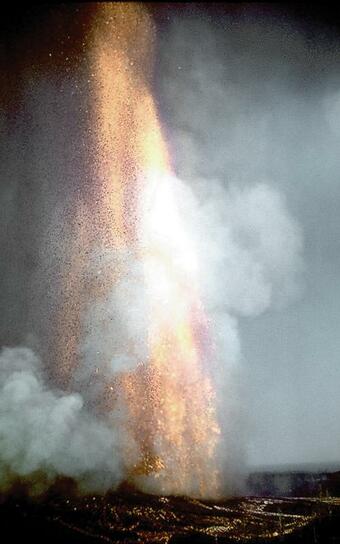
Fountains at Pu’u’O’o, during episode 31 of its eruption. This episode lasted for nearly 23 hours, and erupted about 19.4 million cubic meters of lava that covered an area of 4.8 square kilometers. The fountains reached a maximum height of 309 m. Source: USG, https://www.usgs.gov/media/images/lava-fountain-erupts-puu-oo-kilauea-hawaii
Kilauea is known to do episodic fountaining, where its long-lasting eruptions can contain a phase of on-off lava fountains. This happened during the Pu’u’O’o eruption which started with three years of cone-building. During this phase, in 1983-1986, there were 44 episodes of fountaining. The fountains ended only when in 1986 the eruption moved to a different location. The eruption would continue for another 32 years (see https://www.usgs.gov/volcanoes/kilauea/science/puuoo-eruption-lasted-35-years), but the fountains did not return.
Before Pu’u’O’o was Maunaulu. This eruption lasted 5 years, from 1969 to 1974. The fountains occured early in the eruption, with 12 episodes over a 7 month period, coming from a fissure. The tallest fissure reached 540 meters – taller than Empire State Building, as HVO pointed out, although their image showing both together would now be seen as an early example of AI hallucination!

Fountains at Mauanulu, 1969. Source: https://www.nps.gov/havo/learn/nature/mauna-ulu-eruption.htm
Before Maunaulu was Kilauea Iki. During its initial eruption in 1959 there were 17 episodes of lava fountaining. The tallest was just before the sudden end, with the fountain reaching 580 meters high. As in the other two cases, after the fountains ended, an effusive eruption began, but in this case there was a longer delay and is started at a different location, along the east rift.
Kilauea 2024-2026
And now we are in the fourth series of Kilauea lava fountaining in 57 years. The summit episodes started on 23 December 2024. During the first year, there were 38 episodes. We are now at episode 55. Like Yellowstone, Kilauea has found stability.

Tilt near Kilauea, used to predict the onset and end of each episode
In this fourth series, the episodes became more regular over time. From April 2025, they increased in volume and occurred at longer intervals. At that time, the lava output and magma input was approximately in balance. From December 2025, the output became more than the input.
A sudden change in April 2026 caused faster, smaller episodes. Most recently, the episodes temporarily ceased, when new openings alomng the caldera wall opened safety valves. A new dike along this path closed these off again, leading to episode 55. What happens next should become clearer soon!
Each episode starts with rising magma levels in the conduits, followed by a series of overflows, each ending in a drain back. Eventually the overflow become faster and lava begins to form an umbrella. This umbrella grows over an hour or less, and becomes a tall fountain, most recently around 200 meters high. After several hours the height begins to decrease but it does not go back to the umbrella shape. The end is quite sudden, with magma retreating deep in the conduit and not coming back up. In some cases, a gas jet spurts out for 1 or 2 minutes just after the end.
Health and safety
The most obvious difference between the overflows, the umbrellas and the fountains is in the speed of the lava. During the overflows, the lava level rises above the rim, but there is little or no excess speed. The lava comes up at a leisurely rate, perhaps as low as 10 cm/s. The umbrellas of 10-30 meters tall require much faster upflow, of 10-25 m/s. Finally, a 200-meter fountain requires speeds of 60-70 m/s, and to get to 400 meters, a speed of up to 100 m/s is needed. To put this in context, that is the speed of a Japanese bullet train. The lava flow rate during a fountain episode is as high as 250 m3/s. It dropped to 100 m3/s before the dike formation on 30 September 2026, but for episode 55 in October 2026 it was back at the high value. It amounts to 500 tons per second on mass! Imagine being hit by a 500 ton lava bomb moving at 200 miles per hour – every second for 10 hours!
This should make it obvious why HVO’s main task seems to be to keep people away from the fountain spectacle. The episodes are best viewed from a large distance, or with a live camera – and even one of those cameras we have seen being destroyed by the high speed lava bullets.
Volcanoes can kill in many ways, but HVO has managed to ensure that the main risk of fatalities from Kilauea is human stupidity error. HVO deserves congratulations and respect for this. But no volcano can ever be made entirely fool-proof, sadly.
(As an aside, I used the numbers for the Kilauea flow rates from https://www.usgs.gov/volcanoes/kilauea/science/eruption-information which are preliminary and subject to change!)
Volatiles
But how can magma be accelerated to these kind of speeds? And where does it get the energy from? This is not an easy question to answer. We have to look at something that is very common around Hawai’i – water.
Magma is more than just molten rock. There are volatiles dissolved into the magma, which were present in the original rock as well. There are three main volatile species : H2O, CO2, and sulfur. How much of these are dissolved in the magma can vary a lot between volcanoes. For Kilauea, the CO2 content of the parental magma (the original abundance in the melt, as it comes up from the mantle) is around 0.7% by weight. The parental water content is between 0.5% and 1%. Finally, the parental sulfur abundance is around 0.15% by weight.
But these are not the amounts found in magma close to the surface. The magma loses volatiles on the way, and especially the CO2 may be as low as 0.1% when reaching the surface. The rest exsolves on the way, meaning the opposite of dissolving: it becomes a gas. For CO2, this happens at a depth of typically 5 km and so by the time the magma approaches the surface, most of the CO2 is already gone. Water and sulfur exsolve slower. In hot magma, water also reacts with the molten silicates and this releases some hydrogen. The water abundance in the magma near the surface may be down by half. But this is difficult to measure because there is so much water in the environment! Separating water that originated from lava from water already in the atmosphere is often not possible.
The exsolved gasses rise through the magma and through any cracks in the rock that it can find. CO2 can hang near the ground and suffocate the unwary. Escaping water vapour causes the steam clouds which hangs around the eruption site before and after eruptions. And sulfur causes the bad smells emanating from active volcanoes.

From Fundamentals of Physical Volcanology, Partfit et al. (Wiley, 2nd edition)
Why does it exsolve? The maximum amount of a volatile in magma goes down as the magma rises. Magma under high pressure keeps the volatile dissolved, but under lower pressure some may come out. The picture above shows this for water. At 8 km depth, where the pressure is 200 MPa, basalt can contain about 4% (by weight) of water. Rhyolite is more forgiving and can contain almost 6%. But at 2km depth (50 MPa), these amounts are down to 2% and 3%. If the basalt contains 2% originally, this is still fine, but a bit closer to the surface and some of the water has to come out of the solution: let the exsolution begin. Once the magma becomes supersaturated, small bubbles begin to form. And the closer to the surface, the more bubbles form.
For Kilauea magma, CO2 begins to exsolve at 8 km depth but water only at 1 km. Thus, the deeper magma (say at 5 km) contains CO2 bubbles. Magma at this depth tends to be located in fairly stable magma chambers. The bubbles have time to rise to the top of the chambers and escape through the rocks. In this way, volcanoes breath out CO2 even when not erupting. Water vapour bubbles form much closer to the surface. A stable magma chamber close to the surface can lead to a steamy volcanic breath, in the same way as a deeper chamber causes a CO2 breath. But during an eruption, when magma is rising from the deeper magma chamber towards the surface, water vapour bubbles have no time to escape and remain entrained in the erupting magma.
(This is not the only source of water. Ground water can be found at the same depth and may be heated by deeper magma. This tends to be the cause of the steam in the fumaroles around Kilauea.)
Bubbles in action
It is not easy for a bubble to form in magma under high pressure! Compared to water locked away inn the liquid, it needs a sufficient number of molecules to come together, it needs to create space, and a surface to keep it separate from the liquid. The latter is a stumbling block. There is tension in the surface, and that tension tries to shrink the surface. The smaller the bubble, the larger the tension force per molecule. The initial bubble is only a few nanometers across. If the bubble is too small, the surface tension just forces the molecules back into magma – whether the magma wants it or not. The magma stays supersaturated, and it may take as much as 100 MPa overpressure for these mini-bubbles to become stable. Spontaneous formation of bubble is possible, but it is slow.
It works much better if there is a solid structure, preferably a bit irregular, for the molecule to adhere to. The solid side protects against the surface tension, and it gives the bubble space to grow. Once it becomes a bit larger, the bubble doesn’t need the solid surface any longer and it can detach and become independent. You can see this in a beer glass. The bubbles form on the surface of the glass, detach and begin to rise. (I tried to find a picture of bubbles in beer but couldn’t find one that wasn’t AI generated. You’ll have to pour it yourself. Cheers! You may want to try to foamy-looking one below.) With such a surface, the bubbles quickly become a micrometer across rather than a nanometer.

What solids are available in magma? First, like to beer, there is the surface of the conduit (or the glass). But crystals in the magma also work, and they are much more helpful as they are scattered throughout the magma while the side of the conduit is only found at the edge.
Now a secret law of physics spring into action. As gas exsolves from magma, the bubbles take up space that wasn’t needed before. The magma needs to expand. If that space isn’t there, as in a closed magma chamber, the gas will be driven into minute cracks in the rock that the magma itself doesn’t fit in. The gas begins its arduous escape. But if there is room, for instance in a conduit, the magma expangs into the larger volume. The density of the magma, the total mass divided by the total volume, begins to decrease. As the bubbles grow, the magma becomes less and less dense.
This happens in a stable situation. But if there is an eruption in progress, then this happens while the magma is coming up in the conduit. The higher it moves, the lower the pressure and the more gas comes out of the solution. This has a strange consequence. The amount of magma passing through the conduit per second must be the same at the top and the bottom – otherwise a magma traffic jam would occur. But the density at the top is lower. To keep the same flow rate, in kilograms per second, in a conduit of constant size, the speed must increase. The amount of magma passing through a certain level is given by the cross section of the conduit, times the density, times the velocity. Thus, velocity times density is constant and as the density decreases, the velocity must increase. It is a simple law of physics, but one with dangerous consequences. The traditional rocket-in-a-bottle experiment shows the speeds that a supersaturated, evaporating liquid can reach.
The bubbles are initially tiny. They grow in several ways. The first is straightforward decompression. For an ideal gas, physics tells us that at constant temperature, the pressure times the volume is constant. If a bubble forms at 200 meters depth and is carried upward to the surface, the pressure drops from 5 MPa to the surface pressure, 0.1 MPa (also known as 1 atmosphere, for obvious reason). The volume of the bubble will increase by a factor 50, and the radius by a factor of 3.5.
In reality the bubbles grow much faster than this. This is caused by the second mechanism: more gass is added to the bubble. It enters by diffusion from the liquid, which expels more and more gas as the pressure decreases.
The final mechanism comes from coalescence, also known as cannibalism. Big bubbles tend to eat small ones. Worse, they even chase them! It comes from the fact that the bubbles are buoyant. They have a much lower density than the liquid, and therefore try to rise through the liquid. The buoyancy depends on the volume of the bubble. It is countered by the drag force from the liquid which only reluctantly lets go of the bubble. The drag force depends on the viscosity of the magma, the radius (r) of the bubble and the rise speed of the bubble. Because the buoyancy depends on the volume, which goes as r3, and the drag force only goes as r, larger bubbles will rise faster. They catch up with the slower smaller bubbles – and swallow them.
Because of these three effects, bubbles increase dramatically in size. As the magma rises from 200 meters depth to the surface, the bubbles increase a thousand fold in radius. They can reach sizes of a meter or more. We can see that in the Kilauea lava: the spattering often seen before an episode happens when such a 1-meter-sized bubble reaches the surface of the lava.
Why is the spattering strong before an overflow, but becomes less or ceases while an overflow is in progress? While the magma is sitting stable inside the conduit, the bubbles have time to rise and grow. But when the lava is flowing, the magma is moving up and this reduces the amount of time the bubbles have in the magma: they don’t grow as large, because both diffusion and coalescence need time to act. The spattering comes from the largest bubbles, and they have less time to grow. Typically, when the magma rises at 1 m/s, the bubbles grow only to around 1cm, with little coalescence. To get to 1 meter in size, coalescence is essential, and that requires that the magma takes its time and sits and waits.
Magma foam
But how much gas is there in the magma? It can become considerable. If the magma originally was 1% water by weight, and all of it becomes gas, then the volume of the gas will become ten times larger than that of the magma itself! This is no longer a bubbly beer. It is almost like the foam sitting on the top.
And this is in fact what can happen. The picture below show a piece of scoria, thrown out by an eruption. This is magma that solidified while flying through the air. It is pockmarked by spherical holes. Each of these holes was a bubble, in this case typically of centimeter-size. This scoria is a swiss cheese, with more hole than material! The gas volume exceeded that of liquid. Think magma sponge – although you probably wouldn’t want to use it as such.

Scoria
Scoria typically comes from basaltic eruptions. Pumice is similar but has smaller holes which are often not round but elongated. Pumice comes from evolved magma, which was much more viscous. This makes it much harder for the bubbles to travel through the magma, and therefore they can’t grow well. The tug of war between the buoyancy and the drag also can make the bubbles more elongated. The rock can be just as spongy as the scoria, though, and you can find pumice stones with very different holes.

Pumice (source: https://rockhoundresource.com/pumice/)
Lava doming
At the start of a Kilauea ‘episode’, there is a phase where an overflow turns into a lava ‘dome’, an umbrella. There is little spattering, but the lava forms a round shape which can be ten meters tall, but which continues to feed the overflow. The dome is quite stable (for a while at least) but it can also disappear very quickly. The lava seems to form a sheet around whatever is holding it up.
This phase develops out of an overflow. During the overflow, the upward speed is limited but the bubble growth is suppressed so that the meter-sized bubbles don’t develop. Even a small upward velocity of the magma can make a large difference to the bubble growth. Even in low-viscosity magma, a 1-cm bubble will move upward at a speed of no more than a few cm/sec. If the magma is stationary than it takes a few hours for the bubble to reach the surface – there is time to eat and grow. But during an overflow, the magma itself may move at say 0.1 m/s. Now the bubble reaches the surface in 20 minutes. Even a very slow upflow dramatically reduces the time available for bubble growth.
The upper levels of the magma in the conduit have had time to degas. The exsolved gas moved up and escaped, leaving a partially degassed magma behind. During the overflow, this layer is removed. The layer below is now under less pressure (the weight from above is gone) and it has more gas to come out. The situation remains the same as before, but as more gas comes out of the solution the density decreases and the upward velocity increases. The lava comes out at higher speed. This continues until the gas content is so high that the speed reaches 10 m/s. The bubbles are now small (having had only minutes to grow). What comes out is a smooth flow of low density magma which forms a beautiful umbrella shape. The gas escapes and the lava falls back to the ground. For an exit speed of 10 m/s, the umbrella will reach a height (if ballistic!) of 5 meters, and for 20 m/s it is around 20 meters.

Source: USGS, https://www.youtube.com/watch?v=SnRF-LXvKNc
But the situation is not fully stable. If the flow velocity reduces a little, the gas bubbles can grow larger, move faster, and escape. Their faster velocity reduces the gas content of the magma (the bubbles are further apart), the density increases and the velocity declines further. More gas will come out of the solution, but this takes time. In the mean time, the lava level goes down and once it is below the level of the exit, surrounding lava may drain back – forming a degassed lid. The domed overflow ends quite suddenly and we have to wait for new bubbles to form below, before a new overflow can happen.
Lava fountains
But it can also change in the opposite way. At some time, the lava dome begins to grow taller. It quickly develops further, and the dome becomes replaced by a much less regular looking fountain. Clearly the outflow speeds have increased. But how does this happen?
It comes from how the bubbles and the magma interact. You can see the effect in your (fresh) glass of beer. The bubble rise to the top and at the top it forms a layer of foam – the head. There is a sharp dividing line between the beer and the head.
This also happens in the magma in the conduit. Once the gas content is high but the bubbles are small, the bubbles begin to touch each other. There is now a dramatic change where the magma fragments into blobs and filaments. The magma beer turns into a head. It is like a poorly poured beer which is all head and nothing to drink. Somewhere in the magma column, there is a sharp dividing line. Below it, it is a magma with bubbles, Above, it is a gas containing liquid magma drops, a moving magma foam. The magma has turned from a flood into an upward rain.
These dramatics have dramatic effects. The upward velocity increases fast,, beyond this point of no return. The density approaches that of gas, which is 2000 times less than that of magma. Where the initial velocity was 10 cm/sec, it now grows to 200 m/s. The magma rain comes at half the speed of sound, and at the same time is maintains its original flow rate in terms of mass per second, at hundreds of tons per second. These are not numbers within our experience. It is out of this world, and best to stay well away from. But this speed is the reason why lava fountains can reach heights of a kilometre or more. Kilauea is not quite as extreme as this. The fountain heights have been limited to around 500 meters, or an outflow velocity of around 100 m/s.
To get these extreme speeds, magma has to fragment. Without this fragmentation, outflow speeds are limited to typically 10-30 m/s.
(The largest velocities requires a particular shape of the top of the conduit, where it first narrows a bit and then gets larger again. It is called a De Laval nozzle. The cones that build on top of the conduit have a tendency to evolve to this shape.)
But where does the energy come from to reach these kinds of velocities? The answer lies in the gas bubbles. As they expand, the inside pressure acts against the restrains and pushes out. The energy locked up in the highly pressurised bubbles accelerates the gas. But it comes at a cost. As the gas expands, it also cools down. The flying lava remains hot, but the surrounding gas is now very much cooler. And the surfaces of the lava fragments solidify while they are still flying through the air.
When the fountain runs, it is quite stable. The fast rise of the magma causes the gas to come out quickly at the same depth, the magma accelerates and spouts out. It can go on for hours.
What causes it to end? The problem is that the flow rate at the top of the conduit is too fast for the inflow from the bottom. The magma chamber can’t quite keep up. Initially, this is no problem as the pressure there is high enough. But once that pressure drops, the rate at which magma gets into the conduit reduces. This also reduces the flow velocity – after all, the output rate is cross section times density times velocity and the latter is the only number that can go down. After 4 or 5 hours, we see the height of the fountain decrease. Once the flow rate reaches a critical value, the fragmentation stops, perhaps because the bubbles now have too much time to grow. The magma column collapses, and within minutes is below the exit level. Instead of becoming a slow, measured flow, it just turns off altogether. At the very end there is a short period of time where the lava has stopped but bubbles still are coming out. Without the constraint to carry magma, the gas shoots out as a brief jet, visible because the expansion makes them cold enough to condense the vapour back to water.
Explosion
It can get worse. If the magma is entombed, the volatiles can’t get out of the solution and the magma becomes severely oversaturated. It becomes a battle between whatever is entombing it, and the over-pressure of the magma. Eventually, something gives. The ground cracks and the pressure goes down a tad. Instantly, all the excess gas comes out of the magma. The volume increases hundred-fold or more and the mountain explodes. We have just seen Tambora blow up, and a deep crater appear where once there was a magma chamber. Now the velocities can exceed the speed of sound. But the sonic boom is the least of your worries.
Flames
One more question. Before the episode, and at a time when there is no spattering or overflow, some of the vents show strong flaming. What is that? Neither water nor CO2 can burn!
The answer is hydrogen. Water dissolved into hot magma can react with silicates to for OH, leaving one hydrogen free. The hydrogen forms H2 and this is a very small molecule, hard to restrain. It can escape more easily. While the build-up is on-going, hydrogen goes early – and when meetin atmospheric oxygen, catches fire – and forms water in the process.
In the past, people used fires on hills to warn of approaching danger. Apparently, Kilauea does it too.
Water is an amazing substance. The fountain of life is made of water. Even volcanic fountains.
Albert, November 2026


And an overflow has started
without nearly any spattering/low fountaining as well..for a time theres even been an overflow on top of the overflow
12:16:53 HST
It was intensifying and still dome fountaining down there, but the lava ver much lowered down below the rim.
And it has resumed to overflow only a few minutes ago. It seems like the primary vent is the one dome fountaining, while it secondary vent was blasting/shatter spattering, maybe a drainage vent preventing it from going full fountain?
Tremor has picked up and the overflows are getting intense. Is this Ep. 56? Might be too early to say, but I am fairly confident.
The lava went below the rim, but the fountaining us still intense in there and tremor dropped by half but still high.
(Apologies for the frequent announcements, but this is somewhat strange behavior. Will not comment again until Ep. 56 truly starts…)
Now (or was), both the south and west vents just overflowed.
I wanted to get this post out before episode 56 would start. Apparently only just made it!
A great explanation of nucleation and growth combined with a little fluid dynamics.
I am not sure how many people reall grok this but you tried.
It is, however, one of those things that benefit from pictoral explanations and simple animations.
Sadly I do not have the tools to do this any sense, but maybe others do.
Its important because it underlies how many volcanic systems behave.
I agree! A picture is worth a thousand words. But I found hard to find ones that really show what happens. The closest found was the beer video at the end.
Yes, it needs an animation program and a half decent animator. However its worth understanding how it works as simple hydrodynamica and nucleation and growth is both quite simple, not entirely self-evident and actually covers a whole range of real physical systems. Who would have thought nucleation and growth is a critical player in developing hardness in metals (eg see duralumin tempering) for example. Volcanoes are a really fun illustartion of these processes. Job for as uni with animation students as well as physicists!
Third paragraph: This eruption has only a year left?
The Pahala deep earthquakes continue.
It’s been discussed many times in this site that at some point the summit eruption will cause the magma to travel to lower elevations, but there’s been no sign of this yet.
Even Mauna Loa is filling up.
All the papers I’ve read seem to indicate that not only is Kilauea showing no signs of stopping, but the volume is increasing (and getting hotter).
If you look at the tilt during the episodes before the 30 September intrusion, the amplitudes were slowly decreasing while the maximum tilt was going up slightly. Extrapolate, and in about a year the tilt would be what it was at the start of the episodes, and the amplitude would be zero. So something would have to change by that time.
That would only be the end of episodic fountains, not the whole eruption. Before E55 it was doing continuous shield building for a few days that apparently had enough flow to start the runaway degassing, but the wide open north vent now to me suggests its unlikely to repeat that process so easily this time. E56 might still fountain but it could equally just become an overflowing lava lake, and if not E56 it gets harder to avoid that with every new fountain widening the vent more.
Most likely the magma system will pressurize to the point of reactivating the rift connectors by the end of this year, SWRZ possibly first and already starting. When ir if that becomes an intrusion is unknown but likely next year. And unlike in 2024 theres nowhere else for magma to go so rift eruptions are likely to be larger. If it happens in the right place lava could even reach the ocean. A repeat of the 1974 SWRZ eruption lasting twice as long (still only 12 hrs) would likely do it
Yes, that is correct. It would be the end of this phase, not of the eruption. But I would expect something to change or have changed by then,
It is around 16:44 HST 11/03 2026
V! cam

V3 Cam
Sorry 2026_11_02
The Northern Crater hosts a convecting lava lake that has lava waves like water during a hurricane storm … and from time to time makes overflows with lava dome fountain.
All summit tiltmeters show deflation now, it is flatter than during actual episodes. Is it a failed attempt for E56?
Great View on V2 webcam now:
The lava flows looke like “Highways from/to Hell”. They resemble highways / motorways full with cars at night from a distance.
A DI event has started. This could delay things a bit
The overflows make pretty dome fountains, now visible on V2 cam. How can the percursory eruption continue during a DI event? I’d expect that a DI event slows down the eruption or switches it off.
yes, that is true, or at least has been true in the past .. and we are still well below the tilt level at the start of episode 55. It is a mystery..
Thank-you for the explanation of basic geophysics around Kilauea’s eruptions!
Kilauea is a bit more explosive than Mauna Loa (or Piton de la Fournaise) with a higher part of explosive eruptions and Strombolian tendencies.
 ?itok=OhkzeBIe
I find it interesting that concerning Mauna Ulu and Pu’u O’o there is a rough relation of 1:10 between the time of episodic eruption and the time of the constant eruption. Mauna Ulu did the episodes for ~0,5 years and the constant eruption for 4.5 years (1:9). Pu’u O’o had a relation of three years to 32 years.
Kilauea Iki was different to any of these eruptions that there didn’t follow an effusive/steady stage, but that the episodic stage continued on LERZ in January 1960. It was relatively gasrich magma, that first was on the summit, that then erupted on LERZ with tall lava fountains – very different to the relatively degassed magma 2018. Maybe we should treat the 1960 LERZ eruption as the final episode of Kilauea Iki.
https://www.usgs.gov/volcanoes/kilauea/science/1960-kapoho-eruption-provided-lesson-kilauea-behavior
During E55 ESC tiltmeter (Pauahi Crater, lower chain of craters) had the counter-movement to UWD: upwards instead of downwards:
Since September the GPS stations around the “Chain of Craters” show flat to positive deformation, after they had a negative tendency until summer 2026. F.e. PUHR GPS (Puhimau Crater, upper chain of craters):
A similar development is visible on GPS stations in the southern summit area. The larger summit region has accumulated more pressure than it has released since September.
https://www.youtube.com/watch?v=HggWKlZv9yk
The lava is so gassy it looks viscous and forthy
At 8:51-8:52 HST on V1 you can see drain-back in action. It is wonderful to see the lava turn black
https://www.youtube.com/watch?v=f9-oSpYpubg at the base of the growing lava shield there is a smooth flat round area: this is a rootless lava lake surface its acually a hole into the whole caldera rootless lake crust into its liquid interiory. Its a round hole in the rising lake crust that formed in 2020 that have never fully solidifyed the crust there maybe decimeters thick while elsewhere its maybe 15 meters or more on the rootless lake, lava fountains and rivers have keept this hole weak and not allowed it to solidify more than a thin shell on top of it around it the lava crust is much stronger, lava flows from the shield cone flows into this hole and it lifts the crust and forms pahoehoe overflows during pre – episode overflows
Nice explanation of things around Kilauea and lave fountains in general thank you. Quote:
“The summit episodes started on 23 December 2024. During the first year, there were 38 episodes. We are now at episode 55. Like Yellowstone, Kilauea has found stability.”
Is the lower frequency in 2026 already a sign for the end of eruptions or purely accidental?
The early episodes were smaller and faster. After Summer 2025, they became larger and further apart
I wonder what hawaii hotspot woud be in subartic / arctic antartica waters … a huge glacialy covered giant thats always erupting. By 2026 Puu Oo lava fields woud already haves a thin glacier on them by today at latitude 58 S in pacific ocean
Youtuber “itchy Boots” (Noraly Schoenmaker) visits Kyushu, Japan on her world motorcycle adventures. Her former career was geology/geochemistry so you can probably guess a caldera will feature prominently 🙂
I followed her briefly when she was in saudi arabia, alone. Some scenery was amazing but the way people behaved was surprising (good) as she was a single girl alone. Glad to see she is still alive and not in prison somewhere.
You wanted bubbles? Boris has bubbles!
Fantastic!
Seismicity has recently concentrated on the southern caldera rim near OUTL GPS station. Is this on the Ring Fault?
Yes, that is on outer ring fault. Not that shallow though
Nice view of the collapsed side of the north vent on V1cam.
I wonder whether this would affect the fountain
On V1 cam you can also see the lava lake in the crater of the northern vent. The lava lake behaves more Strombolian than f.e. the 2008-2018 lava lake in Halema’uma’u. That lava lake was usually quiet and effusive, it did only explosive spattering/ash eruptions, when rockslides from the crater wall hit the lava lake.
Was the 2008-2018 magma comparable to the 2020-2023 magma, while since 2024 the magma is more gasrich and primitive (f.e. higher Mg content)? Did the 2020-2023 magma come from the shallow magma chamber unlike the current eruption?
Different configurations, I think. The lava lake is not comparable as it more a puddle than a lake at the moment. The spattering is mainly when the vent is not overflowing. When the overflow begins, the spattering diminishes (but does not stop) and when the level goes down it picks up again. The gas content is varying, depending on how it degasses. So hard to tell from this whether it is different from the earlier phase when the lake was convecting but not overflowing.
The hydrogen flaming is showing up again. The build-up to the next episode is quite slow. The DI even of the past few days may be to blame. That seems finished now, though, and we could be in business within a day or so – if things go as scheduled!
You’re in luck, because recently a paper was published on the chemistry of the ongoing eruption (albeit until episode 39). The following is the magma composition graph of the summit eruptions since 2020, with the striped line the composition of the summit lava lake until 2018, as determined by wavelength dispersive x-ray fluorescence (WD-XRF):
The paper itself, open access: https://doi.org/10.1016/j.jvolgeores.2026.108749
Volcanic gas emissions detected on Mars.
Trace Gas Orbiter discovers potential evidence of volcanic activity on Mars via atmospheric observations (NSF, 4 Nov)
More information at the link. How new the vents are isn’t yet known, since “new” still could mean millions of years old. But that HCl is being sublimed each summer suggests recent active emission of some sort of volcanic gases to replace what is being volatilized.
This paper has a steep hill to climb to convince the community it is from volcanic activity. It is very interesting but the argument seems far from conclusive, reading the paper. The main source of HCl on Mars is the surface, which has perchlorate. Ice that forms in the winter may also contain it. HCl is seasonal in the Mars’ atmosphere. What they found is a small amount in one location in a different season. It lies along the rift that passes through the Tharsis volcanoes but is not obviously associated with them. The relation with magma that they propose seems a bit tenuous. People will be looking for other possible explanations.
Found an old but good paper on the Kirishima volcanoes which helps to establish their link to Kakuto Caldera. Research tends to focus on either one or the other, so finding a paper that relates them was weirdly difficult, to the point that I don’t remember why I started looking.
From Kyushu University, so it’s in Japanese (except for the abstract):
https://catalog.lib.kyushu-u.ac.jp/opac_download_md/4705298/1203_p311.pdf
Are all the south Kyushu volcanic systems mechanically linked, similar to Toba/Sinabung and the Taupo Volcanic Zone? I remember reading about a link between inflation at Kirishima and Aira.
That wouldn’t shock me, and now I have a rabbit hole to go down in the morning. Kakuto, Aira, and Ata calderas all exist in close proximity. Ata’s the odd one out here, as Aira and Kakuto remain vigorously active via Sakurajima and the various vents at Kirishima. Still, all three are physically close.
I don’t really think they’re directly linked, but they all the volcanoes south of Kirishima sit within a geologically similar environment in the Kagoshima Graben.
I do think it’s a little bit comparable to the Taupo Volcanic Zone, which similarly has a lot of calderas and volcanic systems within a wide ranging area, but still act as separate system.
The deeper you go, the more difficult it becomes to define what constitutes a separate volcanic system or not, but I would say that by and large, the Kagoshima Graben Volcanoes in Kyushu are separate volcanoes. But it wouldn’t be shocking or surprising if in the geological future eruptions occured between two of the major calderas.
And for what it’s worth, I’m aware that there was some research showing how eruptions of one of the volcanic systems (I think Sakurajima) influenced Kirishima, or something of the sort. When I see stuff like this, I don’t necessarily think this always means that there is direct plumbing connections linking the two volcanic systems. What it probably means is that when you get a significant change in pressurization/depressurization of a magma chamber, it can affect other nearby magma chambers as well.
I think if there were a connection however, it would very much be a crystallized mush, and not some direct flowing conduit, and definitely not one mega magma chamber that encompasses the two caldera systems.
8:30 am EST/1:30pm UTC. Looks like the instruments for HVO are not showing up. The earthquakes are showing but none of the instruments.
Direct links still work, e.g
There was a M3 earthquake on Mauna Loa. Close to the surface
Looking at the V3 camera of Kīlauea (albiet blurry at the moment), there seems to be a new vent just to the north of the original west vent and inside the walls of that crater. Something changing?
P.S. looking at the map on the USGS HVO site, there’s no instruments. A map update?
Here we can see the boiling lava lake in the northern crater:
https://www.youtube.com/watch?v=HggWKlZv9yk
The altitude of the lava lake’s surface above sea level is very high. It is high enough to do many overflows and lava floods in the caldera. Maybe it will grow into a sustained “lava flooding” mode that sometimes will be interrupted by lava fountains.
There was practically no time between the last Strombolian spatter-shower and the next overflow.
Oh thanks for this. Its the first time I got to see the entire impressive event as its time-scrollable. Pretty amazing. It looks like the lava goes from red tol orange-yellow as time progresses. Is that a real increase in temperature or an optical illusion?
We think it is saturation in the camera. But we could be wrong
Semeru (East Java, Indonesia) with major Pyroclastic Flow: https://rri.co.id/en/archipelago/2873772/mount-semeru-releases-pyroclastic-flows-three-times-reaching-45-km
Reaching 4.5km, not 45km! Haha.
Since 8:00 HST until now after 11:00 HST there is voluminous constant overflow of the northern crater … and deflation has begun. Is it episode 56?
Doming is beginning. It could become the next episode
This is it! Episode 56 has 100% started!!!
Yes, a bit hesitant at first but it has arrived!
This may be a bit premature, but it appears that the fountaining is not as robust as previous episodes. The UWD tilt also didn’t get as high as the previous episode.
Still growing.
Peak
cessation at sunset
After the eruption there is a hole in the eastern part of the lava field glowing. Did the weight of lava masses cause inbalances on the “frozen” surface of the 2020-2023 lava lake?
I don’t see it so can’t comment! Afterglow can come from lava still creeping down a slope.
According to this graph the caldera floor has risen by > 30m 2026. It is now ~1050m above sea level:
On it sits the lava shield with +50m? With this altitude the 200m tall lava fountains of E56 reached to 1300m above sea level. That’s around 800m above the elevation 2018 depression.
That was a good episode! The change in the tilt was less than in the previous episode, and about what it was in July before the tilt changes became less stable.
On SDH station deflation stopped above -5 microrads, while during E55 it stopped below -10 microrads:
The southern summit area and Koae Fault zone accumulate more pressure than the episodes release. The GPS stations there have entered into a positive trendency since September.
IKI station has an opposite direction: It loses more during the episodes than it gains between them.
Mauna Loa stopped inflating in June, when it likely completed the refilling of the 2022 eruption. Deformation is nearly zero now:
The first significant historical eruption in 1843 was like 2022 one towards the Humuʻula Saddle area. It happened, when Mauna Loa was still relatively inactive. After 1843 it lasted six years until the next eruption: 1849 a weak summit eruption that was predominantly Phreatic to Strombolian for >23 days. We are now four years after 2022.
With 6 million cubic meters = 0.006 km³ E56 did 4% of Mauna Loa’s eruption 2022 (0.151 km³).
The 16 episodes 2026 had an accumulated volume of 0.1078 km³. We can expect three more episodes in November and December with a volume in sum of around 20 million cubic meters. The volume of 2026 may reach then 0.12-0.13 km³. No other historical summit eruption of Kilauea was as productive as the ongoing eruption since Christmas 2024.
Mauna Loa’s summit eruptions in 1940 and 1949 had a comparable volume of 0.11 resp. 0.12 km³ in 164 resp. 144 days. The longterm summit eruption of Mauna Loa 1872-1877 had in sum a volume of 0.63 km³ which applies to ~0.12 km³ per year.
So it seems that productive summit eruptions of Kilauea and Mauna Loa do an annual volume of around 0.12 km³. It is approximately the same annual productivity of Pu’u O’o over 35 years. In this regard Pu’u O’o was more productive than Maunaulu. If we look at the productivity of Kilauea, the current eruption is a continuation of Pu’u O’o.
Are you deducting the volume that collapsed back when the lava lake went? After all it did retyrn to the depths …
; -)
2018 the LERZ eruption pushed >1km³ magma out, when the summit caldera collapsed. Kilauea likely needed some time to build up magma pressure again to do an annual eruption of at least 0.1 km³ again.
2019 excessive deep earthquake swarms occured in the Pahala region. The first eruption 2020-2021 had a volume of 0.04 in 154 days. This applies to an annual rate of 0.095 km³
The second eruption 2021-2022 had a volume of 0.1 km³ and was until then the largest summit eruption since 1968.
The three eruptions 2023 were a transition from the continuous style towards an episodic style. The chemistry, that J.O. posted in the comments, show a tendency towards more Magnesium. So I think that the relatively gasrich and primitive magma was already in the background of the development 2023, although it itself didn’t come to the surface yet.
Ioto is erupting yet again
https://x.com/Dr_eishu/status/2118893276111773955/photo/1
any changes in inflation / deflation rates?
I’ve seen a video clip of Ioto, looks to be going well:
https://www.facebook.com/reel/4711319779089420
Slowing horizontal deformation with inconsiderate uplift.
Looks to be building a new cone and island, though it may connect to the main Island soon enough. From Tallis’s post, this seemed to be in the same area as the other eruption last year.
Supposed to be a reply to Mike Ross…
I think I got the date wrong when this other eruption happened (November of 2023). This current one at Ioto seems to be bigger than the other one.
M 5.7 Earthquake in Japan on webcam:
https://www.youtube.com/watch?v=QnNeY06mltw
22 people were injured. It was 40km deep: https://japantoday.com/category/national/m5.7-quake-strikes-central-japan-over-20-injured
The earthquake was a “5+” on Japan’s intensity scale which applies to Mercallie’s 7. “At upper 5, most people find it difficult to walk without holding onto something and unfixed furniture may topple over, while at lower 5 objects such as dishes and books may fall from shelves.”
https://www.youtube.com/watch?v=sHf0RQFGXFM
1831 eruption identified as Zavaritskyi.
He makes a good point that the medium caldera (likely a high VEI5 to mid VEI6) needs accurately dating.
Actually this was confirmed over a year ago! Boo
Still a good find! More and more of the mystery eruptions are being identified
New post is up! Ioto’s present eruption – and its past
https://www.volcanocafe.org/the-quest-for-iotos-colossal-eruption-and-the-mystery-tephra-of-2-7-ka/