
The legend of the horsemen of the apocalypse goes back to the first century AD. It is a gripping image which has transcended cultures. The best-known of the horsemen is Death, riding an ashen-coloured horse. This is the only one given a name in the original. One horseman, riding a black horse, brings famine, making grain unaffordable but leaving luxuries (oil and wine) unaffected. One horseman rides a fiery red horse and brings war. The remaining horseman, on a white horse, has lost it meaning over time. Originally, it represented conquest. In the early 20th century, the white-horse man was renamed: it became Pestilence, based on the fact that in the original, the horsemen brought death by ‘sword, famine, and pestilence’.
Ever since the origin of the legend, there have been times when it seemed one or more of the four horsemen were about. There have been wars. Famine could strike at any time; it needed only one bad harvest. And epidemics, of diseases not known now, would come and go; descriptions of the symptoms sound strangely unfamiliar to us.
And there was one time when all four seemed about, riding across the entire known world. It was a bad time. It was the beginning of the Dark Ages.
Events
It had been a bad time. Sixty years after the fall of the Roman empire, Europe had fragmented into dozens of small, warring states. Still, a vestige of Roman life survived across Europe. The new rulers were not barbarians (even if one tribe gave us the name Vandals), and they kept their regions functioning. Some trade continued and in some places (but not Britain) Roman land owners and their villas continued under the new regimes. Many Roman cities survived. But war was common and cities were falling in disrepair. Life was deteriorating.
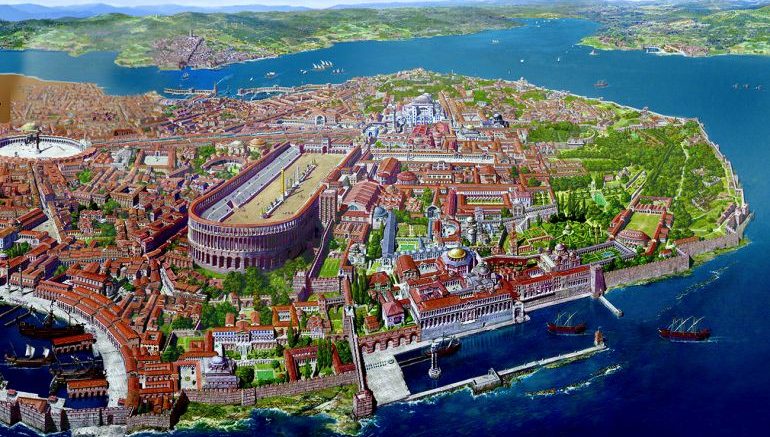
Constantinople during the Eastern Roman empire
But there was hope of better things. The Eastern Roman empire had survived the fall of Rome. It ruled the region of Greece, Turkey, Palestine and Egypt, incorporating a substantial part of the old empire. A new, dynamic emperor, Justinian, had taken the reigns, and he was set on re-establishing the old borders. Africa and Italy were being conquered, and for the first time in a century, Rome was again Roman. The Hagia Sophia was being constructed. A new future was just around the corner.
But that future never came. A decade later, Europe lay devastated, farm land fallow and cities abandoned. Instead of a renaissance, it was the onset of darkness. And it all started in the year 536.
The first inkling of the disaster came in March of that year. Michael the Syrian, a bishop writing in the twelfth century is one of our sources. He probably quoted John of Ephesos, an ecclesiastical historian of the sixth century, and describes the event as follows (quotes in this post are taken from Antti Arjava): “In the year 848 [536/37 CE] there was a sign in the sun the like of which had never been seen and reported before in the world. If we had not found it recorded in the majority of proved and credible writings and confirmed by trustworthy people, we would not have recorded it; for it is difficult to conceive. So it is said that the sun became dark and its darkness lasted for one and a half years, that is, eighteen months. Each day it shone for about four hours, and still this light was only a feeble shadow. Everyone declared that the sun would never recover its original light. The fruits did not ripen, and the wine tasted like sour grapes.”
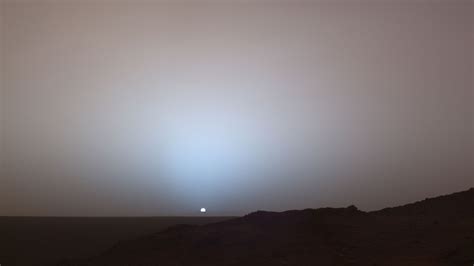
The principal historian of the age was Procopius. He came from Caesarea in Palestine, and as legal advisor accompanied general Belisarius who fought most of Justinian’s battles. (The two fell out later. Generals and reporters can be an unstable combination.) During 536 and 537 Procopius was with the armies in Africa and Italy. He wrote: “And it came about during this year that a most dread portent took place. For the sun gave forth its light without brightness, like the moon, during this whole year, and it seemed exceedingly like the sun in eclipse, for the beams it shed were not clear nor such as it is accustomed to shed. And from the time when this thing happened men were free neither from war nor pestilence nor any other thing leading to death. And it was the time when Justinian was in the tenth year of his reign [536/37].”
Several documents mention strange weather in 536 and 537. Cassiodorus, in Italy, comments after nearly a year of haze: “So we have had a winter without storms, spring without mildness, summer without heat.” Further east, things were different. In Mesopotamia, the winter of 536/537 was a bad one: “from the large and unwonted quantity of snow the birds perished.”
Another, unnamed Syriac chronicler writing probably later in the sixth century, adds earthquakes and storms: “And [Pope Agapetus] came with them to Constantinople in the month of March in the year fourteen [536]; and Severus was there and Anthemius was chief priest. And the whole city was disturbed at the arrival of Agapetus; and the earth with all that is upon it quaked; and the sun began to be darkened by day and the moon by night, while ocean was tumultuous with spray, from the 24th of March in this year till the 24th ofJune in the following year fifteen [537]. And Agapetus, when he appeared before the king, had a splendid reception from him.” No one else mentions earthquakes or storms, suggesting a fair amount of exaggeration or false facts. Not every ancient record is true!
Location
The same Syriac chronicler gives information on the extent of the haze. The text continues: “And this we have seen from the events themselves, when many wars broke out in the west and that tyranny was dissolved, while India, and the Persian realm, and whatever dry land lies toward the rising sun, were not troubled at all. And it was not even likely that those regions would be affected by the calamity because it was in Europe that the moisture in question evaporated and gathered into clouds dimming the light of the sun so that it did not come into our sight or pierce this dense substance.”
The passage suggests that Persia and India had not been affected by the haze. There is doubt whether China was affected. There is one mention from China which may indicate a haze, saying that Canopus could not be seen. This star is very low on the southern horizon in southern China (south of 38 degrees), and can only be seen during clear weather. But apart from this indirect indication, none of the Chinese documents mention a haze or powerless Sun.
This may be related to latitude. The haze was reported from locations above 35 to 40 degrees latitude. The areas that did not have the haze (Persia, India) are below approximately 35 degrees northern latitude, and this also includes most of China. The haze may thus have been confined to higher latitudes.
Famine
Michael the Syrian mentioned that fruit did not ripen in 536. Others also mention issues with food. Italy appears to have had a bad harvest, as Ravenna had to be supplied from the other side of the Adriatic which apparently had had a better harvest. John Lydos writing in Constantinople during the 540s, says “If the sun becomes dim because the air is dense from rising moisture – as happened in the course of the recently passed fourteenth indiction [535/36] for nearly a whole year, when Belisarios held the consular office, so that the produce was destroyed because of the bad time – it predicts heavy trouble in Europe.” (The reference to moisture should be discounted, as everything suggests that this was ‘dry fog’, i.e. a high altitude haze.) It mentions that produce was ‘destroyed’ – but does not state how.
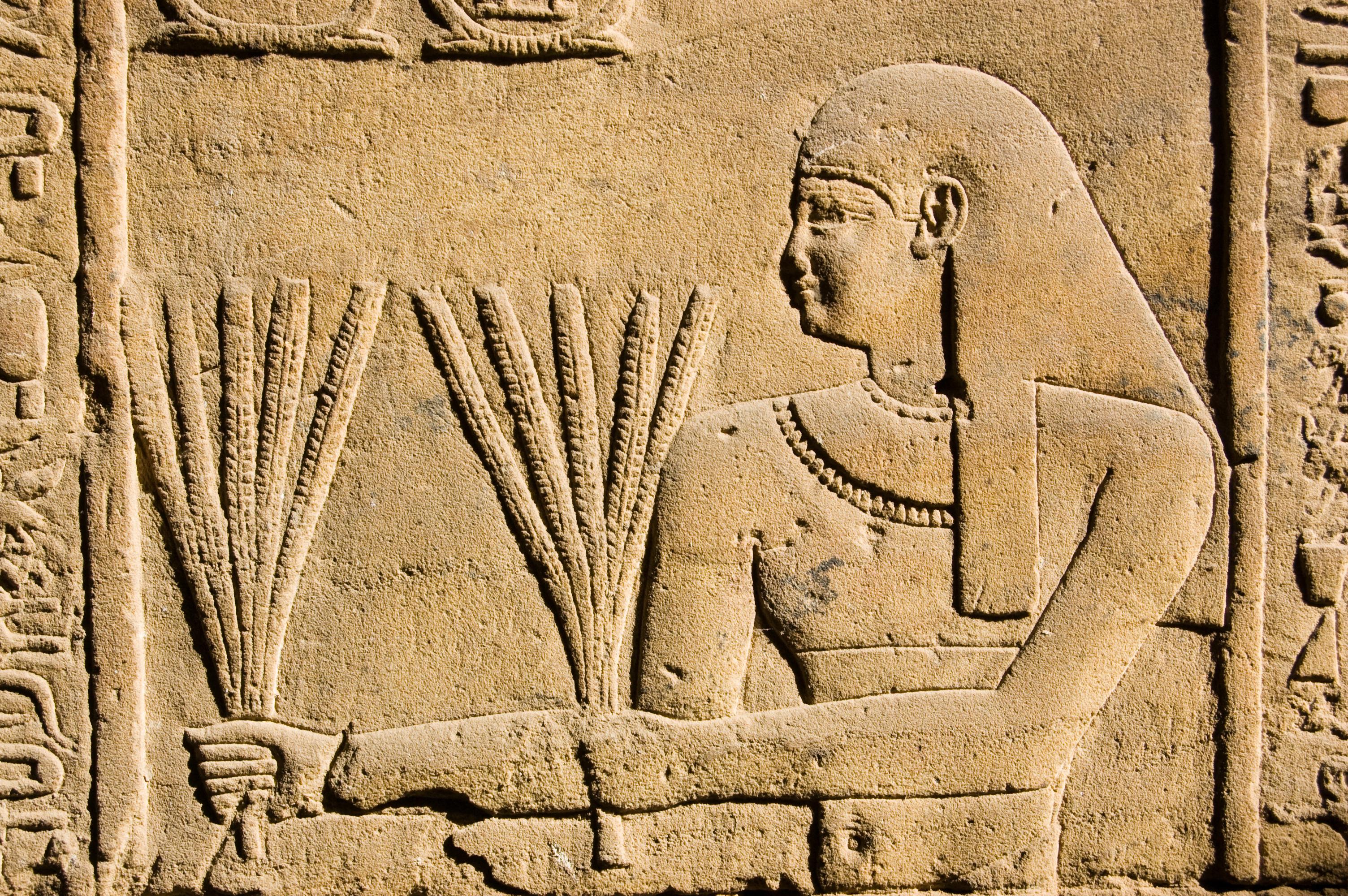
Priest carrying wheat. Temple of Horus, Edfu, Egypt.
Much of the grain in the empire came from Egypt. The lack of ripening of fruit suggests that the summer had been very cool, presumably because of the haze. However, this would not have affected the grain (and in fact cooler weather could have been beneficial). Photosynthesis may have been reduced by the haze, but we don’t know whether the dense haze had covered Egypt. However, food production in Egypt is mostly dependent on the availability of water. The Nile obtains its water from the monsoon in central Africa. This monsoon can fail after volcanic eruptions: both the Eldgja and Laki events caused low water levels in the Nile. But the reason for the ‘destruction’ of produce is conjecture. A little more scientific training of the writers could have helped a lot!
The problems in Italy became much worse. Northern and Central Italy, which remained under Ostrogoth control, had a severe famine in 538, with one report stating that 50,000 people died. It was attributed to the fact that the land had not been cultivated during the previous year. Whether this was due to the lingering haze or to the war between the Romans and Ostrogoths is not stated.
There were also problems elsewhere. Irish documents mention a ‘failure of bread’ in 536 and again in 539. The British Annales Cambriae refers to a death toll (‘mortality’) in Britain and Ireland in 537, but frustratingly does not give a cause. China appears to have been severely affected. Reports mention severe drought and dust storms, but also snow, hail and frost in southern China in the summers of 536 and 537. The Nanshi (“History of the South”) mentions what follows: “famine happened in 538, and the Imperial Court decided on the 30th of the January of the year, to implement an amnesty to the tax – cut to it’s 12 southern provinces where famines were observed, especially to those who were unable to pay the tax.” (translation taken from https://history.stackexchange.com/questions/51147/what-are-some-chinese-sources-testifying-the-extreme-weather-events-of-535-536-c) The drought appears to have started in 535, which if correct means it predated the haze. A worse famine ensued in northern China. One document gives the startling number of 70% to 80% mortality among the population of one area, and states that cannibalism occurred.
When studying extreme weather, it is important to check when it began. Documents tell of a severe drought in Persia in 536 (this would have been during the summer before the snowy winter). However, this drought started long before the haze. In the Levant, a very dry period began around 522, lasting several decades and which caused water shortages from Persia to Constantinople. Thus, there was environmental stress already well before the eruption. In the Roman empire, the quarter century 526-550 had the highest number of recorded famines for the entire period 100 BC to 800 AD, but these may not be all related to the 536 haze. The long-term drought may have been an important factor. Conflicts also do not help: wars and food production are an uneasy combination.
The haze exacerbated the effect of the drought, but by and large the Eastern Roman empire was well organized and could survive a few poor harvests. The worst famine happened in Ostrogoth Italy, perhaps because the people there had little access to food resources elsewhere. The British isles were somewhat affected. China may also have suffered from a lack of organized food distribution. This was the time when the Northern and Southern Dynasties were in perpetual civil wars. The elite had better things to do than providing food.
What happened elsewhere in the world is not well known, due to a lack of written sources. To know more, we needed to look into other, non-written records. And the results of those investigations were much worse than what had been expected. This really was an apocalypse.
Of ice and trees
A good way to study the past is by using ice cores. These are obtained from glaciers: every year a new layer of ice forms from compacted snow, and these layers can be recognized and counted as if they were tree rings. Find a deep enough glacier, and the record can go back a long time. And the icecaps of Greenland and Antarctica are very deep indeed.
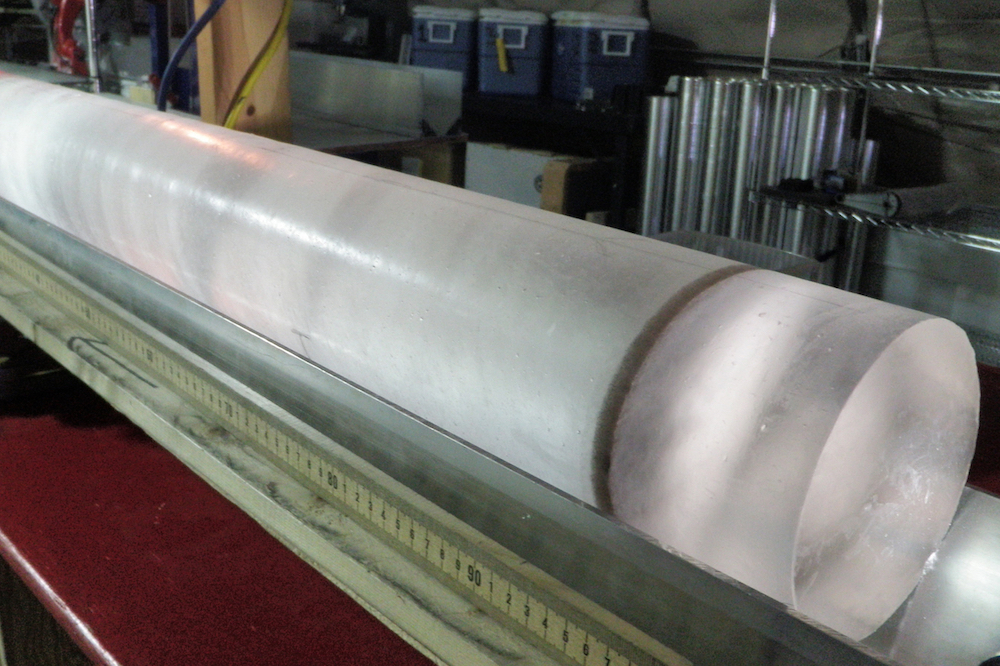
Ice core from Antarctica, with a dark layer of volcanic ash
The ice is very good at providing evidence for old volcanic eruptions. In the best case, an annual layer in an ice core contains tephra particles which signify an eruption and which allows the specific volcano and year of eruption to be identified. This is rare, because tephra tends not to travel far. More commonly, the eruption is indicated by sulphate. The amount of sulphate in the ice core depends on the size and sulphur content of the eruption, and on the distance from the glacier.
Exact timing of the eruptions has proven somewhat difficult. The annual layers can be thin and difficult to recognize. Counting errors add up, and past a millennium can easily reach 5-10 years. Luckily, it can be calibrated using a second record of the past: tree rings. These are easily counted; the science of counting rings is called dendrochronology. By combining different tree-ring records, an accurate timing has been reached going back several millennia. The width of the rings indicate how grow-some the weather was in that year. In a bad year, there may also be frost damage inside the ring, if a hard frost occured during the growing season. And occasionally, the wood contains other indicators. Twice in the past 2000 years there was a spike in the amount of beryllium in the atmosphere, possibly due to massive solar flares. The beryllium layers can be identified both in the trees and in the ice, and can be used to bring the two in line with each other.
The plot below shows the ice core and tree ring record for the period around the year 536. The top panel show the Greenland ice core, and the bottom panel the Antarctica ice core. The middle panel shows the tree rings, where green indicates the relative width of the ring and orange the change in summer temperature indicated by the tree rings. The top panel shows an impressive spike in the year 536. It was indeed an eruption. But where?
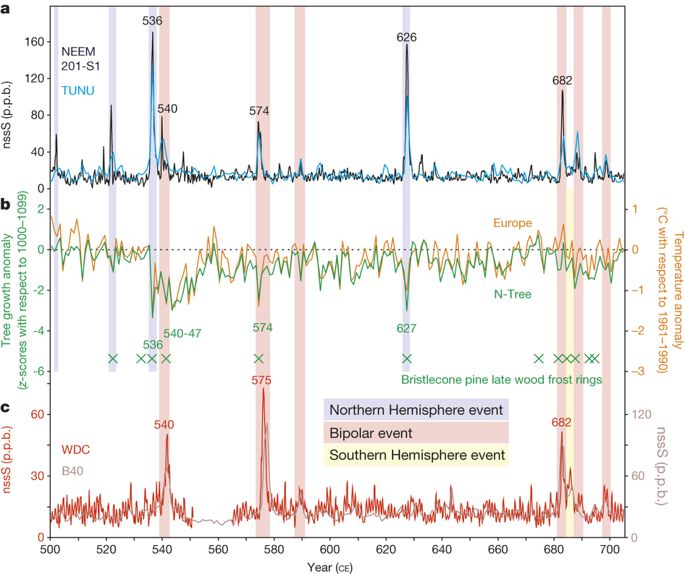
Helpfully, volcanic ejecta have difficulty crossing the equator. Northern eruptions tend not to spread to the southern hemisphere and vice versa. Tropical eruptions, on the other hand, pollute both hemisphere. Therefore, comparing Greenland and Antarctic ice cores allows one to see where an eruption happened. A sulphate spike seen only in Greenland is normally from a volcanic eruption in the northern hemisphere. One present with comparable strength in both ice cores is from a tropical eruption. The spike in 536 was present only in the Greenland ice. This means that the eruption happened somewhere in the northern hemisphere, and not in the tropics.
But on closer look, both ice cores showed a second spike in AD 540. Apparently, two volcanoes were involved, a northern one in 536, and a tropical one in 540. And that was a surprise.
The European (Irish and Scandinavian) tree rings provided further information. A sharp temperature drop was apparent in 536, followed by an incomplete recovery. A second drop occurred in 540, and now the recovery was extremely slow: only by 550 were the trees back to normal. Clearly, the second eruption had had a major impact in Europe. But this had not been apparent from any of the written documents. Something was missing.
Micheal Sigl et al (2015) rank the eruptions of the past 2500 years in terms of total amount of sulphate, converted to something called ‘global forcing’. That is a number that indicates how much of the power in sunlight is intercepted by the sulphate layer. The Sun provides us with 1000 Watt per square meter (assuming that it is directly overhead). The top-ranked eruption was in the year 426 BC, from an unknown volcano: it reduced global sunlight by 35.6 Watt per square meter. On this list, the 536 event is number 18, and the 540 eruption is number 5. If they had happened simultaneously, it would have ranked as number 3, after the -426 eruption and Samalas in 1257.
(In case anyone asks: Laki is included, and it ranks as number 8. The eruption at -44 is now attributed to Okmok.)

The local impact on Europe may be very different from the global effect listed in the table. Regarding temperature drop in Europe (last numeric column), the 536 eruption is the top dog, and the 540 eruption ranks number 4, just after Tambora.
So Europe -and the world- was hit by a double whammy, which together made for one of the worst volcanic events of the past 2500 years – for Europe, possibly the worst one. That agrees with the tree ring record in which this decade is the coldest in the northern hemisphere over the entire period. The evidence is seen in trees at every northern continent: this was not just limited to Europe or the Atlantic area (as for Laki) but affect a much wider area. The time around this decade is sometimes known as the LALIA: the Late Antique Little Ice Age which covers roughly the 6th century. But this decade was the core of it, and possibly the only part. It is not clear that without this decade, the century would have qualified for such a term, even if there was increasing drought already before 530.

Number of sites across the northern hemisphere showing different types of tree ring damage. Any year will have some poor weather somewhere, but in 536 that damage was everywhere, and it continued for a decade. Source: Buntgen et al 2022, Science Bulletin 67, 2336
It leaves several questions. Which volcanoes were responsible for the coldest decade? Why is the 536 eruption clear from the documents while the 540 eruption seems to have gone unnoticed? Were there effects elsewhere in the world? The answer to the second question turned out to be sobering: the disaster was clear to see – we just hadn’t connected it to a volcanic eruption.
Volcanic suspects
Before accusing particular volcanoes, we first need to put to rest two widely reported myths. The first of these came from a book by David Keys who claimed that a large eruption had taken place at Krakatoa in 536. There are severe problems with this claim: the Java myths which he based it on give a date which is a century off, and do not clearly refer to Krakatoa; there is also no local evidence for any such eruption. In all likelihood, this never happened. (Krakatoa is also in the wrong place for a northern hemisphere eruption)
Mike Baillie, famous for his research on tree rings, for a while moved away from a volcanic cause for the 536 event. This was because originally the timeline for the ice cores did not match up with the tree ring chronology, leaving no obvious volcanic candidate. He argued that an impact with a comet could have caused the event. There are many problems with this idea, and the mismatch was eventually solved by a better ice core chronology. (If you are interested: you need a large comet to supply enough sulphur; I estimated 5 km diameter. Something that size will punch through the atmosphere, hit the ground and leave all kinds of hints – such as, where have all the dinosaurs mammals gone, and why do we suddenly have a 100-km crater in Mexico? Stratospheric sulphate would be far from the only urgent problem.) Baillie (now retired) went back to favouring a volcanic cause. The comet has gone away (they always do) – but as with Krakatoa, the story still surfaces regularly. Myths can be long-lasting.
But let’s go back to the real world. Which volcanoes were to blame?
There is strong evidence that there were two eruptions in short succession from both the ice cores and the tree rings. The first eruption shows up only in the northern hemisphere. The reports of haze all come from further north than 35 degrees. Further south, including much of China, the skies were apparently clearer. The tree rings which show the poor weather of 537 are also from high northerly latitudes, 50-70 degrees. Finally, although the haze was problematic and caused food shortages, there are no reports of unsurmountable problems for the Roman empire with its access to Egyptian grain. It all points at an eruption at mid to high latitude, badly affecting northern regions. The haze first appeared on March 24, 536, suggesting that the eruption happened (or started) around the ides of March. However, the tree ring damage began later in the years, after the spring growth. That may either indicate an eruption closer to summer, or it may be because the temperatures took a while to be affected by the haze.
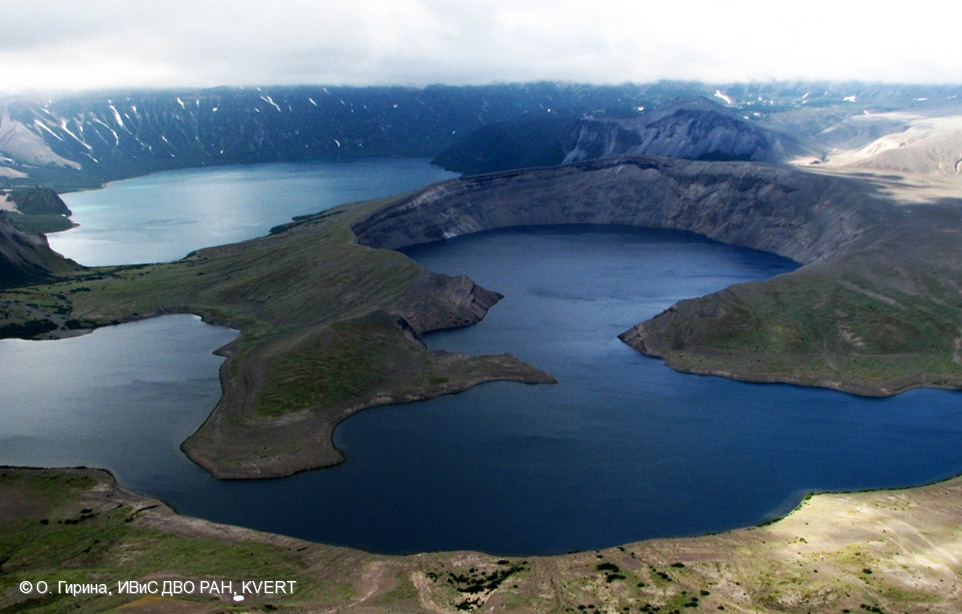
Ksudach
In 2018, a few tephra fragments with an Icelandic signature were found in ice cores from a glacier in the Alps, but again without a specific volcano attached. But Iceland has been ruled out for the main event: a huge explosive eruption in Iceland which could cause stratospheric sulphate for over a year would leave plenty of signs all over Iceland – nothing has been found. An effusive eruption would not put sulphates high enough to reach Constantinople (Laki did not manage this) and again, there would be a huge and obvious lava field somewhere. Iceland frequently explodes, and the Alpine tephra could easily come from other, unrelated Icelandic eruptions.
A Pacific-ring volcano appears most likely. On the map, the eye is quickly drawn to Alaska and its arc of Aleutian islands. Is one of its islands perhaps missing? The White River Ash (Mount Churchill) has an alibi: it comes from two eruptions, one around 840 and one around 60, which are not consistent with 536. Which is a pity, because the size of the eruptions would fit the occasion: the ash even reached Europe. Perhaps its alibi is false, and a large eruption in between is hiding in the data? Or was the eruption on the other side, in Kamchatka or the Kuriles? The largest caldera-forming explosion there is dated 1650-1900 BP which almost fits: Ksudach caldera V, the second largest known caldera event in Kamchatka during the Holocene. Tephra from this explosion has been found in North America. But it is estimated at ‘only’ 20 km3 of tephra: it seems a bit small and a bit too early for the 536 event. Opala, nearby, had a significant eruption around 600 AD, where the eruption column reached 20 km, but the 10 km3 of tephra seems rather small to explain the events of 536. No other smoking gun has yet been found, and neither Japan, Kamchatka or North America show other significant tephra deposits around this time. The discussion is not over, but Ksudach, Opala and Churchill might all be worth another look. Otherwise, the lack of a clear ash layer suggests that we should be looking at an isolated island volcano, in which case the Aleutians and the Kuriles are the most likely regions.

Opala volcano Source: https://www.kamchatsky-krai.ru/fotografii-kamchatki/opala/88-96.htm
We could also look at the Azores. It has frequent eruptions: about one every 20 years. (The last one was more than 25 years ago. I just mention it.) The events there can reach VEI6, and the Azores are well placed to affect the Mediterranean. Recently it has been suggested that some of the tephra in European peat bogs that was attributed to Jan Mayen in reality comes from the Azores. But again, a smoking gun is lacking and this should have been obvious.

The caldera lake of ilopango
The second eruption, in 540, affected both hemispheres and must have been a tropical eruption. And it was a serious eruption, which deposited 10% more sulphate in the ice than Tambora managed. Tree rings narrowed worldwide and temperatures appear to have dropped significantly, with several very cold years. The southern hemisphere was less affected than the north: this may be because it has more ocean to moderate temperatures, or because in the north it came on the heels of the 536 eruption. There are no reports of haze. El Chichon has been suggested, but although it may have had an eruption at approximately the right time, there is no evidence for anything on the scale of Tambora. Taal too has been suggested in the popular media, but the evidence for an eruption at this time is rather slim (to non-existent, really). Pago in PNG might be possible: it has frequent large eruptions and had two major ones around this time, although neither has been dated to this specific time. Rabaul, Hankow Reef and Bismarck have also been mentioned but perhaps more out of desperation than based on actual evidence.
The one that got away
In 2010, a strong candidate for the 540 eruption was identified: Ilopango, the largest lake of El Salvador, up to 13 by 17 km across and 70 km2 in area, surrounded by cliffs up to 500 meter high. The beauty is bewitching, but this is the dangerous beauty of Cleopatra. This beauty hosted the largest explosion in El Salvador. The lake is a water-filled silicic collapse caldera. It is located in a pull-away graben, something it has in common with Toba. Just the water volume of the lake alone (12 km3) shows that this was not a minor event, and of course the actual explosion would have been much larger. The area is surrounded by a thick white ignimbrite, up to 30 meters thick, which extends into neighbouring countries. Most of the tephra went south and south-east. The eruption had been dated to 240 AD, until Dull et al, in 2010, measured a carbon-14 date of a charcoaled tree trunk buried underneath a pyroclastic flow, and improved the date to within the period 450-545 AD. Although not quite accurate enough for a secure identification, it made Ilopango the plausible source for the 540 eruption. Dull et al claimed it as the source of the 536 eruption, but it is too far south for that.
The volume of the eruption is estimated at 84 km3 of tephra, or a high VEI6. At 15 degrees north, it fits the requirement for a tropical eruption and an eruption this size would have affected both hemispheres. Central American volcanoes have typically a high sulphur content of 1000 ppm or more. This means Ilopango can have had 40% more sulphate than Tambora, even though it was a smaller eruption.
Ilopango is a repeat offender. The oldest dated eruption occurred 1.7 million years ago. Since that time it has exploded regularly, including three events in the past 57,000 years. The largest event produced over 100 km3 of tephra. It should now be safe for quite some time (there was a minor eruption in 1880) but one may wonder about the wisdom to build the capital, San Salvador, only 10 kilometers from the caldera.
But this identification was quickly ruled out again. Ice core dating for tephra found in Greenland indicates that this major eruption happened in 431+-2, over a century too early. The local archaeology support this early date. The 2021 paper by Victoria Smith et al. (https://www.pnas.org/doi/10.1073/pnas.2003008117) removed our best candidate. This left us with two major unknown eruptions. Somewhere, the true scars must still be hiding.
This causes a bit of a conundrum. When dated to 540, Ilopango was seen as having a significant climate impact. But when dated to 431, it does not seem to have caused much cooling in spite of its large size. There is a lot of interest at the moment in explaining why similar volcanoes can have such different impacts. The amount of sulphate is a major part: when dated to 431, Ilopango becomes much less sulphate-intense. The double-whammy may also be important: large volcanoes within 7 years seem to have caused more severe climate impacts, perhaps because the second event happens in a pre-cooled world.
Impact of the 540 eruption

Isopach for the Ilopango tephra

Area of demographic collapse following the TBJ eruption (red line) Source: Dull et al. 2010
The 540 event coincided with significant upheaval in Central America. The Maya were a very long-lasting civilization who clearly knew how to survive and prosper in their rain forest environment. Over 2000 years of history, their empire showed several collapses and set-backs. This included a century-long interruption from around 550, when building work ceased and some cities were abandoned. Tikal, the main Maya city of the time, was defeated and suffered significant damage. The period is called the Maya Hiatus, and its start is shortly after the 540 eruption. The Maya civilization overall was less affected, and eventually there was a full recovery, although in El Salvador (badly affected by Ilopango a century earlier) it took decades to centuries before a few sites became re-occupied. The Mayan had bigger set-backs at other times, which are thought to be drought-related. But the Hiatus may have been triggered by environmental stress caused by the mystery eruptions.
Teotihuacán, near modern Mexico city, was the largest city in Central America, with a population in excess of 100,000. It was one of the wonders of the ancient world. If you ever have the chance, do visit – but be careful with what you buy from the street vendors. The city was burned and abandoned around 550, apparently by its own people as there is no sign of any invasion. This is a far more significant event than the Maya Hiatus: Teotihuacán, the most powerful city in all of the Americas, became abandoned and was forgotten. There is a strong case for major upheaval in the area and the 540 eruption is a major suspect. But without strong evidence that the eruption was in this area, the relation would have been in the long-distance effects. The cold (dry?) climate of the decade may have played a role in the upheaval, rather than the proximity to the eruption.
Elsewhere, we have Chinese reports of events in this period. “the extraordinarily strange climate continued, finally the Emperor declared on November 541: Applying the Road Of Heaven in order to share the benefit of the earth’ is the old proverb by sages. Except for the lands for the Imperial Household, let us give all the abandoned lands and mulberry fields and houses to the poor. We will look into the labor power of these poor, and in accordance with it, let’s give them the appropriate size of arable lands.” The famines in southern China worsened throughout the 540’s.
Let’s return to Europe. There is no indication that the weather in the Eastern Roman empire was particularly bad during 540, and no haze was reported apart from an unclear mention of ‘poisonous air’ related to the coming epidemic. If there was haze, it is likely to have been much less strong over the Mediterranean than it was in 536. But the lack of reports may in part be due to other reasons: few personal records were written during the catastrophe that unfolded in the 540’s, and those discussed more urgent events. The medieval historian Roger Wendover describes that in 540/541 there was “a comet seen in Gaul so vast that the whole sky seemed to be on fire”. That can’t have been a comet (which would have been in many manuscripts of the time), but perhaps is the 540 eruption, with Krakatoa-like skies. But the veracity of the claim is rather unclear.

Tree rings at high time resolution. Source: Mike Baillie, 2015.
If instead we trust in tree rings, the impact of the 540 eruption is very clear. The tree rings show that there was a pronounced dip in temperature in 536 when the climate cooled by as much as 3 degrees for Scandinavia and Siberia, and is estimated at -1.4 oC over the entire northern hemisphere. Trees across the northern hemisphere show the impacts with frost rings and other evidence for damage. The temperature mostly recovered over the next three years, but in 540/541 there was another drop, again to 2-3 degrees below normal. This dip lasted 10 years. Note that the recovery in 542 may have been real but it may also be due to inherent year-on-year fluctuations in the data.
The old Scandinavian literature contains the concept of the Fimbulwinter. It comes from the Prose Edda, written up in the 13the century but based on older oral traditions. The story is that of a winter lasting for several years: “a winter will come called Fimbulwinter. Then snow will drift from all directions. There will then be great frosts and keen winds. The sun will do no good. There will be three of these winters together and no summer“. A similar tradition exists in the Finish Kalevala. There is discussion whether this is based on a real event: if so, the period 536-545 is by some distance the best candidate, when both eruptions are considered. The 536 event by itself was rather brief to account for the three-year Fimbulwinter. (In the Finnish Kalevala, the winter even lasted a full decade.) But the two together may fit.
Why did the temperature continue to decline for years after the 540 eruption? Stratospheric sulphate lasts at most 3 years before it has all returned to the ground, and over this time the depth of the haze steadily reduces. Tambora caused one particularly cold year. We can speculate that the double eruption caused the cold period to last long enough to cool the Atlantic ocean, which could have prolonged the cold spell. Separately, the eruptions were large but perhaps not exceptionally so. Together they caused the coldest decade in the northern hemisphere over 2000 years, with a cooling that was 50% larger than that of the double eruption of 1809 (unknown) and 1815 (Tambora). Globally, the decade was ‘only’ the third coldest. The northern hemisphere was hit hardest.
Models
The 536 sulphate haze was obvious for a full year. Models show that for the sulphate to remain aloft such a long time, the explosion must have reached a height of about 25 km. The plot (from Toohey et al. 2016) shows the predicted reduction in strength of sunlight at the latitude of Constantinople. The 30hPa line corresponds to about 25 km altitude; the other two are lower. The amount of sulphate that was used is consistent with the ice core data. Shortly after the eruption, sun light was down by 65%, and even by the end of the year it was still down by 33%. Above 60 degrees latitude the reduction was even a bit worse. The models suggest that the impact of 540 eruption would have been similar, making the lack of written records surprising but explaining the strong tree-ring signal.

The effect on summer and winter temperatures is shown in the next plot, taken from the same paper. The colours show the average effect over the decade. The very large anomaly over part of the Arctic ocean is because of the expansion of sea ice, which in the simulations almost reaches Iceland. It is possible that in later years, the melting of this newly formed ice cooled the Atlantic ocean, and caused cooling up to 550.

The temperature drop in Northern Europe was severe. This had consequences. Both Finland and Sweden suffered a population crash around this time with many settlements disappearing. Eastern central Sweden was partly abandoned, and according to one estimate, the population of Scandinavia halved. (Other estimates put the decline as less.) The cold weather is a possible cause. In high-latitude climates, farmers are normally resilient against a severe winter. (The main issue may be access to water.) Cities can be a bit more affected, especially if snow and ice prevent supplies from reaching them. Later in the Middle Ages, things became worse, and cities could quickly run out of food in bad winters. A critical point was bread: this required the water mills to run, in order to grind the grain. If the rivers were frozen, the mills stopped – and soon there was no more bread. But farming communities tended to store sufficient food to last the winter and spring.
A cold summer was a much bigger problem. That meant that less food could be grown, and winter supplies might run out. Such a summer may have put an end to the Viking settlements on Greenland. Several cold summers in a row could be disastrous. Was this what happened? There are also suggestions that the poor summers allowed a fungus, to infect the rye and barley. The fungus, Claviceps pupurea, causes food poisoning, potentially fatal, to people and animals. On the island of Gotland, off the Swedish coast, the settlements were burned by invaders. Were the invaders starving farmers from the main land? They didn’t settle: the island became temporarily abandoned. Norway also showed a population decline at this time, with a 75% decline in burials in southern Norway. There may have been population crashes also in Germany and the Netherlands, but very little is known about this.
But whether these changes were caused by the eruptions is difficult to assess, and the declines may also have occurred over a longer period. Archaeology rarely gives exact dates. Disasters often have more than one cause, and the impacts can play out over many years. The worldwide evidence for upheaval in the mid-6th century is consistent across different continents, which argues for a common cause, but that does not rule that other, more local causes, played a role.
And there were other horsemen about.
The Justinian plague
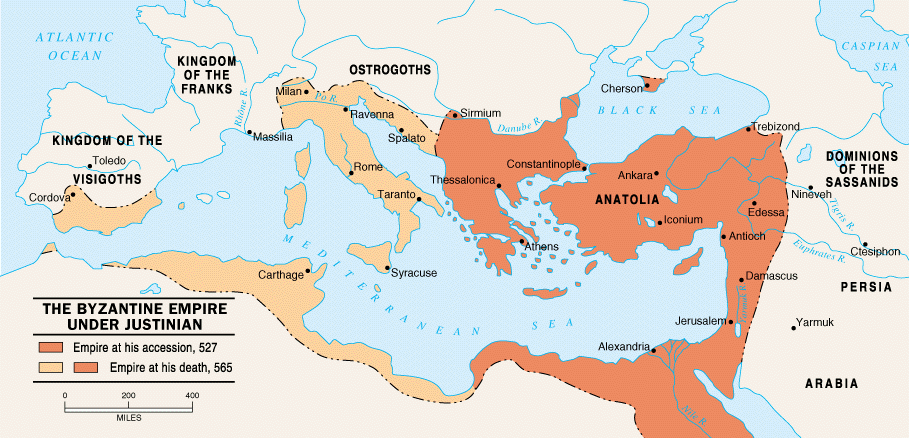
Justinian was among the greatest emperors of the Roman empire. He took power in 527 AD. At the time, the Western Roman empire was long lost, and the Eastern empire was fighting a war of attrition with the Persian empire. Justinian managed to buy off the Persian empire, albeit at considerable cost: 11000 gold pounds each year. That freed up the army, and he began to expand into the Mediterranean. Carthage in North Africa fell in 534, in a battle that ended the Vandals as a major power. The re-invigorated Roman armies invaded Italy in 535 AD and quickly took Naples and Rome from the Ostrogoths. The Ostrogoth armies came back and besieged Rome for a full year, but the Romans managed to hold the city and in 538 the Goths retreated. By 540, much of the Italian peninsula was back under Roman control. The empire was well and truly being re-established, with its new capital in Constantinople.
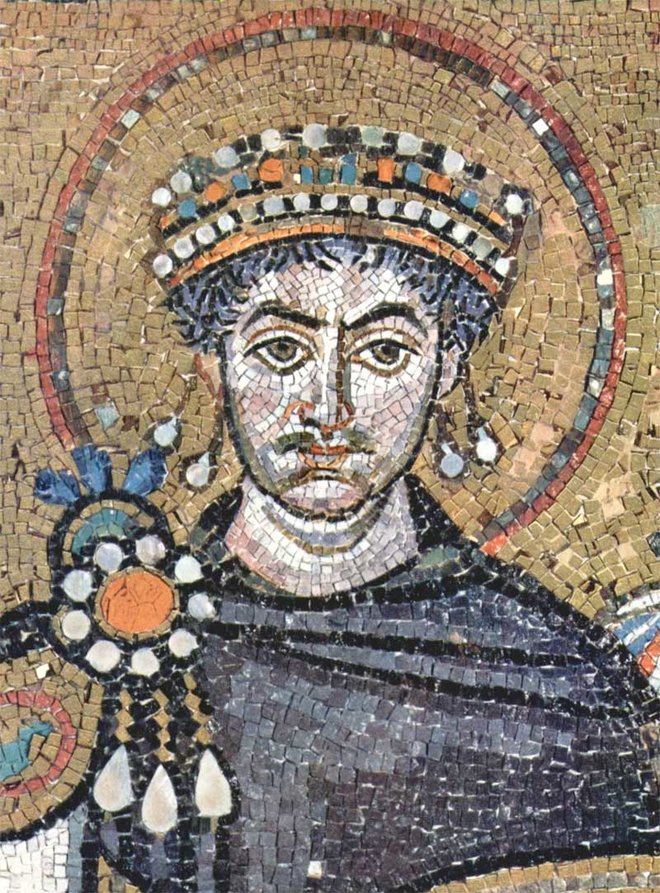
Justinian I
It is interesting to guess what might have happened. On the one hand, the warring parties were evenly matched and Justinian would have had to commit many more troops to gain a lasting conquest, as he had done in North Africa. The invasion seemed half-hearted. On the other hand, if successful and perhaps in alliance with the Goths, a large Mediterranean power could have given stability and a critical mass for technological progress. Civilization could have skipped many hundreds of years, directly into the world of the late Middle Ages. It was not to be.
The apocalypse started in 541 when a new disease appeared in Egypt. One report states that it had originated in Ethiopia, but this must be considered doubtful: it was common to blame Ethiopia for mishaps. Procopius tells the story:
“It began with the Egyptians who live in Pelusium. It divided and part went to Alexandria and the rest of Egypt, and part to the people of Palestine, the neighbours of the Egyptians, and from there overran the whole earth. This disease always began from the coast and then moved up to the country inland. The plague lasted in Byzantium [Constantinople] for four months and was at its peak for about three. At the beginning not many more people died than usual, then the disaster grew greater, and finally the number of dead reached five thousand a day, and then attained ten thousand and even more than this.”
The numbers may be overstated, but the death toll is believed to have exceeded 250,000, out of a population of 500,000. The effect was devastating:
“At that time it was not easy to see anyone in Byzantium out of doors; all those who were in health sat at home either tending to the sick or mourning the dead. If one did manage to see a man actually going out, he would be burying one of the dead. All work slackened; craftsmen abandoned all their crafts and every task which any man had in hand.”
The disease moved on, but became endemic in the Mediterranean and eventually returned to the city in 558 AD. Agathius wrote:
“During that year at the beginning of spring a second outbreak of plague swept the capital, destroying a vast number of people. From the fifteenth year of the reign of the Emperor Justinian when the plague first spread to our part of the world it had never really stopped, but had simply moved from one place to another, giving in this way something of a respite to those who had survived its ravages. It now returned to Constantinople almost as though it [had] been cheated on the first occasion into a needlessly hasty departure. People died in great numbers as though seized by a violent and sudden attack of apoplexy. Those who stood up to the disease longest barely lasted five days. People of all ages were struck down indiscriminately, but the heaviest toll was among the young and vigorous and especially among the men.”
The disease started with a fever, and within a day progressed to the classical plague symptoms. It became so bad that people reportedly started wearing name tags when going out, so that if they died suddenly they would not be buried anonymously. Constantinople may have lost 40% to 60% of its inhabitants. The empire overall is said to have lost 10 million people. The total population of the empire was around 25 million; it implies a mortality rate similar to the Black Death. Farming was badly affected, with many farms empty and abandoned. Famines followed in 542, 545, and 546.
The plague had significant impacts. New wars broke out with Persia, and the man power to fight three fronts (including North Africa) was no longer available. Much of Italy had to be given up, until the Persians (whose armies were also being decimated) could be bought off again. After 550, new armies were send and Italy was conquered again, against an equally depleted Ostrogoth army. A successful incursion was made into Spain. Now the Eastern Roman empire reached its greatest extent. But the armies were much smaller, and largely consisted of mercenaries. Agathius wrote “whereas there should have been a total effective fighting force of six hundred and forty-five thousand men, the number had dropped during this period to barely one hundred and fifty thousand.” There were not enough people left to keep control of such a large empire. The economy had also become impoverished. Gold coins after 540 contained much less gold than those minted before. In 568, Italy was invaded by the Lombards and Roman control of the area crumbled.
If the plague hadn’t come, it seems possible that the Roman empire would again have controlled the entire Mediterranean, and possibly Central Europe as well. That was no longer possible. Instead the empire began its slow contraction to its eventual demise, nearly a millennium later.
What was this disease? The symptoms were those of bubonic plague, Yersinia Pestis. This identification has been challenged, mainly because there were some symptoms which were not present in the later plague epidemics, and because it started in Africa rather than Asia. However, DNA fragments found in graves point at bubonic plague. The plague originally came from China and it may first have spread with the westward migration of the Huns, establishing itself in the area. A different strain of this bacterium would later cause the Black Death, and a third variety caused the 1894 Asian epidemic.
Over the next 200 years there were a number of outbreaks, until the disease finally disappeared around the year 750. The overall death toll over those 200 years is estimated as between 50 and 100 million. This was at a time when the world population was perhaps 300 million.
What caused the sudden spread? The plague is carried by the fleas on rats, but can possibly also be transmitted through human fleas, person to person. The bacterium makes the fleas ravenous; flea bites now infect the next victim. The plague quickly became a disease of the poor. Both in 540 and in 1347, the plague followed a major volcanic eruption. In 1347, the disease spread from the Crimea, where poor, wet and cold weather was the trigger, perhaps causing rats to invade the food stores which were shipped around. In 540, the food came from Egypt with a very different climate. One paper proposes that the exceptionally cool summer benefited the Egyptian rats, and allowed their numbers to explode. Something allowed plague-carrying rats to get into the grain storage. The fact that the disease always started at the coast shows that ships carried the rats, probably as part of the grain transport. In times of shortage, there may have been pressure to ship as much food at as fast a pace as possible. Fast food can be a killer.
It has been suggested that a deficiency of vitamin D, caused by the lack of sun, made the population vulnerable to the plague. This does not fit well with the dates, as the sunless year was several years before the epidemic. If 540 too was a year of haze, this was not recorded.
The plague spread beyond the Eastern Roman empire. Much less is known about this, because of the lack of local written records after the retreat of the first Roman empire. Archaeology has found that skeletons in an early medieval cemetery in Aschheim, Bavaria contained DNA from Y. Pestinus. The disease had either managed to cross the Alps or spread independently to here. The DNA also showed that although it was first recorded in Africa, the 541 plague, like the 1345 and 1894 epidemics, had its origins in Asia. Similar evidence was found in France, where Gregory of Tours reported that plague was raging by 543, noting “soon no coffins or biers were left. 6 or more were buried in one grave.”
Much less is known about the spread of the plague elsewhere in Europe. The best documentation exists for Ireland, albeit written down some 50 years after the events. The 6th century Irish invented their own word for the disease: blefed. The Annals of Tigernach mention ‘a great mortality, which is called blefed’ and which according the the Annals of Ulster arrived in 545. Nearby, Maelgwn, king of Gwynedd in Wales, was said to have died of the “Yellow Plague of Rhos” around 547. The lack of written records in Britain makes it hard to know whether the plague reached here. (There is a written history by Gildas, dated to 540, but his story is in poor agreement with what we know from other sources.) However, there is indirect evidence that there were significant changes, at the end of so-called ‘sub-Roman Britain’ (the period after the Romans had left but before the Anglo-Saxons became the dominant power). Whether this was due to famine or plague is not known. By 540 AD, romanized Britains remained in power in the centre, west and north, and Saxons held power in the southeast, up to York and Bournemouth. This stable situation collapsed in the next few years, and by 550 the AngloSaxon expansion resumed. The important Roman town of Calleva Atrebatum (in Hampshire) disappeared around or shortly after 550.
The de-peopling of Scandinavia may have been due to either famine or plague. The former is perhaps more likely. Plague-carrying fleas need temperatures of at least 10-15 C, and this would only have been reached in summer, and possibly not at all during the decadal temperature minimum.
A word of caution is needed here. It is always hard to proof exactly what happened when and why. For much of the world, we lack written documents. Archaeology rarely gives dates accurate to a decade. In Britain, we know that the cities changed and declined after the Romans left, but we don’t know exactly when they were finally abandoned. The Anglo-Saxons knew the Roman cities – they build new settlements a few kilometers away. The suggestions that the events after 536 fatally weakened the remaining cities is plausible but can not be proven. In America, it is not possible to proof a link between events such as the fall of Teotihuacán and the eruptions even though it seems likely. More research is needed – especially further candidates for the two eruptions would be useful. The strongest case for catastrophe outside of the Roman Empire comes for the tree ring record. This really was a period with exceptionally cold weather. No country survives well under a lack of food. And where we have a good written record, we know that this decade was apocalyptic (Roman empire) or highly damaging (China). The fact that the timing approximately coincides with significant changes elsewhere makes it plausible that other places were also badly affected.
Understanding the past is like Plato’s prisoners in the cave, who can only see shadows on the wall and from that have to infer what is happening outside. But here, the shadows seem terrifying.
The four horsemen
Ten years after the Roman empire reached its greatest promise, its future had been lost. And the catastrophe went further, encompassing China, Mexico and Scandinavia. Perhaps 10% of the world population died. The apocalypse came swiftly, unexpectedly, and without anyone knowing where it came from. Either of the two eruptions would have been survivable. The combination of the two left the world vulnerable. The four horsemen saw their chance and rode out: famine, war, plague and death attacked and destroyed the weakened civilizations.
This is how the Dark Ages began. One disaster was manageable. Two simultaneous disasters became a catastrophe. And the third disaster truly brought apocalypse.
Albert Zijlstra, March 2019, updated October 2026
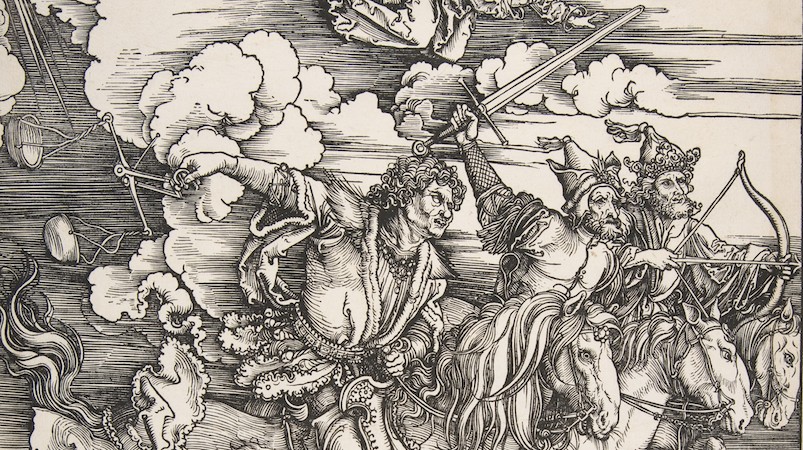
part of Four Horsemen. Albrecht Duerer, 1498
Many articles can be found on these events, although few tell the full story. Scientific papers can be harder to locate. Here are some of the papers I used for writing this post.
Michael Sigl et al., Nature, 543–549 (2015): Timing and climate forcing of volcanic eruptions for the past 2,500 years
Joshua North, Armstrong Undergraduate Journal of History, 3, no. 1 (Jan. 2013): The Death Toll of Justinian’s Plague and Its Effect on the Byzantine Empire https://www.armstrong.edu/history-journal/history-journal-the-death-toll-of-justinians-plague-and-its-effects-on-the
Antti Arjava: Dumbarton Oaks Papers, Vol. 59 (2005), pp. 73-94: The Mystery Cloud of 536 CE in the Mediterranean Sources
Bo Gräslund and Neil Price, 2012, Antiquity, 86, p 428-443: Twilight of the gods? The ‘dust veil event’ of AD 536 in critical perspective
Matthew Tooney et al, Climatic Change (2016) 136:401–412: Climatic and societal impacts of a volcanic double event at the dawn of the Middle Ages
Mischa Meier, Early Medieval Europe 2016 24 (3) 267–292: The ‘Justinianic Plague’: the economic consequences of the pandemic in the eastern Roman empire and its cultural and religious effects
Ulf Büntgen et al, Science Bulletin (2022) 67, 2344: Global wood anatomical perspective on the onset of the Late Antique Little Ice Age (LALIA) in the mid-6th century CE
Eirini Anagnostou et al, Boreas (2025) 54, 1: The AD 536/540 climate event in Sweden – a review<
And some Volcanocafe posts related to this topic
When eruptions make a difference
The Maya collapse: a history in three volcanoes
The Mayas and their lack of volcanoes


This post was first published in March 2019, just 8 months before the likely start of Covid. I just mention it
A recent study suggested that 536 did 3 C of land cooling.
https://egusphere.copernicus.org/preprints/2026/egusphere-2026-1636/
I am not really qualified to scrutinize the methodology of it but it does pose some interesting questions
I know the area is remote, but I find it unusual that we don’t know of large tephra deposits in the Aleutians or the Kuriles that could point to the 536 eruption. Has the ocean perhaps washed away large swaths of evidence?
There are a few ways to hide big deposits. One is in the ocean. For instance, the tephra and other flows of Hunga Tonga, a decent-size eruption, are almost entirely in the ocean and will be difficult (though not impossible) to recognize in the future, and even more difficult to accurately date. Okmok is another example: large enough to change the climate in Rome, but not suspected until recently. The other way is by having it appear as something else. That made me think of Churchill: with the major deposits with dates on either side, was a further complication missed? And finally, a known deposit could have been misdated. That is not unusual: see Ilopango! Tephra cannot be carbon-dated. The dates always come from something else that appears to be associated.
“The best-known of the horsemen is Death, riding an ashen-coloured horse. This is the only one given a name in the original.”
Binky?
Almost. Death
I was referring to the name of the horse 😉
the horse may have carried death in more than one way.
https://www.science.org/content/article/first-human-death-linked-recently-discovered-livestock-virus-europe
Thanks for the repost! Loved it the first time, even more second time around.
Given my other interests in climatology and meteorology it covered all the bases.
One thing I’ve learned (and experienced), is the role that the antecedent conditions of the atmosphere plays on establishing long-term climate variations. Here in California, we measure individual climate periods often in terms of many years to decades long..usually defined by drought and floods. So, to explain some of the long-term climate and eventual societal impacts during the LALIA beyond that of the lifetime of elevated aerosols, it’s possible that the eruptions in 536 and 540 occurred during a pre-existing high standard deviation climate pattern. Hypothetically, lets’ assume the polar vortex is oddly oriented with a trans-polar teleconnection between the North Pacific, then over the north Pole to the north Atlantic (as commonly occurs with events like Sudden Stratospheric Warming events or a Split Polar Vortex) which happen quite regularly. If a volcano in the Aleutians or Kamchatka were to erupt at the right time (536 AD), the effluent could be carried directly over the Arctic with maximum effects on the polar airmass. The cooling and haze in turn then triggers a sudden expansion of ice cover that fails to fully retreat in Summer. By the following WInter, the increased ice cover in turn triggers an earlier and southward extension of the ice pack the following Winter. As the cold air expands in areal coverage, because the air holds less moisture (about 7% per 1C), cyclogenesis and precipitation would be reduced and in some places where precipitation was meager to begin with, a mega drought could occur. Eventually, after perhaps many years, the decreasing snowfalls stabilizes the ice cover then starts the reverse retreating process of from lack of new snow/ice plus increasing CO2 levels due to decreased carbon sequestration by flora and a cooler ocean. So in this scenario, even a single eruption at the right time can trigger a climate shift lasting for many years to decades. But as noted, there was a second a possibly third eruption during the same general time period that could have had a different effect; which when combined with the antecedent conditions at the time was to establish a new atmospheric base state…in essence a new equilibrium. In today’s world, we refer to such a change in the base state as a “tipping point”. but I am of the opinion that Earth’s climate has undergone several similar base state change such as the Medieval Warm Period and the Little Ice Age (more localized) that followed the LALIA by as much as a millennium.
minor typo -should read “exacerbate” rather than “acerbate”
really good article though 🙂
o dear. There are always a few. Thanks and fixed!
Sicily on Tsunami alert looks like a an earthquake swarm has started since this morning.
had a quick look, I think I see a 5.7 and 5 on usgs about 60 km from sicily and 10km deep, not found a beachball yet as I don’t look at usgs very often so don’t know my way around.
The 10-km depth sounds like the USGS number for ‘don’t know’, so ignore that. It is on a volcanic arc. There have been over 10 shocks so far but it may be a main shock and its aftershocks.
I see this manual revision at https://terremoti.ingv.it/event/47606532
Mag: Mw 5.5
Time: 2026-10-23 10:19:15
Lat/Lon: 38.7938 14.1717
Depth: 5km
Published Time: 2026-10-23 11:07:05 TDMT-INGV Revised
that depth suggests it may be volcanic in origin
Looks like it’s in the general region of Marsili bank.
https://earthquake.usgs.gov/earthquakes/map/?extent=38.05611,11.87622&extent=40.22441,17.14966&baseLayer=satellite
Thanks for an excellent article, Albert!
I was alerted to this paper today: “Melt re-injection into large magma reservoir after giant caldera eruption at Kikai Caldera Volcano.” Source https://www.nature.com/articles/s43247-026-03347-9 (open access). It looked interesting.
It is interesting. We used this paper in the recent post on Kikai: https://www.volcanocafe.org/the-kikai-eruption/
Ah. Short term memory loss. Sorry.
I took a cursory glance at 3 articles that give possible candidates for at least the 536 event as being the Mono-Inyo Craters, the Aleutians, and / or the Northern Cordilleran volcanic province.
https://pureadmin.qub.ac.uk/ws/portalfiles/portal/16135501/258284_3_high_res_merged_1429871467.pdf
https://www.sciencedirect.com/science/article/pii/S0277379122005674?via%3Dihub
https://cp.copernicus.org/articles/18/45/2022/
From the article from Queen’s University Belfast:
“Individual shards had geochemical compositions that share affinities with volcanic systems in the Aleutian arc (Alaska), Northern Cordilleran volcanic province (British Columbia), and Mono-Inyo Craters area (California) – indicating at least three synchronous eruptive events, all situated in western North America between 38 and 58°N.”
Found a swarm that started on the 19 and still active today. 56 recorded quakes (all listed at 10KM) with 4 of them 6.0-6,9 in Mag. NW of Port Orly Vanatu.
The Justinian Era is an example for a short cultural peak of a civilization that then enters a tragic period of decline. Was it only a natural disaster or also a combination with cultural problems? In parts, the eastroman Empire was intolerant towards religions, it relied more on brutal force than on the high christian ethos of “Agape” (charity).
Apart from volcanism I’m also thinking about 1. changes in Solar activity comparable to the Maunder Minimum 1645-1715 and 2. wild fires of nature and humans. There did exist man-made effects occasionally on climate before the modern industrial age.
The Eastern Roman Empire lasted almost 1000 years after Justinian. How stable has North America been over the past millennium? How many versions of Germany have there been over that time? Or Iran? Persia was perhaps its most comparable neighbour. How long did the British Empire last? It is hard to think of any country that lasted that long.
The Eastern Roman Empire survived the onslaught of the armies of Islamic world, which entered Europe through Spain, not Constantinople. It disappeared much later, in a world that was entirely different from the one it had started out in. Technology had developed enormously and with that the balance of power in war. The economy changed: with the focus of wealth moving west, less money came to the east. But this was over very long periods of time.
The amazing part is that the empire survived the destruction of the 6th century.
With the Islamic Expansion the Eastern Roman Empire lost all its African and most of the Middle East Provinces. Egypt had traditionally big economic importance for Rome (export of grain), and Palestine was the original center of the christian religion. The losses in the 7th century weakened the Empire for the later historical challenges.
Good idea to dig this out. Was this one ever checked?:
“Lake Haruna occupies the caldera of an ancient stratovolcano that last erupted roughly 1,500 years ago during the 6th century. The eruption created a broad depression at the summit, which gradually filled with rainwater and snowmelt to form the lake we see today. The lake has a circumference of approximately 4.8 kilometers, a maximum depth of around 12 meters, and covers a surface area of about 1.2 square kilometers.”
https://samuraicarjapanjdm.jp/mount-haruna-lake-guide/
Quite a bit of records from China>
The Book of Wei, which mentions hailstorms across multiple commanderies in autumn 536.
The Bei Shi (北史; History of the North), which mentions the “great cold” and “famine” that occurred in autumn 536.[18] In the same year, a great famine in Guanzhong led to cannibalism and the death of 70-80% of the population.
The Zizhi Tongjian, a historical text that mentions the “famine that occurred in the Guanzhong region that year.”
The Nan Shi (南史; History of the South), which describes “a yellow ash-like substance from the sky” in the winter of that year.
No clear blue skies in China: “”A dense, dry fog” in the Middle East, China and Europe.”
https://en.wikipedia.org/wiki/Volcanic_winter_of_536
I haven’t found any records of dry fog for China. Where did Wikipedia find it?
If there are no references, there is usually something in the wiki article for the same subject in another language.
Reference 15-22, most in Mandarin, 22 book
Haruna was a caldera-forming event, since then dormant. The traces would be under ~1.500 years of sediment in the lake.
I don’t think this is our candidate. While it did indeed have two somewhat large (~VEI-5) eruptions in the mid 6th century, they weren’t caldera eruptions.
https://www.jstage.jst.go.jp/article/bullgsj/62/3-4/62_177/_pdf/-char/ja
https://vogripa.org/searchVOGRIPA.cfc?method=detail&id=1209
The caldera is Pleistocene in age. Worth noting that the most recent caldera eruption also wasn’t particularly voluminous.
https://www.gmnh.pref.gunma.jp/wp-content/uploads/bulletin28_06.pdf
https://www.jstage.jst.go.jp/article/vsj/2019/0/2019_145/_pdf/-char/ja
Where did you get this from? The paper is in Japanese. You read Japanese?
I am unfortunately not able to read or speak Jap. This is what wikipedia says:
“Mount Haruna started to form more than 300,000 years ago and the last known eruption was 550 AD.[1] The volcano has a summit caldera containing the symmetrical cinder cone of Mount Haruna-Fuji, along with a crater lake, Lake Haruna, along the western side.”
I admit that this piece of info doesn’t say when the crater lake was formed.
As Asians so far were not extremely interested in our famines, they might never have checked this volcano.
Then we have other candidates in Japan, like volcanoes that go subareal and then submarine, s.th. like somma-volcano Myōjin-shō/Bayonnaise Rocks, at the moment mostly submarine.
So, if China had real problems after all, my guess is Japan. And keep in mind – our lack of knowledge of Asian languages due to utter arrogance over the centuries is misleading here. The earthquake of the Cascadia fault in 1700 was only found out by an American who spoke Japanese and went over to study Japanese documents. Afterwards they talked to the American Indians who have a brilliant collective memory.
It doesn’t help with these things to have been sitting in an ivory tower for many centuries, the great guys, right, interested first in spices, today more Lithium and Uranium.
The papers listed reveal events that would have been awful on a local scale, possibly a problem on a regional scale, and likely of little consequence on a global scale. The tephra deposits are dated and mapped. There are even ruins under some of the deposits.
If the Chinese records are accurate – and they generally are, from what I understand – there may be a link to Haruna or elsewhere in the region, but Haruna’s activity was not a global event.
I must add: I do not appreciate your insinuation that I do not understand what I am looking at. I have not spent years studying Japanese and years living in Japan to have my credentials questioned.
That is what I was asking. Whether you can read Japanese.
That’s okay then.
And Kudos!
I tried to learn a bit and found it too difficult.
I don’t think your credentials were intentionally being queried. It was phrased a bit direct, in a way done in other languages but less so in English, but I read it as just inquiring whether you read Japanese, or otherwise whether the material had been translated.
Yes, Haruna at VEI 5 is too small. That was also my issue with attributing the 536 eruption to multiple events. Multiple VEI 5’s do not add up to an VEI 6. We are looking for a single eruption, even if there also were smaller eruptions in that year.
*** Comment removed after some admin discussions ***
Can we ban AI content like this? ^
unfiltered, definitely. Max XXX words, let AI do a precis!
In my experience AI is usually wrong until guided and inordinately waffly (even when told not to be).
Very good (7/10 mark) when doing tech stuff like sorting out automatons etc in Home assistant, its good at syntax, makes many mistakes conceptually initially.
Definitely too wordy. Also it judges it as a scientific article rather than public writing.
It picks up on the fact that the recent results on Ilopango are not consistently discussed. This is because it was written before the 2020 paper appeared and although I updated it, some discrepancies that resulted slipped through.
It is wrong about some of the data. Some numbers it complains about are correct. Uncertainty ranges are often confusing in writing like this. I tend to pick representative numbers which don’t overstate things. It says my tephra number is inconsistent. I took a number at the lower range of plausibility. It is at the lower end of Smith et al.: their lowest number for the DRE is the same as my tephra number. (AI missed that.) I did not go for the higher numbers in the literature as it is statistically safer to be at the lower end of published ranges.
Regarding effect on people, I think the AI is wrong. There is a lot of controversy in it, but I am happy to put my name to my opinions! Of course, new research may find new results and change interpretation. Writings have to be falsifiable. That is the fun of science.
And so no, I will not change my writing to fit its preferences. But I am happy to acknowledge where ti correctly identified inconsistencies and probably should do some edits there.
Quite right:
“Regarding effect on people, I think the AI is wrong. There is a lot of controversy in it, but I am happy to put my name to my opinions! Of course, new research may find new results and change interpretation. Writings have to be falsifiable. That is the fun of science.
And so no, I will not change my writing to fit its preferences.”
AI really is not reliable.
It calls my blog very famous. The blog has just a handful of followers and low readership (which I am appreciative of and very happy with).
I had a good laugh.
Terrible.
This is an author (Albert Z.) who can certainly research and write papers, i.e. about Nebulae.
The piece about the 536/540 mystery eruptions is for a larger audience though. It is not a scientific paper, but the conclusions of a very intelligent man. And all who read here are taking advantage of them and can contradict or work on them.
What happened to people is probably correct, but possibly underestimated. We know enough from historians about the Black Death. A. left out cannibalism.
What goes right by such AI conclusions is the author’s sense of humour.
Welcome in a world with AI and without humour. I feel cold. Will prepare a cup of tea with Presidente (Rum).
Take care Albert. We all love you and enjoy reading you.
““The dangerous beauty of Cleopatra.” Decorative.”
See. Not the slightest sense of humour.
Hello!
As a moderator and the former owner of this site I feel that it is time that I weigh in on using AI to comment about what a Human has written.
Especially when the AI constructs a long, fairly useless pile of wordsallad.
What really bothers me is that the SUMO AI also created a situation where it personally attacked Albert.
This is not cool, and clearly violates our main rule: “Be nice!”.
Also, the comment being mostly wordsallad makes SUMO AI violate our “Thou shalt not spam” rule.
Now for a bit of philosophy here.
We are humans, with all our faults and foibles, writing content for other humans interested in a field of science.
We are not AI.
Therefore using AI to judge us, is not fair in any way sort of form.
If we had used AI to create the content it would have been fair to retaliate with AI, but alas, we are humans, and we shall not be judged by our AI gods that we have created.
The other side of the coin is that AI can be a useful tool to find information.
But, the content must at such times be curated by a human, because most humans would not have gone personal against the author like this.
Now for the moderation bit:
SUMO AI violated the be nice rule.
SUMO AI violated the spam-rule.
Therefore SUMO AI should be banned from the site since it is clearly not able to follow the rules.
Could one of the more tech-savvy admins ponder how we can ban that specific AI?
Perhaps via the word filter function?
And, we now land ourselves with needing a new rule, and I kindly ask one of the admins to cut and paste this rule on to the rules page:
“If you use AI in a comment, carefully and humanly curate it so that it is not breaking the “be nice rule” and the “do not spam rule””.
In the future, this will apply.
Thank you Randall for giving us an opportunity to ponder how the rules must evolve with our changing times, and know that I am not writing this as irony.
It was truly helpful.
Great.
I concur with the thanks to Randall. The comment had been meant as being about AI, not about the post. Or me. We are all learning about this new world.
Perhaps you should ask contributors to note in their comments when they have used AI and what they have done to verify it.
Personally, I still find Wikipedia a better initial source.
It is not only VC struggling with AI
https://www.bbc.co.uk/news/articles/c6gelgxjwzdzo
It’s clear that the Mediterannean volcanoes are innocent concerning the Justinian disaster. Apart from this aspect, how was their behaviour in the 6th century? How did the Italian and Greek volcanoes look like around 540?
As far as I can read now: Vesuvius had the last main eruption 512 and was in the beginning of a dormant period. Etna didn’t do any noticable things, maybe comparable to our times. Also Stromboli erupted with the classic Strombolian style like now. Vulcano had a relatively active century at Vulcanello with the formation of three cones and later in Vulcano’s Fossa with the creation of the “Fossa II”. So Vulcano likely did some impressive and nice-to-watch eruptions, but predominantly below the sub-plinian level.
In Greece all volcanoes were quiet, but Santorin had a different shape than now. The present Nea Kameni island didn’t exist, but Palea Kameni.
“Otherwise, the lack of a clear ash layer suggests that we should be looking at an isolated island volcano…”
Why is this one mentioned without a spike in Antarctic ice cores? (Latitude ~ 4 degrees south)
535 AD: There is evidence of a large eruption at Rabaul, that may be the event recorded in chronicles of the reign of Byzantine Emperor Justinian I as ruining the climate and helping to bring on the Middle Ages. But it is not certain, as there are other possible culprits, including Ilopango in El Salvador in Central America.
wikip. Rabaul
As the volcanic eruption which causes such a long-lasting period of slow growth of crops would have to be a VEI 7 traces would have to be somewhere in a volcanic area. However, a combination of an eruption VEI 5-6 and s.th. else might be interesting, s.th. like this:
https://pubs.geoscienceworld.org/gsa/books/edited-volume/674/chapter-abstract/3808140/What-caused-terrestrial-dust-loading-and-climate?redirectedFrom=fulltext
Plus: El Niño and La Niña phenomena have existed for centuries albeit not being known then. Thinking of a combination of causes.
On a side note, a lot of Britons would have died of famine this summer if we had had the year 536. All fields dry.
Don’t know if you saw it or not, butI did mention in my above comment the quote from the Queen’s University Belfast paper:
“Individual shards had geochemical compositions that share affinities with volcanic systems in the Aleutian arc (Alaska), Northern Cordilleran volcanic province (British Columbia), and Mono-Inyo Craters area (California) – indicating at least three synchronous eruptive events, all situated in western North America between 38 and 58°N.”
Thanks for repeating it. I hadn’t seen it. Very interesting indeed.
India as well:
The 6th-century astronomical text Brihat Samhita contains forty-two references to famine, thirty-two to drought and water scarcity, and only eleven to excessive rain—a statistical portrait of civilizational distress. The Gupta Empire did not end in a great battle or a dramatic conquest. It faded away like a building consumed by termites. Under the impact of climate shock, 7th-century northern India fragmented into numerous small kingdoms, none of which possessed the resources to reunite the Ganges Plain.”
China:
“When the volcanic winter reached China in 536 AD, the continent was in the midst of the Northern and Southern Dynasties period—specifically a three-way struggle among the Eastern Wei, Western Wei (later Northern Zhou), and the seemingly powerful Liang Empire under Emperor Wu (Xiao Yan).
No matter what policies any of these states adopted, what religious doctrines they embraced, or what strategies they employed, none could escape the shadow of the volcanic winter.”
No references though. No author either. ???
https://ancientwarhistory.com/the-year-without-a-summer-how-a-supervolcano-eruption-collapsed-the-ancient-world-in-536-ad/
I may have been reading a bit too much into your response earlier, for which I apologize. Still, thank you for clearing the air.
I had a poke around looking for other eruptions roughly around the right time period, and the original suggestions by Albert still look most probable. Even accounting for error bars, there’s nothing in Japan of the right magnitude at the right time, and Ulleungdo and Changbaishan are way off.
Don’t know if Ksudach would be a good candidate. It seems to be well studied enough that if there was an event around that time period, we’d already know by now. Don’t know about Opala either. Churchill sounds interesting though, along with the rest of the Wrangall Volcanic Field for that matter.
The only plausible candidates I have even a little trust in are the ones mentioned in the QUB article (the Aleutians, British Columbia, & the Mono-Inyo craters.) The main reason for my trust being the geochemical composition of the material studied. It might also be worthwhile to consider the idea presented in the same article that it could’ve been multiple volcanoes in different areas that were responsible for the 536 event.
It’d probably be a productive idea to further closely study the composition of the ice cores to see how uniform the chemical makeup is and see if multiple volcanoes may really be the culprit(s).
Hi all,
After some admin discussions around the AI comment by Randall, we decided to remove it.
We are not completely against the use of AI; it can be very useful in certain tasks. But in this case, it was a very wordy analysis of an article that, in my opinion, didn’t require it. Not to mention some completely uninformed and context-unaware criticism of the author.
If you have any questions around AI, please ask one of the admins or email us. At some point, we may add an AI FAQ page to explain future AI use.
Thanks,
Gaz
Good.
Thanks Gaz. I am somewhat relieved to see this decision from the admins. It will help people writing posts for VC, to know that we are here to learn together, not to put unrealistic expectations on them. As Carl said, it is a blog for humans.
Yes, a very human blog. I learnt being more human here meaning nice. When I come across as rough like above it is really the lack of growing up with the British form of the English language which is intricate and beautiful.
I also learnt here that we are allowed to not know stuff and also to contradict when having doubts.
Thank you, Carl and the admins for this beautiful blog.
Hello from a still dark Ottawa!
I am sorry that I am not able to write and comment more at this point in history.
My real world work has made it impossible since there’s not 36 hours per day available to me.
I do miss writing about volcanology, and idly chat in the comments.
I would also like to express my love and respect for Albert and the other authors, admins and moderators that toil away deep in the Dungeons.
I hope I will one day come out alive at the other side of the tunnel, to sit down and write about my new personal volcano, Spitoon de la Furnace.
Until then, have fun and be nice to each other!
/Carl
Nice to hear from you. All the best for you and “Mrs. Indiana Jones”!
Name from https://www.volcanocafe.org/the-mayas-and-their-lack-of-volcanoes/
Nice to hear from you! Keep well, Carl.
Nice to hear from Dr. le Strange again!
Very nice to hear from you again, Carl! We are keeping your seat warm and hope to see you back soon in the world of volcanoes. They too are a real world
He will move to Reuinion much later I think he wanted that long ago. Iceland he likes too but the subpolar oceanic climate he found impossible to live in during Carls time in Reykjavik he is much more tropical kind of a person. Even Malmös conditions with mild winter and warm summers he found too dreary and chilly for most of the year so he is for the tropics and telling the truth to be told Im the same.. but Iceland is the easiet place for me to move to
Happy you are alive Carl! I tought you vanished and I worried that you even was sick Im happy you exist I hopes both your geothermal and other likey ongoing career projects goes as efficent as possible. I myself is busy too assembling the work/ and education experiences that will give me job instantly in Iceland which I wants to do as free resident there as Scandinavian citizen. First I will be offered a job in Umeå in Sweden soon.
Times are VERY special for me too after 30 years of separation from my birth. Im going to meet my biological russian mother ( Svetlana ) soon through kind special – help from many -adoptions organisations and nice contacts through the consulate. Mother is alive but russian father is dead. We are VERY excited here .. in my family circle and in Russia.
Piton will be excellent for you! you told me about that 5 years ago and you should do it. It maybe not Iceland, Hawaii or Galapagos but it still haves a deep magma supply ( in volume a second ) thats larger than over 90% of all the volcanoes on Earth
We’ve all seen the four horsemen in paintings. So I thought it might be nice to some see single versions from the World of Art. There are many which shows how fear of famine, war and death ruled life.
1. From Bamberg Apocalypse
2. Folio 7v of an Apocalypse manuscript (Add MS 35166).
The artist matched each horseman with an evangelist. The (winged) lion is the symbol of Mark.
Date/13th century
3. From Angers Tapestry
4. Gustave Dore, Death on a Pale Horse
Ref. All found wikimedia commons
INSar Iceland:
https://www.vedur.is/um-vi/frettir/stadan-a-reykjanesskaga
English Translation: “Land rise continues to be measures at Svartsengi at a fairly stable rate … pressure continues to build up in the magma collection area at a depth of several kilometers below Svartsengi.”
Bogarnes (Ljósufjöll) has had five earthquakes at 15-20 km depth today. Is this the mantle-crust border?
Surprised there are so few earthquakes in the vicinity.
Also waiting for Grimsvötn thats been accumulating magma for soon 16 years now at a fairly steady rate the inflation ( the best tool at Grimsvötn) have exceeded 2011 a few years ago and the systems glacial lakes ands caldera walls have become very geothermaly active compared to before 2011 and 2004. The magma accumulating is not close to Kilaueas top recent highs in magma influx but its still perhaps 40 – 50 million cubic meters a year pumped into the shallow tank at these days. And thats still alot compared to most other volcanoes. But its been much less magma before pumped in per year before 1998. Maybe Grimsvötn is having a high in magma supply and is in a high volcanic cycle so more large eruptions will come before it enters a more sleepy cycle, 1934 was huge too. Grimsvötn 1873 was another fun one larger than 2011
I have ordered the local helicopter tour companies on Facebook to fly over Grimsvötn soon I sent them photos of the melting caldera icecap and geothermal pools and they are extremely intrested
And Svartsengis local crust have become hot and ductile just like Grimsvötn have become so the magma chamber/sill can expand more without erupting. Next Svartsengi eruption maybe the very largest in this series so far after over a year of slow but very steady magma accumulation I imagines it will make the largest curtain of fire so far since 2021
Is Grimsvötn next or Bardarbunga? It looks to me indecided. Bardarbunga does regular significant earthquakes that show that there is a positive movement.
Holohraun 2014 was moderate compared to Bardarbunga’s really big eruptions. So I think that the volcano can surprise us again.
Grimsvötn inflating
Reading Albert’s article again, one of the eye witness accounts notes:
“Another, unnamed Syriac chronicler writing probably later in the sixth century, adds earthquakes and storms: “And [Pope Agapetus] came with them to Constantinople in the month of March in the year fourteen [536]; and …. the earth with all that is upon it quaked; and the sun began to be darkened by day and the moon by night, while ocean was tumultuous with spray, from the 24th of March in this year till the 24th of June in the following year fifteen [537]. …”
Either he exaggerated, there was seismic activity on the North Anatolian Fault Zone or there was an eruption close enough to Constantinople for earthquakes to be felt and a [small] tsunami to be observed. Anyone checked the volcanoes of the South Aegean Volcanic Arc, which can produce tholeiitic and calk-alkaline basalts, large amounts of dacite with some rhyolite and andesite? Mind you, if one of those was responsible, you would expect more eye witness accounts.
Sorry, can you amend to show that the chronicler may have exaggerated and put a quotation mark before “Another”. Thank you.
done as requested – admin
Yes, I expressed some doubts about this particular record. I quoted it because it is relevant and I don’t leave things out just it doesn’t quite fit my story.. It is also the only one with a specific starting date for the haze, although one wonders whether that was really when the pope came to visit. Tree records indicate that the eruption may have been a few months later.
You’re right to keep it in.
The ice core samples are interesting for 536 as they contain both copper and nickel, which would indicate sources from both subduction volcanism and spreading centre.
The north does not have much spreading-centre volcanics: all of it is in the Atlantic. Tephra only travels far for large eruptions, bur even small eruption can spread tephra locally. So I think for this we are looking at a small (moderate) Atlantic eruption. Iceland is the obvious candidate but Jan Mayen or the Azores are possible. But the main eruption was elsewhere, along the Pacific rim.
There are massive caldera-producing volcanoes throughout Turkey that seems to be constantly overlooked. Though I would imagine there would be a nearby populace that would remember.
There is a huge dome of crustal inflation in southeastern Turkey likely due to delamination of the lithosphere beneath the region but possibly an incipient mantle plume.
I believe the volcanic activity in Turkey while not entirely dead has significantly died down compared to where it was at in the distant past. I would wager that any doming that occurred has largely fallen off or at least subsided in intensity. Overall, I think Turkey is overlooked mostly because the volcanoes there are not particularly active.
What lovely timing!
what do you mean?
Nothing at all…
*Whistles*
🤨
This is indeed interesting: “Outside of the caldera, a thick base surge deposit was emplaced on the western side of Okmok 1,500 years ago and mudflows 400–300 years ago.”
Wikipedia, Mount Okmok, eruption history, ref. 99
Depth north of Umnak Island many miles out not jaw-dropping. Lots of material on the ocean floor I guess.
https://quantrar.com/ocean-depth-map/
It seems there is also a submarine cone north of Okmok.
https://www.google.com/maps/@53.7158545,-167.9695213,147300m/data=!3m1!1e3?entry=ttu&g_ep=EgoyMDI2MTAyMC4wIKXMDSoASAFQAw%3D%3D
Very much OT, as this happend in 563 AD, but interesting, a massive tsunami in Europe’s largest lake:
https://en.wikipedia.org/wiki/Tauredunum_event
“Marius of Avenches also described the event in his Chronicle:
[T]he great mountain of Tauretunum, in the territory of the Valais, fell so suddenly that it covered a castle in its neighbourhood, and some villages with their inhabitants; it so agitated the lake for 60 miles in length and 20 in breadth that it overflowed both its banks; it destroyed very ancient villages, with men and cattle; it entombed several holy places, with the religious belonging to them. It swept away with fury the Bridge of Geneva, the mills and the men; and, flowing into the city of Geneva, caused the loss of several lives.[2]”
Ref. 2 is a book where this is mentioned from 1868, Publisher Cambridge, Deighton, Bell and co.
Up to now I hadn’t been aware of such enormous tsunamis in lakes.
This paper from 2023 might be known by some here esp. Albert, about estimates of sulfur in Okmok II which is important to deduct from for a potential eruption in 535/6. There is also a high amount if SiO2 which has a melting point of 1713 degrees Celsius:
https://ntrs.nasa.gov/api/citations/20230015654/downloads/KDallaSantaGRLNewReprint.pdf
Sio2 It only haves that melting point when its crystalized as very pure quartz crystal phenocrysts, the molten mix itself haves a temperature at about 1000 c for that eruption.
Thanks Jesper
Yes its a molten mix of elements that dramaticaly lowers the melting point of the mix despite that Sio2 is the main compound the other elements acts as fluxes and lowers viscosity and melting points even if viscosity is high. This is how granite can be molten at 780 c yet being over 70% Sio2
Many Sio2 rich lavas are molten at 750 – 900 c thats about as hot as a structure fire or an avarge may bonfire or inside the coal hot zone at your food grill
Basaltic magmas go hotter at 1120 c to over 1200 c but well over 1200 for is rare on Earths surface even in Hawaii and Iceland
That’s why petrology uses the terms solidus and liquidus. Since rocks are not pure solids of one compound in the vast majority of cases each component of the rock will have a different melting point. The lowest component melting point being the solidus, below which everything is solid and the highest component melting point being the liquidus above which everything is liquid.
No change in magma supply rate or storage at Kīlauea at least until 2022: https://agupubs.onlinelibrary.wiley.com/doi/full/10.1029/2026JB034231
The earthquake swarm near Vanuatu is still continuing. M6 now
Closest volcano Suretamatai (210 km), eruptions in 1841, 1860–1865,1965, some large explosive, some pyroclastic flows, dormant since then.
Somebody mentioned Mount Churchill as a possible culprit. As MC had two known eruptions 1,890 years ago and in winter 852/853 it should be well researched. Both dates don’t fit.
Albert’s favorite Okmok though seems a very good candidate, 1. as the dates match, 2. as there is a lot of volcanic material hidden in the sea north of the island or possibly lost in the sea, 3. as the Okmok II eruption 43 BC caused a volcanic winter.
Answer could be hidden in the Kurils. Raikoke is a well-known violent eruptor. Srednii volcano looks young (mostly underwater) caldera and could well have produced a Hunga Tonga-esque eruption with seawater interaction. Rasshua too is relatively young, large, and half submerged – the flows and column would have went straight into the ocean most likely washing away evidence.
The bathymetry near Chrinkotan and Ekarma looks like 2 volcanoes on a caldera ring fault with a resurgent dome between. Very Krakatoa-esque.
Why not. Ushishir btw, partially submerged, has an impressive crater (lake) which doesn’t really correspond to the Explosivity Index of the known eruptions:
https://volcano.si.edu/volcano.cfm?vn=290210
It reminds me of Mazama with Crater Lake and Wizard Island on the other side of that pond.
Any inflation seen with these micro quakes in France please? Finding it hard to get any more info and wondered if anyone here might know. They are unusual but don’t appear significant
Thank you.
https://www.lemonde.fr/planete/article/2026/10/28/dans-le-massif-central-un-intrigant-essaim-de-plus-de-700-microseismes_6801636_3244.html
This paper may be of interest
https://agupubs.onlinelibrary.wiley.com/doi/10.1029/2025GL114904
Concerning Turkey as a suspect we shouldn’t forget Iran. Possible suspects:
Qal’eh Hasan Ali, southwest
Sabalan and Sahand, Northwest
Taftan, south-east
Little known about Holocene or historic eruption, all considered only dormant due to fumaroles. Not much research, possibly sparsely settled at the time, if at all.
Plus Muslim conquest of Persia between 633 and 651 AD, with a very probable annihilation of all data. At about the same time the conquest of what is now Turkey minus Constantinople began. So probably no testimony of the era before. Plus the destruction of the Library of Alexandria. “So, Ibn al-Qifti recounts, the general ordered that the books be burned to fuel the fires heating Alexandria’s city baths. It is said that they were enough to provide heating for six months.” That was around 641/642. Quote from Wikipedia with reference in Latin. Therefore sparce testimony.
JOKU station (near Bardarbunga’s southern fissure swarm) shows inflation since May. Is it related to glacial processes or magmatic/tectonic causes?
Here was an article of GeoLurking in VC about the Dead Zone: https://www.volcanocafe.org/the-dead-zone/
The Dead Zone produced two major rift eruptions during the onset of the Medieval Reykjanes Fires: 870 Vatnaöldur and 934 Eldgjá. So it can do voluminous eruptions > Holohraun within a century.
It looks like there has been an upward trend since data is available (2006):
There are several stations which show an effect of Holohraun in a flater period than before. This station f.e. 2014 to 2017. Stations towards Hofsjökull show a similar behaviour. Maybe this explains, why the volcanoes in the larger environment of Bardarbunga have been calm since 2015.
There aren’t many stations that look at the Dead Zone between Vatna- and Myrdalsjökull. JOKU is in the Dead Zone on the southern border of Bardarbunga’s part (Veidivötn) and north of Grimsvötn’s part (Laki). How would deformation look like, if the Dead Zone prepares for a new eruption like Veidivötn?
This very large inflation is probably glacial rebound. Vatnajokul is melting rapidly and the warm crust in Iceland can react quite fast to this, especially this close to the glacier. The fastest isostatic rebound from the current melting is around 3.5 cm/yr and this seems to be exactly what this station (next to the icecap) is showing. (I guess that number may actually come from this station.) Look hard and you can see that the rebound slowed around 2015 – this may be deflation caused by the magma loss of Bardarbunga.
Here we see HAUC southeast of Hofsjökull with a similar tendency and shape 2014-2017:
If you look hard, there seems to be a pause in the uplift during the early part of each year when snow/ice cover would be at it’s annual maximum…so I agree, isostatic rebound is in play. My only question is why the remarkable long-term linearity of the upward motion? Is the ground steadily heating and melting the glacier from below, or is the atmosphere reducing/melting snowfall/ice cover? If atmospheric/climate effects are in play, then I would expect to see more variations in the long term trend since snow seasons can vary quite a bit year to year with the seasonal rebound pause lasting much longer (or less).
It is purely the melting of the glacier over the past decades. It is going fast. The isostatic rebound is in itself a fairly slow process. Deep-seated rebound on cold rock such as in Sweden takes millennia. Shallow rebound no warm rock goes much faster, but still takes decades to centuries. So you don’t see the year-on-year variation, but the decadal warming. The annual variation is probably more due to local snow cover and might even include a component from winter cooling of the rock on the surface.
Is there a way to monitor the Dead Zone on its own or do they need to look for the central volcanoes (Katla, Bardarbunga, Grimsvötn) that can feed the fissures in the Dead Zone?
On a side note:
I read a few obituaries for Patrick Stewart, Sir Patrick, knighted by HM QEII. Nobody mentionaed that he played “Karla”, the archenemy of George Smiley. Both, Alec Guiness and Patrick Stewart appreciated each other. They were able to transport this appreciation and respect into the last glance that Karla and Smiley share. “Tinker, Tailor, soldier, Spy” and “Smiley’s People”, John Le Carre, brillantly made into a series by the BBC.
What age are two Yunaska calderas? The younger one looks pretty uneroded.
No age has been reported for caldera formation but the fresh morphology of the younger caldera and the non-glaciated nature of the associated pyroclastic rocks suggests it is at least Holocene in age.
https://avo.alaska.edu/volcano/yunaska
If they don’t know……
The younger one is the smaller one and it could be quite young. But the older one is more of the size we would be looking for. I would guess it is too old but it is certainly worth looking at.
Akutan volcano is interesting. It had a large eruption of roughly the right age, depositing meters of tephra in the region. But the caldera is probably too small for us.
As they seem to know that Akutan did a VEI 5 in 340 AD they would probably also know about a VEI ~6 200 years later wouldn’t they? So doubts from my side.
One idea: Could it have been a meteorite? The meteorite site on Yucatan was found a long time after it had been clear that the non-avian Dinosaurs had gone extinct 65/66 Ma.
So, a smaller meteorite than the suspect for the extinction of T-Rex and his colleagues coming down in some shallow sea or some remote place in the Pacific Ocean, Siberia or Greenland seems possible. Or not?
I was also thinking of a Kuwae I, but this would have caused traces in Antarctic ice-cores. There are none though.
Things are complicated by a sparse world population, probably around half a billion, most weren’t able to write.
A large enough meteorite is unlikely because it would still require a ~10km crater somewhere. A meteor large enough to deposit this much sulphate would survive through the atmosphere and only throw up the debris after impact. The evidence would be obvious.
I think we are looking for an eruption that perhaps wasn’t as large as we expect, but was very sulphur-rich. I am still considering Opala.
could there be a sequence? Rare things do happen and a set of large (but much smaller than a smoking gun) over say a decade might even be worse. How many decent sized eruptions are know for the period in question?
Opala was a VEI-5, presumably, although from the numbers it might be close to VEI 6. The problem with VEI-5’s is that sulphate is not injected high enough. You would need a Krakatau-sized event, i.e. low VEI-6. Several of those in the same year might work but are quite unlikely. That leads me to the question whether it just happened to be a very sulphate-rich event. Hunga Tonga of course did eject volatiles very high up in spite of being the same size as Opala, because of the sheer amount of water it contained (with the latent heat of the water vapour providing the additional push). But it had little or no sulphate.
Hiawatha
https://www.volcanocafe.org/hiawatha/
Found 0n 2016!
is ~60 million years old and is huge (~31km diameter). It was only discovered ten years ago. It is absolutely possible that there are more impact craters under the ice, also younger ones. but looking for a volcanic culprit is more promising, more interesting and last but not least some fun.
Hiawatha would have set newly emerging life back by a decade or so.
It is much easier to hide a 60-million year old crater than a 2000-year old one. Impacts that size happen perhaps once per 10 million years. The older ones are eroded, but often remain recognizable. The ones that were found very recently are hiding, or are so eroded that the signs are not recognised (as can happen for large craters that extend over the horizon!). But even the Nordlinger Ries, found a few decades ago in Germany, was already known to be peculiar because of the shocked grains in the local stone. The chance of something 2000 years old being (1) in a location where a fresh 10-km impact crater would not be visible and (2) where the ejecta would also be invisible, is very slim. And that is even before considering that any such impact that young would only have a chance of 1 in 5000 of existing at all.
After Chicxulub ~ 2000 years, diameter between 180 and 200 km.
https://www.sciencedaily.com/releases/2026/03/260315004414.htm
Thanks. Got it.
Opala: Time doesn’t fit. BP! Sounded nice first, until I saw BP equal to BC which I prefer.
“a large Novarupta-type crater filled with extrusive domes (Fig.1). This crater formed about 1500 years BP and produced 9-10 km3 of rhyolitic pumice”.
http://www.kscnet.ru/ivs/volcanoes/holocene/main/textpage/opala.htm
1500 BP is 450 AD. The exact time is quite uncertain, and I would not be surprised if it is a century later. The eruption volume is considered more than 10km3 of tephra, considering some feel in the Pacific Ocean. At 75 kilometre distance (downwind though) the ash is still 20 cm thick. But the crater size suggests it can’t be much larger than 10 km3 – unless there was a big cone on top
Opala’s ash contains a fair amount of sulphur but whether it is particularly sulphur-rich is hard to judge for me. From the published numbers I estimated 0.5% by weight which would be less than El Chicon.
Ok, thanks. Misinterpreted BP. Then it might fit. Impressive edifice.
‘BP’ stands for ‘before the present’. It normally counts back from 1950, but sometimes from 2000 so do check!
Grimsvötn is charging up inflating whats alberts on opinion on what it will do next?
After a week of slowing tilt, Kilauea is back on track. The tilt is increasing fast again and finally there is spatter. The next episode could happen within days!
or not ..
SDH has already exceeded the level of the optimum before E55:
Mag. 6.0 earthquake at great depth – seemingly within the Philippine Sea Plate – along the Nankai Trough. Not sure what it implies, but I think it’s worth reporting.
https://earthquake.usgs.gov/earthquakes/eventpage/us7000tuku/executive
Pretty interesting:
TABLE 3. DUST-RELATED EVENTS IN CHINA A.D. 500–560
Approximately Sep to
mid-Nov 522
Wei shu 105, Tianxiang Zhi: 2341 N. China: “Since the 8th lunar month (6 Sep–5 Oct 522), yellow dust has hidden
the sun….” [Quote is from a document addressed to the emperor from a minister.
Document is dated 14 Nov 522.]
11 Nov–9 Dec 535 Nan shi 7, Liang Benji: 211 S. China: Winter, 10th month (11 Nov–9 Dec 535). Yellow dust fell like snow.
29 Nov–27 Dec 536 Nan shi 7, Liang Benji: 212 S. China: 11th month (29 Nov–27 Dec 536), yellow dust fell like snow. It filled
scoops when picked up.
1 Feb 537 Liang shu 3, Wudixia: 81 S. China: On 1 Feb 537, the sky was cloudless, but it rained ashes of yellow color.
8 Feb 550 Nan shi 8, Liang Benji: 230 S. China: On 8 Feb 550, Yellow sand rained from the sky.
As this happened also in 522 and 550 it could well be desert sand.
Also interesting:
“According to an anonymous writer in Constantinople (41°N)
(Hamilton and Brooks, 1899, p. 267), associated by tradition
with Zacharius of Mytilene, “In the year 14 [536 A.D.]…the
Sun began to be darkened by day and the Moon by night…
from the 24th of March in this year until the 24th of June in the
following year 15.” Because the dimming was less severe and
shorter in duration (15 mo instead of 18) at higher latitudes, it
is generally agreed that the atmosphere was fi lled with fi ne dust
from an unknown, low-latitude source.”
Plus:
“These observations are important because the Tambora erup
tion produced a dim Sun but no reduction in the length of the
day (Rampino et al., 1988). In contrast, during the A.D. 536–537
event, the length of the day was reduced to 4 h. Thus, if the sole
driver of the A.D. 536–537 climate downturn was sulfate from
volcanic sources, the average size of the sulfate peak should be
significantly larger than the peak from the Tambora eruption. As
observed in Greenland, the A.D. 534 ± 2 sulfate peak in three ice
cores has the same amplitude as the sulfate peak from the Tam
bora eruption (Fig. 2).”
https://www.researchgate.net/publication/285825885_Calendar-year_dating_of_the_Greenland_Ice_Sheet_Project_2_GISP2_ice_core_from_the_early_sixth_century_using_historical_ion_and_particulate_data
PDF available
published online August 21, 2014; Geological Society of America Special Papers
Dallas H. Abbott, Dee Breger, Pierre E. Biscaye, et al.
the early sixth century using historical, ion, and particulate data
Calendar-year dating of the Greenland Ice Sheet Project 2 (GISP2) ice core from
From link above, authors thinking of a more complex story like two events at the same time:
“Although our new time scale is consistent with a volcanic contribution to the A.D. 536 event, the relatively small size of the sulfate peak—similar to that from the Tambora eruption—suggests that the story is more complicated. As we will show, the ice core contains particles of extraterrestrial provenance. These particles suggest that significant amounts of extraterrestrial dust were falling through Earth’s atmosphere during
this time.”
“According to Zacharius of Mytilene “And the stars in the sky had appeared dancing in a strange manner and it was the summer of the year eleven” (A.D. 533; Hamilton and Brooks, 1899, p. n240); “And it lasted about 6 or 7 years, until the year three” (A.D. 540; Hamilton and Brooks, 1899, p. n240). This observation has been interpreted by Baillie as a sign of increased cosmic dust loading of Earth’s atmosphere between A.D. 533 and 540 (Baillie, 1999).”
“Corrected for the time range covered by this level (0.82 yr), this represents between 5 and 11 times the average Holocene flux of meteoritic smoke per square centimeter at high latitudes
of Earth. This is a minimum calculation, as we cannot include extraterrestrial particles below a few microns in diameter. Thus, the flux of extraterrestrial material into one level of the ice core
appears to have been significantly higher than the average flux at high latitudes.”
Worth reading the whole thing
What? Woah!
Some reasonable evidence of the sun passing through a in interstellar dust cloud or a large orbiting dust cloud intercepting the inner solar system? The problem is the length of the cold spell, too long really for a volcanic origin, but dust clouds are perhaps another matter.
Luckily we have an astronomer on hand who will almost certainly say something like ‘unlikely as there is no astronomical evidence’ (a very cautious gentheman). Luckily we have a suitable (probably) telescope and presumably a rough direction to look in although the dust cloud velocity is of course unknown. nteresting.
Unlikely as there is no astronomical evidence. Also, the cold spell of 537 was only in the northern hemisphere and we can’t aim an interstellar cloud of typical proportions (several times the size of the solar system) that accurately. And at a speed of 10km/s (velocity of local interstellar gas) the cloud would take some 100 years to pass by. And for an increase of particle density of a factor of 10 over normal, the obscuration even over the distance Earth-Sun would be negligible, and that in our atmosphere non-existent. And of course, identifying individual particles as extra-terrestrial is difficult: it requires detailed isotopic composition. My guess is that any increase in particles is terrestrial and is related to the drought.
Baillie for a while suggested a large comet, to get around all the problems of other extraterrestrial origin, but that model died too. The ice core date leaves little doubt that the cause was volcanic. But which volcano, what size eruption, and why such a notable impact? Without the 540 eruption, the 537 would have been bad but not disastrous. We are not looking for a catastrophe-size eruption. Just a VEI-6, I think.
Dallas Abbott is not a no-name. I think she is not inventing the evidence, so there might have been two events at the same time. Which by no means doesn’t exclude a volcanic eruption which still would have been at least a very high VEI 5 to get the sulfate into the atmosphere. But the length of time is astonishing when compared to Krakatoa or Tambora or Pinatubo.
Unless it was bigger. Say Toba-like. But then there should be evidence, unless it was an island that hadn’t been discovered until then and disappeared completely leaving maybe a caldera like Apolaki or Gakkel, but younger and not found yet, just like MH 370 hasn’t been found in spite of an impressive search. The oceans are huge and deep, and some places have lots of sediment.
And sometimes not very hospitable. Also thinking of Sir Ernest Shackleton’s ship. Foundpretty late.
Since March the GPS station on Hualalai is offline. So HVO is blind concerning the third volcano on Big Island. They expect that it will take some months to repair the station. Until March there was no significant deformation. Fortunately the volcano is very dormant now. But I guess that it can do an eruption in this century … maybe comparable to La Palma 2021.
I would personally guess that it was caused by an island volcano that is no longer visible. There are likely quite a few of these in the Kuriles and Aleutians. IE, stuff similar to Krakatau or Hunga Tonga, that don’t leave as many visible remnants behind.
Reason being that I feel like most of the land-based candidates (large enough size caldera + northern latitude) are more or less known. And the few that we don’t have dates on are not likely to be from 536 AD due to them being obviously much older.
How about somewhere in the Izu-Bonin-Marianas Arc?
New post is up! How to make lava fountains – or beer jets
https://www.volcanocafe.org/the-fountains-of-paradise/
Think fizzy water – where the fizz is the water.